


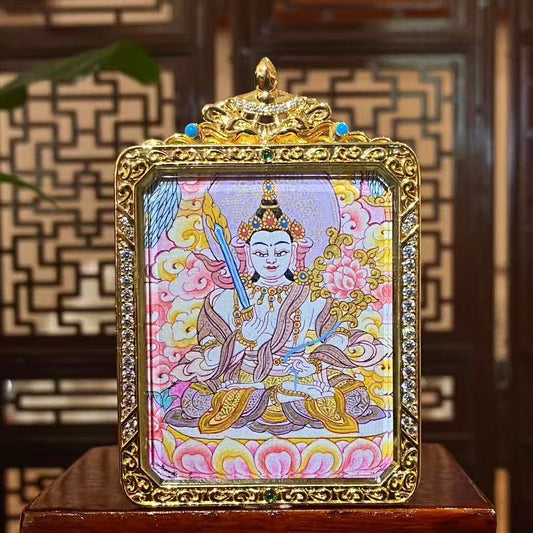
Akashagarbha Bodhisattva & Four-Directional Mandala Double-Sided Thangka Pendant – Hand-Painted Tibetan Gawu Box for Wisdom & Prosperity (55 × 45 mm)
Regular price
$999.00 USD

This Akashagarbha Bodhisattva & Four-Directional Mandala Double-Sided Thangka Pendant is a fully hand-painted Tibetan Buddhist artwork, crafted in a larger gold-plated copper Gawu box and designed for those seeking a deeper and more structured form of symbolic support.
The front side features Akashagarbha Bodhisattva, revered as the Bodhisattva of boundless wisdom, merit, and prosperity.
The reverse side presents a Four-Directional Mandala, representing balance, order, and the stabilization of space.
Together, the double-sided composition emphasizes the relationship between inner cultivation and external alignment, making this piece especially suitable for long-term personal growth, focused intention, and meaningful collection.
Akashagarbha Bodhisattva is known as the “Treasury of Space,” symbolizing blessings as vast and inexhaustible as the universe itself.
In classical Buddhist iconography, he is depicted with:
A Five-Buddha Crown, representing awakened wisdom
A Wisdom Sword in his right hand, cutting through ignorance
A Lotus supporting a Wish-Fulfilling Jewel in his left hand, symbolizing merit, abundance, and fulfilled potential
A calm seated posture upon a lotus throne
He is traditionally regarded as the Guardian Buddha for:
Chinese Zodiac: Ox & Tiger
Western Zodiac: Virgo
Culturally, Akashagarbha Bodhisattva is associated with the cultivation of wisdom, the attraction of supportive mentors and benefactors, and the steady accumulation of positive conditions.
The Four-Directional Mandala is a foundational symbol in Tibetan Buddhist art, representing:
Balance across all directions
Structural harmony and stability
Order emerging from complexity
A centered and grounded state of mind
Rather than functioning as decoration, mandalas serve as symbolic maps of enlightened space, supporting contemplation, focus, and alignment.
When Akashagarbha Bodhisattva and the Four-Directional Mandala are united in a single double-sided thangka, the artwork expresses a complete symbolic system:
Akashagarbha Bodhisattva represents inner resources — wisdom, merit, and beneficial connections
The Mandala represents outer structure — balance, stability, and the harmonization of space
Together, they symbolize the formation of a stable and coherent field of intention, where inner clarity is supported by well-ordered external conditions.
In traditional understanding, this pairing is especially meaningful for those seeking:
Sustainable prosperity rather than short-term gain
The transformation of obstacles into structured paths for growth
A balanced approach to wealth, learning, and personal direction
Technique: Double-sided, fully hand-painted thangka
Pigments: Traditional mineral pigments
Style: Classical Tibetan Buddhist iconography
Process: Painted according to traditional proportional guidelines
Each piece is individually painted, ensuring subtle variations and uniqueness.
Pendant Type: Traditional Tibetan Gawu box
Material: Copper with gold plating
Structure: Double-sided display (Bodhisattva front, Mandala back)
The Gawu box has historically been used as a portable sacred container, suitable for daily wear, travel, or placement in personal spaces.
Painting Size: 55 × 45 mm
Format: Double-sided thangka pendant
Front: Akashagarbha Bodhisattva
Back: Four-Directional Mandala
Finish: Gold-plated copper Gawu box
Advanced portable thangka for daily devotion
Meditation and contemplative practice
Personal altar or sacred space
Meaningful gift symbolizing wisdom, prosperity, and balanced growth
Guardian pendant for Ox, Tiger, and Virgo
1 × Double-sided hand-painted Akashagarbha Bodhisattva & Mandala thangka pendant
Securely sealed gold-plated copper Gawu box
Protective packaging suitable for storage or gifting
This piece is a work of traditional Tibetan Buddhist art, created for cultural appreciation, meditation, and symbolic reflection.
It does not promise specific outcomes, but represents Buddhist values such as wisdom, merit, balance, and mindful intention.
For all orders exceeding a value of 100USD shipping is offered for free.
Returns will be accepted for up to 10 days of Customer’s receipt or tracking number on unworn items. You, as a Customer, are obliged to inform us via email before you return the item.
Otherwise, standard shipping charges apply. Check out our delivery Terms & Conditions for more details.
Returns will be accepted for up to 10 days of Customer’s receipt or tracking number on unworn items. You, as a Customer, are obliged to inform us via email before you return the item, only in the case of:
– Received the wrong item.
– Item arrived not as expected (ie. damaged packaging).
– Item had defects.
– Over delivery time.
– The shipper does not allow the goods to be inspected before payment.
The returned product(s) must be in the original packaging, safety wrapped, undamaged and unworn. This means that the item(s) must be safely packed in a carton box for protection during transport, possibly the same carton used to ship to you as a customer.
Here’s some of our most similar products people are buying. Click to discover trending style.