


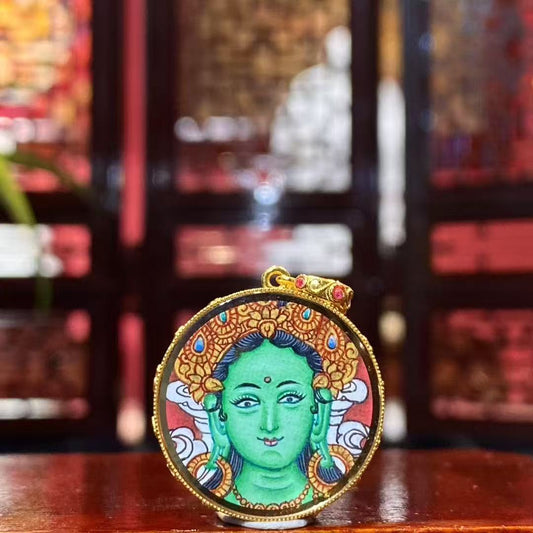
Green Tara & Six-Syllable Mantra Double-Sided Thangka Pendant 18K Gold, Hand-Painted on Both Sides | Rebgong (Amdo) Tradition | 21 mm
Regular price
$1,200.00 USD

This refined round, double-sided Thangka pendant features Green Tara, the embodiment of swift compassion and youthful vitality, paired with the Six-Syllable Mantra (Om Mani Padme Hum)—the heart mantra of Avalokiteshvara.
Entirely hand-painted on both sides with 18K gold and crafted in the Rebgong (Regong) artistic tradition, this pendant unites visual devotion and sacred mantra in a harmonious circular form. Set within a traditional 18K gold Gau amulet box and protected by a sapphire crystal cover, it is designed for daily wear, meditation, and travel.
Green Tara is portrayed in her youthful maiden form, radiating grace, clarity, and approachability:
Crowned with a Five-Buddha jeweled crown
Hair partially flowing and braided over the shoulder
Adorned with necklaces and ornaments
Distinct black-and-white eyes shaped like lotus petals
Holding the utpala (blue lotus) at her chest
A gentle smile expressing maternal warmth and reassurance
Green Tara is revered for her swift compassion and responsiveness, known in Buddhist tradition as one who “hears the cries of the world” and acts without delay. Her green color symbolizes vitality, enlightened activity, and compassionate action, making her one of the most beloved female deities across Tibetan Buddhist schools.
The reverse side bears the Six-Syllable Mantra (Om Mani Padme Hum), regarded as the fundamental mantra of Avalokiteshvara, the bodhisattva of infinite compassion.
In Vajrayana Buddhism, both Green Tara’s mantra
“Oṃ Tāre Tuttāre Ture Svāhā”
and the Six-Syllable Mantra belong to the category of dharani (sacred mantra), traditionally associated with purification, accumulation of merit, and the cultivation of compassion and wisdom.
Doctrinally, Green Tara is often understood as an emanation of Avalokiteshvara. For this reason, devotion to Green Tara and recitation of the Six-Syllable Mantra are not seen as contradictory, but rather as two complementary expressions of the same compassionate principle.
In Mahayana and Vajrayana teachings, compassion may appear through different forms while pointing toward the same realization. Although the Twenty-One Taras manifest in diverse iconographic forms, they are traditionally associated with a unified essence of compassionate activity.
Likewise, the Six-Syllable Mantra encapsulates the universal aspiration to liberate all beings from suffering. When paired together, Green Tara and this mantra emphasize:
Compassion in action (Green Tara)
Compassion in contemplation and speech (Mantra)
This combination reflects the understanding that method and wisdom, form and sound, devotion and mindfulness mutually support one another on the path.
Origin: Rebgong (Amdo / Regong Art region)
Style: Traditional Tibetan Thangka
Technique: Full-detail hand painting (满工)
Finish: Double-sided 18K gold painting
Rebgong Thangka is known for its disciplined lines, refined iconography, and temple-grade craftsmanship.
Painting: 18K gold, fully hand-painted on both sides
Box: Traditional Tibetan 18K gold Gau amulet box
Cover: Sapphire crystal mirror, high clarity and scratch-resistant
Design: Round, balanced form emphasizing harmony and completeness
Personal devotional pendant
Meditation and mantra recitation support
Travel or portable Thangka
Meaningful gift symbolizing compassion and mindful practice
Pendant diameter: 21 mm
Format: Round, double-sided Thangka pendant (Gau box)
Painting size: Custom-fitted within the Gau box
One double-sided Green Tara & Six-Syllable Mantra Thangka pendant
Integrated 18K gold Gau box
Sapphire crystal protective cover
This Thangka pendant is a religious and cultural artwork, created in accordance with traditional Tibetan iconographic principles. It is intended for spiritual appreciation, personal devotion, and artistic collection, rather than as a promise of specific outcomes.
For all orders exceeding a value of 100USD shipping is offered for free.
Returns will be accepted for up to 10 days of Customer’s receipt or tracking number on unworn items. You, as a Customer, are obliged to inform us via email before you return the item.
Otherwise, standard shipping charges apply. Check out our delivery Terms & Conditions for more details.
Returns will be accepted for up to 10 days of Customer’s receipt or tracking number on unworn items. You, as a Customer, are obliged to inform us via email before you return the item, only in the case of:
– Received the wrong item.
– Item arrived not as expected (ie. damaged packaging).
– Item had defects.
– Over delivery time.
– The shipper does not allow the goods to be inspected before payment.
The returned product(s) must be in the original packaging, safety wrapped, undamaged and unworn. This means that the item(s) must be safely packed in a carton box for protection during transport, possibly the same carton used to ship to you as a customer.
Here’s some of our most similar products people are buying. Click to discover trending style.