Product Overview
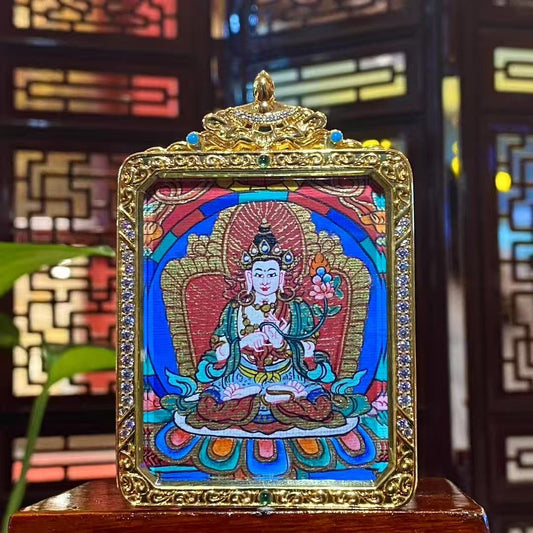
This refined double-sided hand-painted Gawu pendant features Mahāsthāmaprāpta (Great Strength Bodhisattva) on the front and a Four-Directional Mandala on the back, combining Pure Land Buddhist wisdom with Vajrayāna mandala symbolism.
Encased in a gold-plated copper Gawu, this piece measures 55 × 45 mm, offering a larger and more immersive visual presence than standard mini pendants. It is designed for those seeking not only artistic beauty, but also a deeper contemplative structure that integrates wisdom, order, and inner stability.
Front: Mahāsthāmaprāpta (Great Strength Bodhisattva)
Mahāsthāmaprāpta is revered in Buddhism as the embodiment of wisdom light—the clarity that dispels confusion and illuminates the path of mindful action. As the right attendant of Amitābha Buddha and a central figure of the Western Three Saints, he represents strength born from insight rather than force.
This pendant is traditionally associated with:
-
Dispelling inner darkness and mental confusion
-
Cultivating wisdom and clear judgment
-
Supporting calm, rational thinking
-
Enhancing focus and efficiency in daily life
Mahāsthāmaprāpta is also regarded as the guardian Bodhisattva for:
-
Chinese Zodiac: Horse
-
Western Horoscope: Libra
For many practitioners, his presence serves as a reminder to approach life and practice with steadiness, clarity, and composed awareness.
Back: Four-Directional Mandala (Sacred Geometric Field)
The reverse side features a Four-Directional Mandala, a sacred geometric structure widely used in Vajrayāna Buddhism. Mandalas represent the cosmic order and balance of the universe, functioning as visual maps for meditation and inner alignment.
The four directions symbolize stability, completeness, and harmony. Through its precise geometry, the mandala supports:
-
Mental purification and clarity
-
Inner balance and energetic stability
-
A focused and undisturbed contemplative environment
Rather than decoration, the mandala serves as a structured field of awareness, guiding the mind toward order and coherence.
The Combined Meaning: Wisdom & Structure
The combination of Mahāsthāmaprāpta and the Four-Directional Mandala brings together two complementary dimensions:
Spiritual Dimension
Mahāsthāmaprāpta’s wisdom light encourages insight, discernment, and focused awareness, while the mandala’s structure helps the mind settle into a stable contemplative state. Together, they support deeper concentration and sustained practice.
Energetic & Symbolic Dimension
The mandala functions as an organizing field that amplifies the symbolic presence of the Bodhisattva. This pairing is often chosen by those seeking to clear mental distraction, stabilize inner energy, and maintain clarity during periods of challenge or transition.
Practice Support
For practitioners of Pure Land traditions, Mahāsthāmaprāpta is closely associated with the teaching of focused mindfulness described in the Śūraṅgama Sūtra. The mandala complements this by providing a visual and symbolic environment that minimizes distraction and supports continuity of practice.
Suitable For
-
Practitioners: Those engaged in Pure Land or mandala-based contemplative traditions
-
Personal Reflection: Individuals seeking clarity, focus, and inner order during demanding phases of life
-
Energy & Space Awareness: Those who value symbolic structure and balance rather than decorative ornamentation
-
Meaningful Gifts: A thoughtful piece for moments of transition, responsibility, or renewed focus
Materials & Craftsmanship
-
Artwork: Double-sided, fully hand-painted miniature thangka
-
Front: Mahāsthāmaprāpta (Great Strength Bodhisattva)
-
Back: Four-Directional Mandala
-
Case: Gold-plated copper Gawu
-
Size: 55 × 45 mm (painting size)
Gawu pendants originate from Himalayan traditions as portable sacred containers, designed to integrate contemplative symbolism into daily life.
What You Will Receive
Cultural Note & Disclaimer
This piece is a work of religious art and cultural heritage. It is intended to support contemplation, symbolic reflection, and appreciation of Buddhist artistic traditions. It does not replace medical, psychological, or professional advice, nor does it guarantee specific outcomes.