


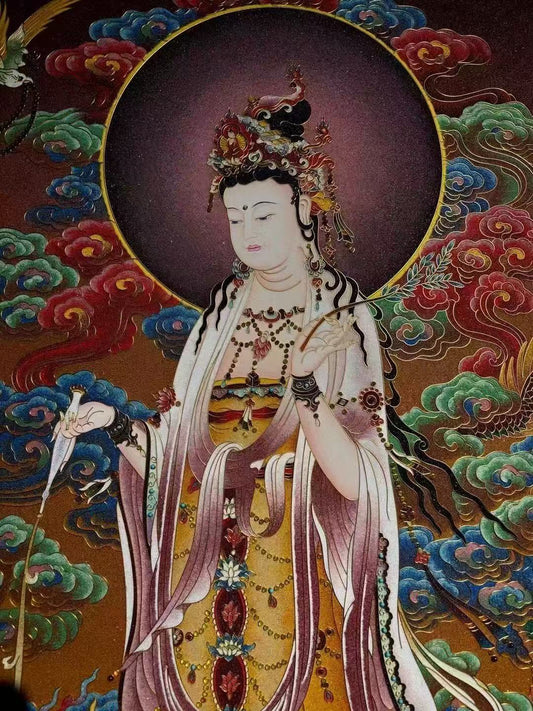
Dragon-Riding Avalokiteshvara (Nanhai Guanyin) Rebgong Gemstone Thangka – Hand-Painted with Natural Mineral Pigments & Pear wood Frame (123 × 83 cm)
Regular price
$25,888.00 USD
This Dragon-Riding Avalokiteshvara Thangka, also known as Nanhai Guanyin, is a large-format gemstone thangka hand-painted in the Rebgong (Amdo) tradition.
The artwork depicts Avalokiteshvara standing gracefully above ocean waves while riding a celestial dragon—an image deeply associated with protection, harmony, and blessings for the human world.
Created using natural gemstone and mineral pigments, this piece is both a sacred visual symbol and a museum-level cultural artwork, suitable for refined interiors and serious collectors.
This Dragon-Riding Guanyin gemstone thangka is ideal for:
Families seeking peace, protection, and auspicious harmony
Individuals drawn to Avalokiteshvara / Guanyin imagery
Collectors of large-scale Rebgong gemstone thangka art
Cultural art lovers appreciating traditional Himalayan craftsmanship
Rather than making supernatural claims, this artwork offers a symbolic and contemplative presence, rooted in Buddhist culture and visual philosophy.
Nanhai Guanyin, also known as Dragon-Riding Guanyin or Dragon-Head Avalokiteshvara, is one of the Thirty-Three Manifestations of Avalokiteshvara in Buddhist tradition.
In traditional cultural belief systems, Avalokiteshvara is also regarded as a spiritual guardian associated with certain zodiac and astrological signs.
This form of Guanyin is traditionally connected with the Rat in the Chinese Zodiac, as well as Cancer and Capricorn in Western astrology. These associations are understood as symbolic rather than predictive, reflecting qualities such as compassion, emotional balance, resilience, and quiet strength.
According to classical narratives, Guanyin rides a dragon across the sea to calm disasters, dispel suffering, and protect ordinary people.
Key symbolic elements include:
The Dragon: harmony with natural forces, protection, and balance
Ocean Waves: the human world filled with challenges
Pure Vase & Willow Branch: compassion, healing, and renewal
Over centuries, Avalokiteshvara’s image evolved from early masculine forms to the elegant female depiction widely recognized today, particularly from the Tang and Song dynasties.
This artwork is created using the Rebgong gemstone painting technique, a highly respected tradition from the Amdo region of the Tibetan Plateau.
Craft features include:
Fully hand-painted by skilled artists
Natural pigments ground from precious gemstones and minerals
Materials such as malachite, cinnabar, lapis lazuli, and other mineral pigments
Multi-layer coloring that creates depth, luminosity, and long-lasting brilliance
Exceptional color stability — resistant to fading over time
Unlike modern synthetic paints, gemstone pigments provide a natural radiance and refined texture unique to traditional thangka art.
A Gemstone Thangka is a traditional form of Tibetan Buddhist painting created using mineral pigments ground from natural gemstones and precious minerals.
Unlike modern synthetic paints, these pigments are carefully prepared through washing, grinding, and layering, following techniques passed down for generations in Himalayan art traditions.
Common materials include lapis lazuli for deep blues, malachite for natural greens, cinnabar for sacred reds, as well as gold, silver, and other mineral substances.
These pigments produce colors that are luminous, rich, and exceptionally stable over time, giving gemstone thangkas their distinctive depth and lasting brilliance.
In the Rebgong tradition, gemstone thangka painting is valued not only for its visual beauty, but also for its respect for material authenticity, craftsmanship, and cultural continuity.
With its large scale and dignified composition, this thangka is well suited for:
Living rooms and main family spaces
Private meditation or contemplation rooms
Reception halls, studies, or cultural interiors
High-end Buddhist or Himalayan art collections
It is recommended to display the artwork in a clean, respectful, and well-lit environment.
Painting size: 123 × 82 cm
Art form: Rebgong Gemstone Thangka
Technique: Hand-painted
Pigments: Natural gemstone & mineral pigments
Frame: Solid Pear wood Frame
The rosewood frame is selected for its durability, fine grain, and warm natural tone, complementing the depth and brilliance of gemstone pigments.
1 × Dragon-Riding Avalokiteshvara Gemstone Thangka
Solid Pear wood framed artwork (as shown)
Protective packaging suitable for international shipping
Artwork information card introducing Rebgong gemstone thangka tradition
What is Dragon-Riding Guanyin?
Dragon-Riding Guanyin, also known as Nanhai Avalokiteshvara, is one of the thirty-three manifestations of Avalokiteshvara, symbolizing compassion, protection, and harmony.
What is a Rebgong gemstone thangka?
A Rebgong gemstone thangka is hand-painted using natural mineral pigments derived from precious stones, following traditional Himalayan Buddhist painting techniques.
Is this thangka suitable for collectors?
Yes. Due to its size, craftsmanship, materials, and framed presentation, this piece is suitable for collectors of museum-level Buddhist and Himalayan art.
For all orders exceeding a value of 100USD shipping is offered for free.
Returns will be accepted for up to 10 days of Customer’s receipt or tracking number on unworn items. You, as a Customer, are obliged to inform us via email before you return the item.
Otherwise, standard shipping charges apply. Check out our delivery Terms & Conditions for more details.
Returns will be accepted for up to 10 days of Customer’s receipt or tracking number on unworn items. You, as a Customer, are obliged to inform us via email before you return the item, only in the case of:
– Received the wrong item.
– Item arrived not as expected (ie. damaged packaging).
– Item had defects.
– Over delivery time.
– The shipper does not allow the goods to be inspected before payment.
The returned product(s) must be in the original packaging, safety wrapped, undamaged and unworn. This means that the item(s) must be safely packed in a carton box for protection during transport, possibly the same carton used to ship to you as a customer.
Here’s some of our most similar products people are buying. Click to discover trending style.