


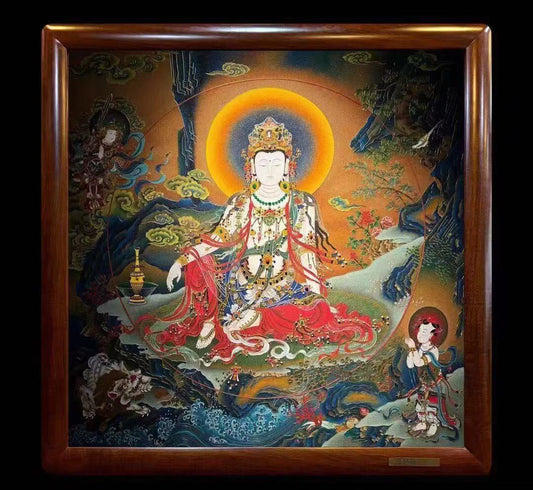
Water Moon Avalokiteshvara ( Shuiyue Guanyin) Rebgong Gemstone Pigment Thangka – Hand-Painted, Pear Wood Frame (134 × 134 cm)
Regular price
$30,888.00 USD
This Water Moon Avalokiteshvara ( Shuiyue Guanyin) Thangka is a large-format, fully hand-painted artwork created in the Rebgong (Regong Art) tradition, using pure natural gemstone-based mineral pigments.
Water Moon Avalokiteshvara is one of the most poetic and humanized forms of Avalokiteshvara in East Asian Buddhist art. Seated in a relaxed royal ease (lalitasana) posture, the figure embodies compassion not as distant transcendence, but as a calm, attentive presence within the world.
Framed in solid pear wood and measuring 134 × 134 cm, this thangka is designed for long-term preservation, contemplative display, and serious Himalayan art collection.
Water Moon Avalokiteshvara, also known as Shuiyue Guanyin, belongs to the Mahayana Buddhist tradition and is one of the Thirty-Three Manifestations of Avalokiteshvara.
This form originated in China and became especially influential from the Tang and Song dynasties onward. The imagery is closely associated with the verse:
“Avalokiteshvara dwells on Mount Potalaka; before the cave lies a pool in which the moon is reflected.”
The “moon reflected in water” symbolizes impermanence, clarity, and compassionate awareness—perfectly aligning Buddhist philosophy with classical Chinese aesthetics and Chan (Zen) thought.
Water Moon Avalokiteshvara is distinguished by a posture that departs from rigid frontal symmetry:
Right leg bent, left foot resting on a lotus, forming a relaxed playful seated posture
Body weight resting gently on the left hip, creating a natural, flowing silhouette
Right hand slightly raised, left hand supporting the body
Robes rendered with soft yet disciplined folds, combining elegance and restraint
This form blends canonical Buddhist iconography with a sense of worldly presence, expressing compassion as something approachable and lived.
Historically, this imagery traces back to Tang dynasty painter Zhou Fang, whose Water Moon Avalokiteshvara compositions profoundly influenced late Tang and Five Dynasties Buddhist art. During the Song and Yuan periods, devotion to Water Moon Avalokiteshvara flourished, with wooden sculptures becoming especially popular.
Important historical examples are now held in institutions such as:
The British Museum (Song dynasty wooden sculpture)
The Nelson-Atkins Museum of Art (Liao dynasty full-wood carving)
In Mahayana Buddhism, Avalokiteshvara represents Great Compassion (Mahākaruṇā) and serves as the left attendant of Amitabha Buddha, together with Mahasthamaprapta Bodhisattva as the right attendant. Together, they form the Three Saints of the Western Pure Land.
Water Moon Avalokiteshvara emphasizes:
Compassion expressed through stillness and attentiveness
Wisdom that observes without grasping
The balance between transcendence and everyday life
In Esoteric Buddhism, this form corresponds to Water-Auspicious Bodhisattva within the Avalokiteshvara Court of the Womb Realm Mandala (Garbhadhātu).
Within traditional cultural symbolism, Avalokiteshvara (Guanyin) is regarded as a compassionate guardian figure for specific zodiac signs.
This Water Moon Avalokiteshvara thangka is traditionally associated with:
Chinese Zodiac: Rat
Western Horoscope: Cancer and Capricorn
These associations emphasize qualities such as emotional depth, resilience, responsibility, and inner strength, making this artwork a meaningful contemplative reference for individuals connected to these signs.
This artwork follows the Rebgong (Amdo / Regong Art) painting lineage, renowned for its disciplined craftsmanship and cultural authenticity.
Rebgong thangkas are characterized by:
Orthodox proportions and iconographic accuracy
Calm, balanced compositions
Refined line work
A dignified, contemplative aesthetic
This tradition is highly respected by collectors for its artistic integrity and long-term value.
This thangka is entirely hand-painted using pure natural gemstone mineral pigments, prepared through traditional methods.
Pigments include:
Gold and silver
Lapis lazuli (blue)
Malachite (green)
Cinnabar (red)
Turquoise, coral, and pearl
Each pigment is carefully washed, ground, and blended by hand.
Compared to synthetic colors, gemstone pigments offer exceptional depth, luminosity, and color stability, allowing the artwork to retain its brilliance for generations.
Art Form: Traditional Tibetan Thangka
Deity: Water Moon Avalokiteshvara (自在观音 / Shuiyue Guanyin)
Zodiac Association: Rat, Cancer, Capricorn
Origin: Rebgong (Amdo / Regong Art)
Technique: 100% hand-painted
Pigments: Pure natural gemstone mineral pigments
Frame: Solid pear wood frame
Format: Framed wall-hanging thangka
Painting size: 134 × 134 cm
This large-format thangka is ideal for:
Meditation rooms and home shrines
Cultural or contemplative living spaces
Buddhist centers or study rooms
Collectors of authentic Himalayan and East Asian Buddhist art
Its balanced composition and serene presence make it suitable as a central contemplative artwork.
One framed Water Moon Avalokiteshvara Thangka
Protective packaging suitable for international shipping
This thangka is a religious and cultural artwork, created within the Himalayan Buddhist artistic tradition.
Its meaning is symbolic and contemplative in nature and should be appreciated as an expression of cultural heritage and artistic philosophy rather than a guarantee of specific outcomes.
For all orders exceeding a value of 100USD shipping is offered for free.
Returns will be accepted for up to 10 days of Customer’s receipt or tracking number on unworn items. You, as a Customer, are obliged to inform us via email before you return the item.
Otherwise, standard shipping charges apply. Check out our delivery Terms & Conditions for more details.
Returns will be accepted for up to 10 days of Customer’s receipt or tracking number on unworn items. You, as a Customer, are obliged to inform us via email before you return the item, only in the case of:
– Received the wrong item.
– Item arrived not as expected (ie. damaged packaging).
– Item had defects.
– Over delivery time.
– The shipper does not allow the goods to be inspected before payment.
The returned product(s) must be in the original packaging, safety wrapped, undamaged and unworn. This means that the item(s) must be safely packed in a carton box for protection during transport, possibly the same carton used to ship to you as a customer.
Here’s some of our most similar products people are buying. Click to discover trending style.