


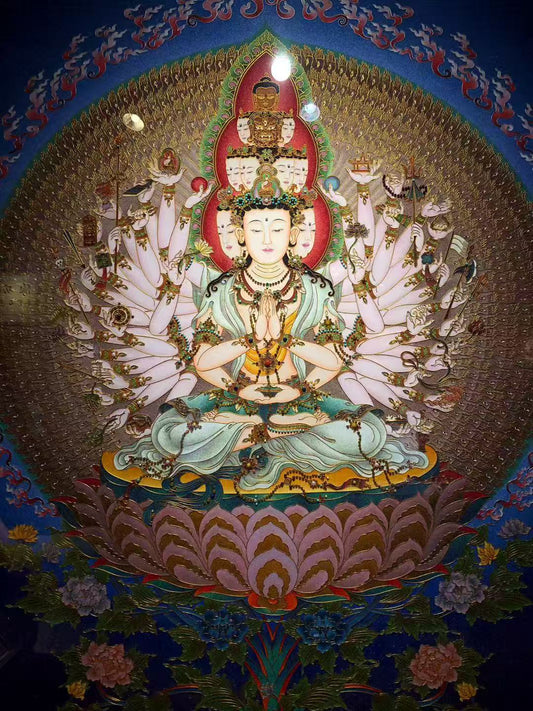
Thousand-Armed Avalokiteshvara (Eleven-Faced Chenrezig) Rebgong Gemstone Pigment Thangka – Hand-Painted, Pear Wood Frame (122 × 99 cm)
Regular price
$25,888.00 USD

This Thousand-Armed, Thousand-Eyed, Eleven-Faced Avalokiteshvara Thangka is a large-format, fully hand-painted work created in the Rebgong (Regong Art) tradition, one of the most respected schools of Himalayan Buddhist art.
Avalokiteshvara—known as Chenrezig in Tibetan Buddhism and Guanyin in East Asian traditions—embodies infinite compassion. In this iconic form, a thousand hands extend across the worlds to offer support and protection, while a thousand eyes perceive suffering with complete clarity and wisdom.
Painted entirely with natural gemstone-based mineral pigments and framed in solid pear wood, this thangka is designed for long-term preservation, contemplative use, and serious art collection.
Thousand-Armed Avalokiteshvara is also known as Thousand-Armed, Thousand-Eyed Guanyin or Thousand-Eyed, Thousand-Armed Chenrezig.
In Buddhist tradition, this form is revered as one of the Four Great Bodhisattvas of popular devotion and represents the perfection of Great Compassion (Mahākaruṇā).
In Pure Land Buddhism, Avalokiteshvara is honored as the left attendant of Amitabha Buddha, together with Mahasthamaprapta Bodhisattva as the right attendant. Together, they are known as the Three Saints of the Western Pure Land.
In Buddhist symbolism, the number “thousand” represents limitlessness and completeness, rather than a literal count.
A thousand hands symbolize boundless compassionate action—reaching all realms of existence
A thousand eyes represent perfected wisdom—seeing suffering clearly and responding skillfully
Each hand is an extension of compassion.
Each eye is a manifestation of awakened awareness, guiding beings toward clarity and liberation.
According to the Dhāraṇī Sūtras, Thousand-Armed Avalokiteshvara responds to beings according to their capacities, manifesting different methods to support sentient beings on the path of awakening.
In traditional East Asian and Himalayan cultural systems, Avalokiteshvara (Guanyin) is associated with compassionate guardianship for specific zodiac signs.
This form of Avalokiteshvara is traditionally regarded as a guardian figure for:
Chinese Zodiac: Rat
Western Horoscope: Cancer and Capricorn
Rather than implying supernatural intervention, this association reflects symbolic alignment—emphasizing qualities such as compassion, emotional resilience, responsibility, and inner strength. For individuals connected to these zodiac signs, this thangka serves as a meaningful cultural and contemplative reference.
This thangka follows the Rebgong (Amdo / Regong Art) tradition, a Himalayan painting lineage recognized for its cultural and artistic significance.
Key characteristics include:
Precise and orthodox iconography
Balanced, dignified compositions
Refined line work with clarity
Harmonious yet powerful color structure
Rebgong thangkas are valued for their authenticity, discipline, and long-term artistic merit.
This artwork is 100% hand-painted using traditional gemstone-based mineral pigments, a technique often referred to as gemstone-pigment thangka.
Pigments are prepared from finely ground natural materials, including:
Gold and silver
Lapis lazuli (deep blue)
Malachite (green)
Cinnabar (red)
Turquoise, coral, and pearl
Each pigment is washed, ground, and blended by hand using traditional Rebgong methods.
The result is rich, luminous color with exceptional depth and durability, allowing the painting to maintain brilliance for generations without fading.
The use of precious minerals reflects reverence for the sacred subject and enhances the symbolic language of color within Tibetan Buddhist cosmology.
Art Form: Traditional Tibetan Thangka
Deity: Thousand-Armed, Thousand-Eyed, Eleven-Faced Avalokiteshvara (Chenrezig / Guanyin)
Zodiac Association: Rat, Cancer, Capricorn
Origin: Rebgong (Amdo / Regong Art)
Technique: Pure hand-painting
Pigments: Natural gemstone mineral pigments
Frame: Solid pear wood frame
Format: Framed wall-hanging thangka
Painting size: 122 × 99 cm
This large-format thangka is suitable for:
Home shrine or meditation room
Buddhist centers and temple spaces
Contemplative living environments
Collectors of authentic Himalayan Buddhist art
Its scale and presence allow it to function as both a visual centerpiece and a focus for reflection.
One framed Thousand-Armed Avalokiteshvara Thangka
Protective packaging suitable for international shipping
This thangka is a religious and cultural artwork, created within the Himalayan Buddhist artistic tradition.
Its meaning is symbolic and contemplative in nature and should be understood as an expression of cultural heritage and spiritual philosophy, rather than as a guarantee of specific outcomes.
For all orders exceeding a value of 100USD shipping is offered for free.
Returns will be accepted for up to 10 days of Customer’s receipt or tracking number on unworn items. You, as a Customer, are obliged to inform us via email before you return the item.
Otherwise, standard shipping charges apply. Check out our delivery Terms & Conditions for more details.
Returns will be accepted for up to 10 days of Customer’s receipt or tracking number on unworn items. You, as a Customer, are obliged to inform us via email before you return the item, only in the case of:
– Received the wrong item.
– Item arrived not as expected (ie. damaged packaging).
– Item had defects.
– Over delivery time.
– The shipper does not allow the goods to be inspected before payment.
The returned product(s) must be in the original packaging, safety wrapped, undamaged and unworn. This means that the item(s) must be safely packed in a carton box for protection during transport, possibly the same carton used to ship to you as a customer.
Here’s some of our most similar products people are buying. Click to discover trending style.