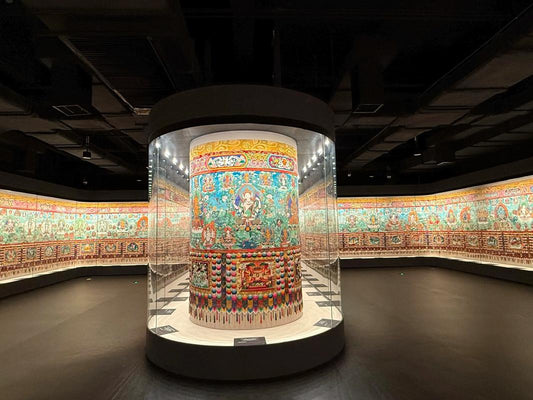

What Is the Greatest “Demon” in the Human World?Altruism in Buddhist Wisdom & Thangka Art
In today’s society, people are carefully trained to acquire skills—but rarely taught how to become whole human beings.
Modern education emphasizes efficiency, competition, and capability: how to use tools, how to speak well, how to perform tasks. What is often missing is a deeper conversation about character, gratitude, and living for something beyond oneself.
And this absence may be one of the most serious issues of our time.
A Missing Dimension of Education: Character and Altruism
Altruism—the ability to care for others—is not something entirely learned, nor is it entirely innate.
It arises from both inner nature and long-term cultivation.
The problem is that contemporary society offers very little support for the latter.
When a system produces people who are highly capable but deeply self-centered, what kind of world does that create? This is not a theoretical question—it is something we witness every day.
Wisdom or Compassion: Which Matters More?
There is a well-known line often quoted in Buddhist circles:
“Wisdom and compassion are eternal topics.”
Wisdom is essential. Without it, even basic life becomes impossible.
But wisdom without compassion can become dangerous.
That is why character education matters as much as intellectual development. Without it, intelligence may simply serve personal gain.
Does Altruism Really Mean Self-Sacrifice?
Many people assume that helping others means losing something themselves.
Yet research and lived experience consistently show the opposite.
In a psychological experiment, one group of students spent their time pursuing only personal pleasure, while another group engaged in volunteer work and helping others. Over time, the results became clear:
those focused solely on enjoyment reported declining happiness, while those helping others experienced lasting well-being and improved mental health.
Altruism, it turns out, is not depletion—it is a deeper form of fulfillment.
A Buddhist Observation on Suffering
In Tibetan Buddhist teachings, especially in The Way of the Bodhisattva, a recurring insight appears:
The stronger self-centeredness becomes, the deeper suffering grows.
When concern for others expands, inner peace follows.
Altruism is often feared simply because it is misunderstood.
When society frames helping others as a burden, people naturally resist it. The issue lies not in altruism itself, but in how it is perceived.
Altruism Is Not Only for Children
Character cultivation does not end with adulthood.
A university professor once reflected openly on how his academic title had quietly nurtured arrogance—toward students, toward colleagues, and toward others outside his field. His conclusion was simple and honest:
Status does not equal wisdom.
Only through self-reflection and the softening of ego can genuine altruism emerge.
Everyone Possesses the Seed of Altruism
Buddhism holds a clear position: all beings possess Buddha-nature.
In other words, compassion and goodness are never absent—only obscured.
As philosopher Peter Singer once wrote:
“Helping others is not self-sacrifice; it is self-realization.”
Those who help often discover that they receive more than they give.
The One Who Benefits Most Is Often the Giver
At first, people may help others while secretly thinking, “I am the one giving.”
With maturity, that perspective shifts:
“I was given the opportunity to help.”
This shift—from ego to gratitude—marks a profound inner freedom.
The Greatest “Demon” Is Not External
From a Mahayana Buddhist perspective, the greatest demon is not external obstacles or forces, but inner self-centeredness.
Material wealth eventually disappears.
But altruism becomes a lasting inner resource—something that continues to grow.
Seen this way, altruism is not moral idealism; it is a deeply rational choice.
A Question Worth Asking Daily
Perhaps we can pause and ask ourselves:
How much of my day is genuinely concerned with others?
The answer itself becomes the starting point of transformation.
How Altruism Appears in Tibetan Buddhist Art
In Tibetan Buddhism, altruism is not treated as an abstract idea—it is expressed visually, symbolically, and artistically.
Thangka paintings are one of the most powerful expressions of this spirit.
Figures such as Avalokiteshvara (the Bodhisattva of Compassion) and Samantabhadra (the Bodhisattva of Great Action) represent unconditional compassion and the commitment to transform insight into action.
These images are not meant for worship alone, but as reminders—visual anchors that invite reflection on how wisdom should serve others, not the ego.
Traditionally, the act of painting a Thangka itself is considered a form of practice. The artist cultivates patience, humility, and focused intention, allowing altruistic values to take shape through disciplined creation.
For those interested in exploring authentic works inspired by this tradition, you may view our curated collection of hand-painted Thangkas here:
👉 Shop Thangka Collection
https://thangkamarket.com/collections/shop-thangka
If you wish to deepen your understanding beyond imagery—learning about symbolism, history, and cultural context—we also share educational resources here:
👉 Learning Center
https://thangkamarket.com/collections/learning-center-learning-center
A Closing Reflection
Thangkas are not merely religious artworks or decorative objects.
They are part of an ongoing inner dialogue—quiet companions that gently redirect attention from “me” to something wider.
In a world increasingly driven by self-interest, perhaps the most meaningful practice is not acquiring more, but learning how to care beyond ourselves.