


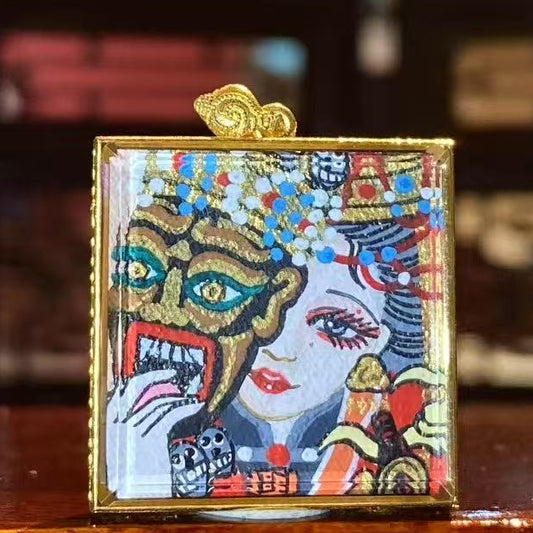
Zaki Lhamo Thangka Pendant – Past & Present with Mantra Seed Syllable Pure Hand-Painted Double-Sided Thangka in 18K Gold Gau Box (20x17 mm)
Regular price
$699.00 USD
This Zaki Lhamo Thangka Pendant – “Past & Present” is a pure hand-painted Tibetan thangka, created as a refined miniature devotional artwork and enclosed in a premium 18K gold gau box.
The front depicts Zaki Lhamo, one of the most widely revered female wealth guardians in Tibetan Buddhism, symbolizing protection, compassion, and the possibility of renewal through rebirth.
The back features Zaki Lhamo’s mantra seed syllable, forming a complete double-sided composition traditionally used in Tibetan Buddhist contemplative practice.
The pendant is protected by double-sided sapphire crystal glass, offering excellent scratch resistance and clarity, making it suitable for daily wear, long-term preservation, and personal reflection.
According to Tibetan oral tradition, Zaki Lhamo’s previous life is believed to have been marked by suffering and injustice. Through the guidance of Buddhist masters, her path transformed from hardship into awakening.
This transformation reflects the Tibetan Buddhist understanding of karma, rebirth, and redemption—the belief that even deep suffering can become a source of wisdom and compassionate strength. Her story is widely regarded as a symbol of renewal, resilience, and liberation across lifetimes.
Zaki Lhamo is revered throughout Tibet as:
A Dharma Protector, safeguarding practitioners and households
A Female Wealth Deity, associated with fortune, stability, and auspicious conditions
A guardian who supports people in overcoming obstacles that block progress and balance
Rather than representing excess or desire-driven gain, her symbolism emphasizes responsible prosperity, ethical action, and long-term stability.
The back of the pendant is inscribed with Zaki Lhamo’s mantra seed syllable, an essential element in Tibetan Buddhist visualization and meditation traditions.
Seed syllables are understood as the condensed essence of a deity’s enlightened qualities
Often used alongside mantra recitation and focused awareness
Traditionally associated with clarity of mind, purification, discipline, and inner stability
This element adds depth to the pendant, making it not only a visual artwork but also a symbolic contemplative object.
In Tibetan Buddhist tradition, a deity image and its mantra seed syllable are often used together, integrating outer contemplation and inner cultivation.
In this pendant:
The front-facing image of Zaki Lhamo represents active protection, courage, and compassionate strength, helping one face external challenges with steadiness.
The mantra seed syllable on the back represents inner clarity, awareness, and ethical discipline, supporting focused intention and self-reflection.
Balance Between Action and Awareness
Meeting life’s challenges with both strength and mindfulness.
Protection with Inner Refinement
Not only guarding against obstacles, but encouraging responsibility, clarity, and personal growth.
Karmic Reflection and Renewal
A reminder that transformation arises through awareness, compassion, and sustained intention over time.
This pairing is traditionally valued not for instant results, but as a daily contemplative reminder supporting confidence, stability, and ethical alignment.
Technique: Pure hand-painted Tibetan thangka
Detailing: Fine gold outlining (gold detailing finish)
Style: Traditional Tibetan Buddhist iconography
Case: 18K gold gau box
Protection: Double-sided sapphire crystal glass, scratch-resistant and highly transparent
Each pendant is individually hand-painted, ensuring subtle variations that reflect authentic craftsmanship.
Pendant Type: Mini Thangka Pendant
Diameter: 20x17 mm
Format: Wearable / Portable / Travel Thangka
Suitable for:
Necklace pendants
Personal altar or meditation space
Daily wear or travel
Meaningful cultural or spiritual gifts
1 × Hand-painted Zaki Lhamo Thangka Pendant (double-sided)
18K gold gau box with sapphire crystal protection
Protective packaging for storage or gifting
This pendant is offered as a sacred cultural artwork rooted in Tibetan Buddhist tradition. It is intended for reflection, devotion, and cultural appreciation, rather than as a guarantee of specific outcomes.
For all orders exceeding a value of 100USD shipping is offered for free.
Returns will be accepted for up to 10 days of Customer’s receipt or tracking number on unworn items. You, as a Customer, are obliged to inform us via email before you return the item.
Otherwise, standard shipping charges apply. Check out our delivery Terms & Conditions for more details.
Returns will be accepted for up to 10 days of Customer’s receipt or tracking number on unworn items. You, as a Customer, are obliged to inform us via email before you return the item, only in the case of:
– Received the wrong item.
– Item arrived not as expected (ie. damaged packaging).
– Item had defects.
– Over delivery time.
– The shipper does not allow the goods to be inspected before payment.
The returned product(s) must be in the original packaging, safety wrapped, undamaged and unworn. This means that the item(s) must be safely packed in a carton box for protection during transport, possibly the same carton used to ship to you as a customer.
Here’s some of our most similar products people are buying. Click to discover trending style.