


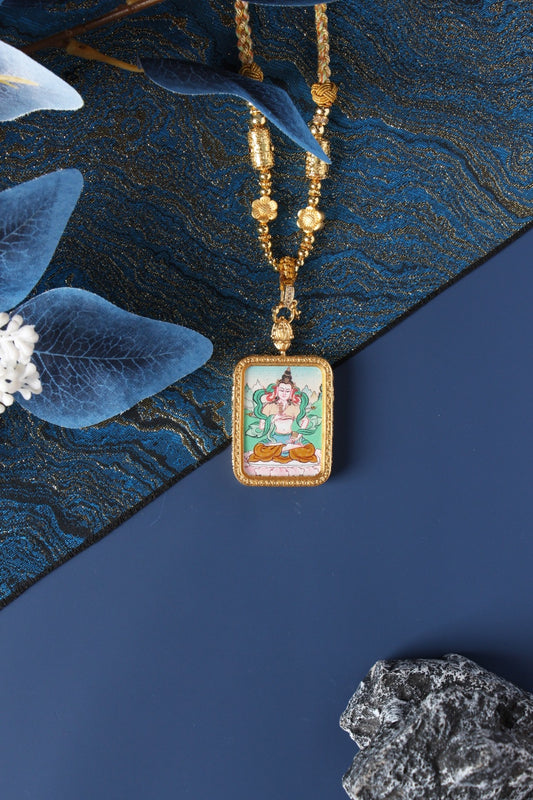
Vajrasattva Mini Thangka Pendant Hand-Painted • Mineral Pigments • Tibetan Karma Gadri Style • 2.5 × 3.5 cm
Regular price
$2,250.00 USD

Product Overview
This Vajrasattva Mini Thangka Pendant is a high-grade Tibetan devotional artwork presented in pendant form, created within the Tibetan Karma Gadri Thangka Series. Fully hand-painted by a Tibetan lineage artist, the image is executed with traditional mineral pigments and protected in a double-sided titanium steel case, allowing the artwork to be appreciated as both a wearable object and a compact collectible.
Crafted with attention to iconographic clarity and fine detailing, this piece is presented for those who value authentic Himalayan thangka tradition—where disciplined drawing, balanced composition, and careful color structure matter as much as the finished appearance.
Deity Introduction
Vajrasattva is revered in Tibetan Buddhism as a central tantric figure often described as a Primordial Buddha and a principal source of pure awakened qualities across many lineages. Within the Buddhist system, Vajrasattva represents pristine awareness and the indestructible nature of wisdom (vajra), expressed through a calm, luminous presence.
Symbolically, Vajrasattva is associated with wisdom and clarity, and is widely respected as a figure of protection in the sense of safeguarding one’s commitments and spiritual integrity—without implying certainty or guaranteed outcomes.
Spiritual Meaning & Practice Logic
Vajrasattva is traditionally associated with purification-oriented practice frameworks that emphasize right intention, ethical reflection, and the steady cultivation of mental clarity. In traditional Buddhist practice logic, this is approached as a gradual discipline: practitioners focus on aligning motivation, refining attention, and returning to a clear mind through consistent effort and supportive conditions.
This pendant is therefore best understood as a cultural and devotional reference to that tradition—supporting mindfulness and reverent remembrance—rather than a promise of immediate effects or fixed results.
Combined Practice Logic
Not applicable.
Artistic Origin & Lineage
This thangka originates from Tibet and is presented in the Karma Gadri tradition, a style recognized for its balanced spatial rhythm, airy composition, and elegant proportion. Karma Gadri works often emphasize a sense of openness and harmony in layout, while maintaining strict iconographic structure to preserve religious and cultural correctness.
As part of the Tibetan Karma Gadri Thangka Series, this piece is fully hand-painted with a focus on proportion, line discipline, and visual balance—reflecting a lineage-based art form rather than factory reproduction.
Materials & Craftsmanship
The painting is executed with natural mineral pigments, valued in Himalayan thangka practice for their layered texture and long-term color stability when applied with proper technique. The surface appearance typically reflects the depth and structure mineral pigments can create, especially in areas requiring careful transitions and controlled detailing.
The pendant is housed in a double-sided titanium steel case designed to protect the artwork and provide stable wearability, while keeping the presentation clean and structured. The overall build prioritizes durability and display clarity, consistent with a collectible devotional object.
Size, Format & Details
Painting size: 2.5 × 3.5 cm
Format: Mini Thangka Pendant
Structure: Double-sided case (titanium steel)
Origin statement: Tibetan lineage, Karma Gadri series presentation
Usage & Suitable For
Suitable for Buddhist practitioners who want a portable devotional reference, and for collectors who appreciate Tibetan thangka artistry in small-format works. It can be used for personal shrine placement, travel, and quiet meditation settings where a compact, protected format is preferred.
This is also appropriate for culturally mindful gifting to recipients who understand and respect Tibetan Buddhist imagery and its traditional context.
Cultural Note & Disclaimer
This pendant is a religious artwork and cultural object. It does not guarantee specific results or outcomes, and it should not be treated as a substitute for medical, legal, or professional advice. Its value lies in artistic heritage, cultural continuity, and its role as a respectful support for traditional Buddhist study, reflection, and practice.
For all orders exceeding a value of 100USD shipping is offered for free.
Returns will be accepted for up to 10 days of Customer’s receipt or tracking number on unworn items. You, as a Customer, are obliged to inform us via email before you return the item.
Otherwise, standard shipping charges apply. Check out our delivery Terms & Conditions for more details.
Returns will be accepted for up to 10 days of Customer’s receipt or tracking number on unworn items. You, as a Customer, are obliged to inform us via email before you return the item, only in the case of:
– Received the wrong item.
– Item arrived not as expected (ie. damaged packaging).
– Item had defects.
– Over delivery time.
– The shipper does not allow the goods to be inspected before payment.
The returned product(s) must be in the original packaging, safety wrapped, undamaged and unworn. This means that the item(s) must be safely packed in a carton box for protection during transport, possibly the same carton used to ship to you as a customer.
Here’s some of our most similar products people are buying. Click to discover trending style.