


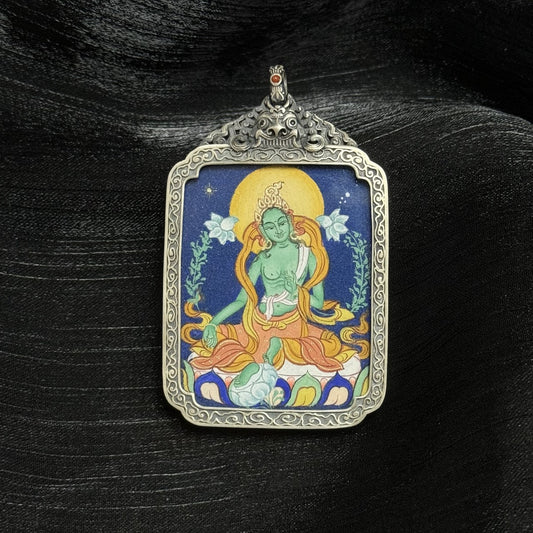
Green Tara Mini Thangka Pendant Hand-Painted • Mineral Pigments • Tibetan Origin • 3.5 × 4.5 cm
Regular price
$4,750.00 USD

This Green Tara Mini Thangka Pendant is a collectible-grade devotional artwork created within the Tibet Coarse Mineral Thangka Series, a series defined by dense mineral pigment application, layered texture, and long-term material stability. Hand-painted in Tibet using traditional thangka techniques, this piece reflects a strong visual presence and structural depth that distinguish mineral-pigment works from lighter painted or printed devotional pendants.
Presented in a compact pendant format and paired with a vintage-style silver case, the artwork is designed for long-term preservation, cultural inheritance, and serious spiritual use rather than decorative display.
Green Tara is one of the most widely revered female deities in Tibetan Buddhism and is regarded as the embodiment of active compassion. She holds a unique position as the deity traditionally responsible for liberating beings from the Eight Great Fears, a role especially emphasized in Tibetan practice traditions.
Within the Buddhist system, Green Tara represents swift compassionate response, protection, and nurturing care, and she is particularly associated with safeguarding women and children. Her iconography conveys readiness, movement, and responsiveness, symbolizing compassionate action in the world.
Green Tara is traditionally associated with transforming fear and uncertainty into clarity and wisdom, and with cultivating courage, confidence, and compassionate intention. In traditional teachings, devotion to Green Tara emphasizes overcoming inner hesitation and cultivating discernment, allowing practitioners to act with clarity rather than doubt.
Practice related to Green Tara focuses on disciplined intention, compassion-driven action, and long-term inner transformation, rather than expectations of immediate or guaranteed results.
Not applicable.
(This artwork presents a single deity and is not intended as a combined or dual-practice form.)
This thangka originates from Tibet and follows established Tibetan thangka painting conventions rooted in lineage-based transmission. The painting is hand-executed by trained artisans who adhere to traditional iconographic proportions, symbolic accuracy, and compositional discipline, reflecting authentic workshop practices rather than industrial reproduction.
As part of the Tibet Coarse Mineral Thangka Series, this piece is created using natural mineral pigments applied in multiple dense layers, producing visible texture, depth, and tonal richness. Mineral pigments are historically valued for their durability and resistance to fading, making them suitable for artworks intended to endure across generations.
The painting is housed in a vintage-style silver case, providing structural protection while reinforcing the artwork’s identity as a long-term collectible and inheritable object.
Painting size: 3.5 × 4.5 cm
Format: Single-sided hand-painted mini thangka pendant
Painting medium: Natural mineral pigments with layered texture
Series: Tibet Coarse Mineral Thangka Series
Outer casing: Vintage-style silver protective case
Production method: Fully hand-painted, non-factory artwork
Suitable for Buddhist practitioners devoted to Tara practices, collectors specializing in Tibetan mineral-pigment thangka, and individuals maintaining a personal shrine. The pendant format allows for portability during travel or daily practice while remaining appropriate for long-term preservation and inheritance.
This product is presented as a cultural, artistic, and religious support object rooted in Tibetan Buddhist tradition. It does not guarantee specific spiritual or worldly outcomes. Its value lies in its symbolic meaning, craftsmanship, and its role in supporting respectful practice and cultural continuity.
For all orders exceeding a value of 100USD shipping is offered for free.
Returns will be accepted for up to 10 days of Customer’s receipt or tracking number on unworn items. You, as a Customer, are obliged to inform us via email before you return the item.
Otherwise, standard shipping charges apply. Check out our delivery Terms & Conditions for more details.
Returns will be accepted for up to 10 days of Customer’s receipt or tracking number on unworn items. You, as a Customer, are obliged to inform us via email before you return the item, only in the case of:
– Received the wrong item.
– Item arrived not as expected (ie. damaged packaging).
– Item had defects.
– Over delivery time.
– The shipper does not allow the goods to be inspected before payment.
The returned product(s) must be in the original packaging, safety wrapped, undamaged and unworn. This means that the item(s) must be safely packed in a carton box for protection during transport, possibly the same carton used to ship to you as a customer.
Here’s some of our most similar products people are buying. Click to discover trending style.