


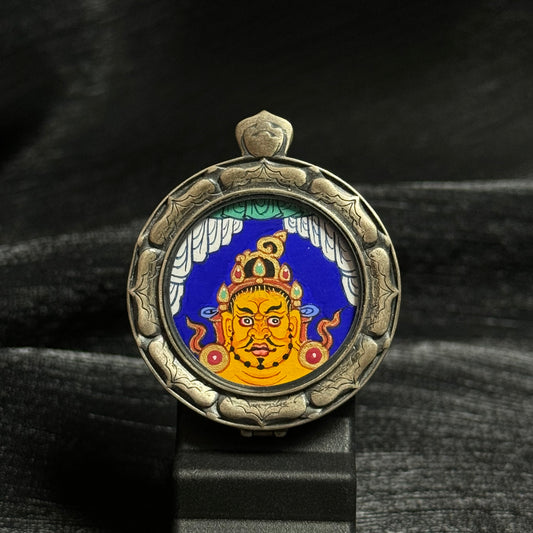
Yellow Jambhala Head Mini Thangka Pendant Hand-Painted • Mineral Pigments • Rebgong Origin • 2.5 cm Diameter
Regular price
$1,900.00 USD

This Yellow Jambhala Head Mini Thangka Pendant features a sacred portrait-style depiction of the Tibetan Buddhist wealth deity, presented in a circular miniature thangka format. The artwork is fully hand-painted by a Rebgong (Regong) lama artist using traditional mineral pigments, preserving the classical painting techniques of the renowned Rebgong thangka tradition in Amdo.
The composition focuses on the face of Yellow Jambhala, emphasizing the expressive features and symbolic crown associated with the deity. The painting is housed in an exclusive 925 sterling silver protective case, with the reverse side incorporating the Three Hares shared-ear motif, a traditional Tibetan auspicious symbol representing harmony, continuity, and cyclical balance.
Yellow Jambhala (Dzambhala Serpo) is one of the most important wealth deities in Tibetan Buddhism and is traditionally regarded as the principal figure among the Five Jambhalas. Within Buddhist cosmology he is associated with prosperity, generosity, and the removal of poverty.
Symbolically, Yellow Jambhala represents the balanced development of material prosperity and spiritual merit, embodying qualities traditionally connected with generosity, wisdom, abundance, and protection from scarcity.
In Tibetan Buddhist practice, Yellow Jambhala imagery is traditionally associated with cultivating generosity and the accumulation of merit. Devotional engagement with this deity encourages practitioners to maintain ethical conduct, generosity, and positive intention in relation to material resources.
Rather than promising guaranteed wealth, the symbolism of Yellow Jambhala reflects the Buddhist principle that prosperity arises through virtuous action, causes and conditions, and the cultivation of merit and wisdom.
Not applicable – this piece depicts a single deity.
This miniature thangka originates from Rebgong (Regong) in Amdo, one of the most important centers of Tibetan thangka painting. The Rebgong tradition is widely respected for its strong preservation of Buddhist iconography, balanced compositions, and vibrant mineral pigment application.
Each pendant painting is individually hand-painted by a Rebgong lama artist, maintaining the discipline of sacred thangka creation rather than using printed or industrial production methods.
The thangka is painted using natural mineral pigments, a traditional medium known for its vivid color depth and long-term stability. These pigments are layered carefully to achieve clarity and enduring visual richness.
The artwork is protected by a 925 sterling silver pendant case, developed as an exclusive design for this series. The reverse side features the Three Hares shared-ear design, a symbolic motif widely recognized in Tibetan and Central Asian art representing cyclical harmony and auspicious continuity.
Painting size: 2.5 cm diameter (circular thangka painting)
Format: Mini Thangka Pendant
Origin: Rebgong (Amdo, Tibet)
Case material: 925 sterling silver case with Three Hares shared-ear back design
This miniature thangka pendant may be suitable for:
Buddhist practitioners maintaining personal devotional objects
Collectors of Tibetan religious art
Individuals creating a portable meditation or travel shrine
Those interested in Rebgong thangka craftsmanship
This item is presented as a cultural and artistic representation of Tibetan Buddhist sacred imagery. Such imagery traditionally serves as a support for contemplation, devotion, and personal spiritual reflection.
The pendant does not guarantee specific material or spiritual outcomes. Its value lies in its artistic heritage, symbolic meaning, and connection to the living tradition of Himalayan Buddhist culture.
For all orders exceeding a value of 100USD shipping is offered for free.
Returns will be accepted for up to 10 days of Customer’s receipt or tracking number on unworn items. You, as a Customer, are obliged to inform us via email before you return the item.
Otherwise, standard shipping charges apply. Check out our delivery Terms & Conditions for more details.
Returns will be accepted for up to 10 days of Customer’s receipt or tracking number on unworn items. You, as a Customer, are obliged to inform us via email before you return the item, only in the case of:
– Received the wrong item.
– Item arrived not as expected (ie. damaged packaging).
– Item had defects.
– Over delivery time.
– The shipper does not allow the goods to be inspected before payment.
The returned product(s) must be in the original packaging, safety wrapped, undamaged and unworn. This means that the item(s) must be safely packed in a carton box for protection during transport, possibly the same carton used to ship to you as a customer.
Here’s some of our most similar products people are buying. Click to discover trending style.