


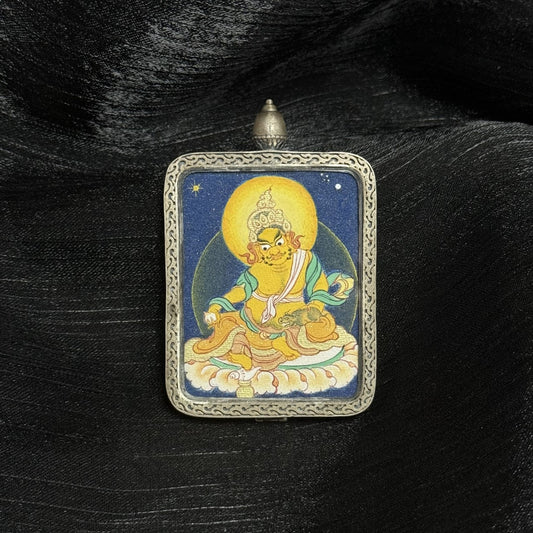
Yellow Jambhala Mini Thangka Pendant Hand-Painted • Mineral Pigments • Tibetan Origin • 3.5 × 4.5 cm
Regular price
$4,750.00 USD

This Yellow Jambhala Mini Thangka Pendant is a collectible-grade devotional artwork created within the Tibet Coarse Mineral Thangka Series, a category defined by dense pigment layering, strong visual depth, and long-term material durability. Unlike printed devotional pendants or light watercolor thangka miniatures, this piece is fully hand-painted in Tibet using traditional mineral pigment techniques that produce visible texture and structural richness.
Designed for preservation, inheritance, and serious spiritual use, the pendant format allows portability while retaining the integrity of a formally constructed thangka painting. The addition of a silver protective case ensures structural stability and long-term safeguarding of the artwork.
Yellow Jambhala is one of the Five Wealth Deities universally venerated across the major schools of Tibetan Buddhism. As the most widely practiced form within the Jambhala system, he represents balanced prosperity grounded in merit, generosity, and ethical conduct.
His yellow body symbolizes abundance, nourishment, and the stable growth of both material and spiritual resources. Within the doctrinal structure of Tibetan Buddhism, Yellow Jambhala embodies wealth not as indulgence, but as a supportive condition for sustaining practice, community responsibility, and disciplined cultivation.
Yellow Jambhala is traditionally associated with the accumulation of merit, the development of generosity, and the stabilization of material foundations that allow practitioners to pursue the path without anxiety caused by scarcity.
The internal logic of his practice emphasizes correct intention, ethical acquisition of resources, and the transformation of wealth into beneficial action. The focus remains on alignment between material sufficiency and spiritual clarity rather than immediate or guaranteed external outcomes.
Not applicable.
(This piece presents a single wealth deity and does not function as a dual or composite practice form.)
This thangka originates from Tibet, produced within traditional workshop systems that maintain lineage-based iconographic discipline. Each figure is proportioned according to canonical standards, ensuring doctrinal accuracy and symbolic integrity.
The painting is executed by trained artisans working within preserved Tibetan techniques rather than contemporary decorative reproduction processes.
As part of the Tibet Coarse Mineral Thangka Series, this artwork is created using natural mineral pigments applied in multiple layered applications, resulting in a dense, textured surface with strong chromatic weight.
Mineral pigments are historically valued for their color stability and resistance to fading, making them suitable for works intended to endure across generations.
The pendant is paired with a silver case featuring the Dunhuang Nine-Colored Deer motif, combining structural protection with classical Buddhist decorative symbolism. The casing not only safeguards the painting but reinforces its identity as a long-term collectible and inheritable object.
Painting size: 3.5 × 4.5 cm
Format: Single-sided hand-painted mini thangka pendant
Painting medium: Natural mineral pigments with layered texture
Series: Tibet Coarse Mineral Thangka Series
Outer casing: Silver protective case
Production method: Fully hand-painted, non-factory artwork
Suitable for practitioners engaged in wealth-deity devotional traditions, collectors specializing in Tibetan mineral-pigment thangka, and individuals maintaining a personal shrine.
Its compact format makes it appropriate for travel, meditation spaces, and structured devotional environments, while its craftsmanship supports long-term preservation and generational inheritance.
This product is presented as a cultural, artistic, and religious support object rooted in Tibetan Buddhist tradition. It does not guarantee material, spiritual, or personal outcomes. Its value lies in its craftsmanship, symbolic structure, and preservation of traditional artistic lineage.
For all orders exceeding a value of 100USD shipping is offered for free.
Returns will be accepted for up to 10 days of Customer’s receipt or tracking number on unworn items. You, as a Customer, are obliged to inform us via email before you return the item.
Otherwise, standard shipping charges apply. Check out our delivery Terms & Conditions for more details.
Returns will be accepted for up to 10 days of Customer’s receipt or tracking number on unworn items. You, as a Customer, are obliged to inform us via email before you return the item, only in the case of:
– Received the wrong item.
– Item arrived not as expected (ie. damaged packaging).
– Item had defects.
– Over delivery time.
– The shipper does not allow the goods to be inspected before payment.
The returned product(s) must be in the original packaging, safety wrapped, undamaged and unworn. This means that the item(s) must be safely packed in a carton box for protection during transport, possibly the same carton used to ship to you as a customer.
Here’s some of our most similar products people are buying. Click to discover trending style.