


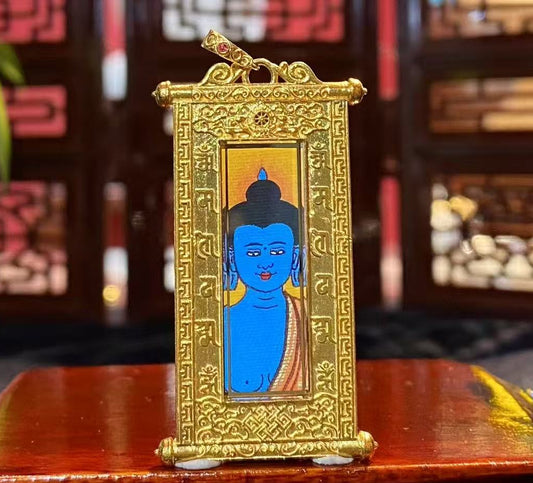
Medicine Buddha (Bhaisajyaguru) & Guru Rinpoche (Padmasambhava) 18K Gold Double-Sided Hand-Painted Tibetan Scroll Thangka Pendant – Wisdom & Compassion (44 × 23 mm)
Regular price
$2,200.00 USD
This 18K gold, double-sided, fully hand-painted Tibetan thangka pendant presents Medicine Buddha (Bhaisajyaguru) on the front and Guru Rinpoche (Padmasambhava) on the reverse, integrated into a distinctive scroll-style design that merges traditional thangka composition with contemporary jewelry aesthetics.
Hand-painted in the Rebgong (Regong / Amdo) thangka tradition and sealed in an 18K gold gau box with sapphire crystal lens, this piece represents a refined union of devotional art, cultural heritage, and modern wearable form. Its elongated scroll format gives it both ceremonial presence and visual elegance, suitable for collection, meditation, or statement wear.
Medicine Buddha, formally known as Bhaisajyaguru Vaidurya Prabha Tathagata, is revered in Buddhist tradition as the embodiment of compassion, clarity, and liberation from suffering. According to the Medicine Buddha Sutra, he presides over the Eastern Pure Lapis Lazuli World and made the renowned Twelve Great Vows to guide beings away from ignorance and distress.
In this thangka, Medicine Buddha is depicted in accordance with classical Tibetan canon:
Posture: Seated in full lotus on a lotus throne, symbolizing stability and awakened awareness
Body Color: Deep lapis-lazuli blue, representing purity, clarity, and unwavering compassion
Right Hand: Gesture of generosity and reassurance
Left Hand: Meditative posture, signifying inner balance and mindfulness
In Buddhist art, references to “healing” are understood as spiritual clarity and relief from mental affliction, not as medical treatment.
The reverse side features Guru Rinpoche (Padmasambhava), the founding master of Tibetan Buddhism and the central figure of the Nyingma lineage. Revered as the “Second Buddha,” he is credited with establishing Buddhism in Tibet during the 8th century.
Born in Oddiyana (present-day regions of Pakistan) and said to have manifested from a lotus flower, Guru Rinpoche was invited to Tibet by King Trisong Detsen, where he oversaw the construction of Samye Monastery, the first Buddhist monastery in Tibet. He is also known for harmonizing Buddhist teachings with indigenous traditions, allowing Buddhism to take root in Tibetan culture.
Symbolically, Guru Rinpoche represents:
Wisdom and compassionate guidance
Transformation and removal of ignorance
Protection of the Dharma
Transmission of enlightened insight
His presence on the reverse side complements Medicine Buddha by emphasizing awakening through wisdom, alongside compassion.
Together, the two sides form a powerful symbolic dialogue:
Medicine Buddha (Front): compassion, clarity, relief from suffering
Guru Rinpoche (Back): wisdom, transformation, enlightened guidance
This pairing is traditionally appreciated by practitioners and collectors seeking a balanced focus on compassion and insight, central pillars of Tibetan Buddhist philosophy.
Origin: Rebgong (Amdo / Regong Art)
Technique: Full-detail hand painting (Man Gong)
Materials:
18K gold detailing
Traditional mineral pigments
Design: Scroll-style composition integrating jewelry aesthetics
Rebgong thangka art is renowned for its disciplined line work, rich mineral colors, and precise iconography, all evident in the refined details of this piece.
Each pendant is individually hand-painted, ensuring subtle variation and artistic uniqueness.
Gau Box: 18K gold protective case
Lens: Sapphire crystal mirror surface
High transparency
Scratch-resistant
Preserves intricate brushwork
Painting size: 44 × 23 mm
Format: Scroll-style double-sided thangka pendant
Structure: Sealed artwork in protective gau box
This larger format offers enhanced visual presence while remaining suitable for wear or display.
Devotion to Medicine Buddha and Guru Rinpoche traditions
Meditation and spiritual reflection
Cultural and high-end spiritual gifts
Collectors of museum-grade Tibetan thangka jewelry
Statement wearable art combining tradition and modern design
This artwork is a religious and cultural art piece rooted in Tibetan Buddhist tradition. References to healing or protection are symbolic and spiritual, reflecting inner clarity, compassion, and wisdom rather than medical treatment or guaranteed outcomes.
For all orders exceeding a value of 100USD shipping is offered for free.
Returns will be accepted for up to 10 days of Customer’s receipt or tracking number on unworn items. You, as a Customer, are obliged to inform us via email before you return the item.
Otherwise, standard shipping charges apply. Check out our delivery Terms & Conditions for more details.
Returns will be accepted for up to 10 days of Customer’s receipt or tracking number on unworn items. You, as a Customer, are obliged to inform us via email before you return the item, only in the case of:
– Received the wrong item.
– Item arrived not as expected (ie. damaged packaging).
– Item had defects.
– Over delivery time.
– The shipper does not allow the goods to be inspected before payment.
The returned product(s) must be in the original packaging, safety wrapped, undamaged and unworn. This means that the item(s) must be safely packed in a carton box for protection during transport, possibly the same carton used to ship to you as a customer.
Here’s some of our most similar products people are buying. Click to discover trending style.