


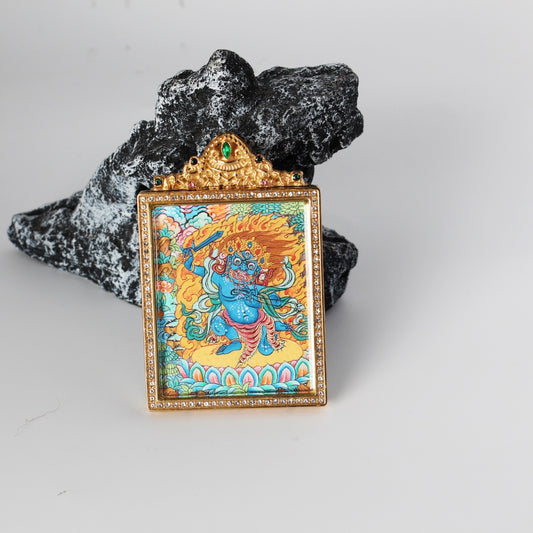
Acalanatha (Fudo Myo-o) Mini Thangka Pendant Hand-Painted • Double-Sided • Mineral Pigments • Nepal Origin • 4 × 5 cm
Regular price
$1,250.00 USD

This Acalanatha (Fudo Myo-o) Mini Thangka Pendant is part of the Nepal High-Grade Colored Thangka Series, a newly introduced collection emphasizing refined coloration, strong iconographic presence, and elevated craftsmanship in portable Buddhist art. The artwork is created as a miniature hand-painted thangka and presented in a pendant format designed for portable viewing and respectful personal keeping.
Hand-painted in Nepal and enclosed in a double-sided jewelry-grade titanium steel case, this piece is crafted and presented as a high-standard Buddhist art object. It is created with traditional iconographic intent and careful detailing, rather than produced as a mass-market decorative accessory.
Acalanatha, widely known in Japanese traditions as Fudo Myo-o, is regarded as the foremost of the Five Wisdom Kings and is revered as a fierce protective manifestation expressing the unwavering intent of the Buddhas. In Vajrayana contexts, he is understood as an enlightened protector figure whose imagery emphasizes steadfastness and the power of disciplined commitment.
Within the Buddhist system, Acalanatha symbolizes protection, fearlessness, determination, and resolute clarity. His iconography conveys a firm, immovable mind that stands against harmful forces and supports stable practice, without making absolute or guaranteed claims.
Acalanatha is traditionally associated with strengthening vows, cultivating self-discipline, and developing courage to face obstacles with steadiness. Practice connected with this deity emphasizes intention, ethical foundation, and consistent effort as the basis for clearing confusion and sustaining right direction.
Rather than focusing on guaranteed outcomes, devotion to Acalanatha is understood as supporting the gradual development of resilience, decisiveness, and inner stability through appropriate causes and conditions.
Not applicable.
This mini thangka is hand-painted in Nepal, where Himalayan thangka painting has been preserved through long-standing artistic lineages. The composition follows classical iconographic proportions and traditional devotional painting conventions appropriate to wrathful protector imagery.
Each piece is individually painted, reflecting artisanal heritage and careful workmanship rather than standardized factory reproduction.
The artwork is fully hand-painted using traditional mineral pigment techniques. It is enclosed in a double-sided jewelry-grade titanium steel case, selected for durability, stable protection, and refined presentation.
The construction supports long-term wear or display while helping preserve the painted image during daily handling.
Painting size: 4 × 5 cm
Format: Mini Thangka Pendant
Structure: Pendant format with double-sided protective titanium steel case
Buddhist practitioners drawn to protector imagery and discipline-centered symbolism
Collectors of Nepalese and Himalayan Buddhist art
Suitable for meditation settings, travel use, or placement in a personal shrine.
In traditional symbolic systems, Acalanatha (Fudo Myo-o) is commonly linked with the Chinese Zodiac Rooster, representing constructive qualities such as courage, steadiness, and protective vigilance. He is also associated with Aries (Western Horoscope), a sign connected with bravery, decisiveness, and the determination to overcome obstacles. These associations are presented as cultural symbolism rather than guarantees, and interpretations may vary across traditions.
This item is offered as a religious and cultural art piece intended to support cultural appreciation and personal practice. It does not guarantee spiritual, physical, or material outcomes. Its significance lies in artistic heritage, symbolic meaning, and its role in supporting contemplative and cultural engagement.
For all orders exceeding a value of 100USD shipping is offered for free.
Returns will be accepted for up to 10 days of Customer’s receipt or tracking number on unworn items. You, as a Customer, are obliged to inform us via email before you return the item.
Otherwise, standard shipping charges apply. Check out our delivery Terms & Conditions for more details.
Returns will be accepted for up to 10 days of Customer’s receipt or tracking number on unworn items. You, as a Customer, are obliged to inform us via email before you return the item, only in the case of:
– Received the wrong item.
– Item arrived not as expected (ie. damaged packaging).
– Item had defects.
– Over delivery time.
– The shipper does not allow the goods to be inspected before payment.
The returned product(s) must be in the original packaging, safety wrapped, undamaged and unworn. This means that the item(s) must be safely packed in a carton box for protection during transport, possibly the same carton used to ship to you as a customer.
Here’s some of our most similar products people are buying. Click to discover trending style.