


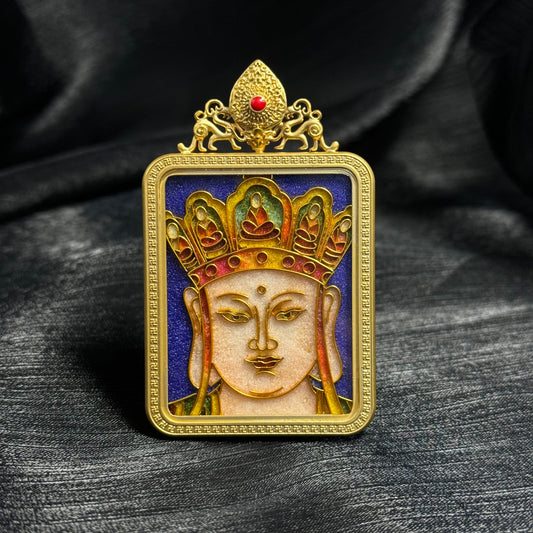
Ksitigarbha Bodhisattva (Dizang Wang) Mini Thangka Pendant Handcrafted Cloisonné Enamel • 24K Gold-Plated Copper Case • Tibetan Buddhist Bodhisattva • 4 × 5 cm
Regular price
$320.00 USD

This Ksitigarbha Bodhisattva (Dizang Wang) Mini Thangka Pendant is a handcrafted sacred pendant created using traditional cloisonné enamel craftsmanship and housed within a 24K gold-plated copper case. Designed as a portable devotional object, the pendant presents the revered Bodhisattva in a compact miniature thangka format.
Crafted entirely by hand, the piece reflects the fusion of Buddhist sacred symbolism and traditional enamel artistry. Its refined structure and durable metal frame allow it to function both as a devotional object and as a collectible example of Himalayan-inspired Buddhist art.
Ksitigarbha Bodhisattva, widely known in East Asian and Tibetan Buddhist traditions, is revered as a Bodhisattva of compassionate salvation and spiritual guardianship. He is most famous for the profound vow: “Until the hells are empty, I will not become a Buddha.”
This vow symbolizes boundless compassion, perseverance, and the dedication to liberating suffering beings. Ksitigarbha represents spiritual protection, moral awareness, and the commitment to guiding beings toward liberation from suffering.
In Buddhist traditions, Ksitigarbha Bodhisattva is traditionally associated with compassion, protection, and the transformation of suffering through moral awareness and sincere practice. His symbolism emphasizes the Buddhist principle of cause and effect (karma) and encourages practitioners to cultivate virtue and compassion in daily life.
The imagery of Ksitigarbha also carries the symbolic meaning of the earth-like quality of patience and inclusiveness. Just as the earth supports and nurtures all living beings, Ksitigarbha represents the capacity to guide beings patiently through spiritual growth and ethical transformation.
His story, especially the well-known narrative of rescuing his mother from suffering, is also widely understood as a powerful representation of filial devotion, gratitude toward parents, and compassionate responsibility toward others.
Not applicable.
This pendant presents a single sacred figure.
The design draws inspiration from the Himalayan Buddhist visual tradition, where sacred figures are represented with clear symbolic forms and devotional meaning. Although presented as a miniature pendant, the composition follows the iconographic language used in traditional Buddhist imagery.
Rather than mass-produced decorative art, the piece emphasizes handcrafted devotional craftsmanship, preserving the symbolic character of Buddhist sacred art within a compact wearable format.
The pendant is produced using traditional cloisonné enamel techniques, in which fine metal wires form delicate outlines that are filled with colored enamel and fired to create durable decorative surfaces.
Craftsmanship details include:
Copper protective case
24K gold electroplating
Handcrafted cloisonné enamel artwork
Solid metal structure designed for long-term preservation
The gold plating is designed to maintain its color under normal use conditions.
Painting Size: 4 × 5 cm
Format: Mini Thangka Pendant
Case Material: Copper with 24K gold plating
Craft Technique: Handcrafted cloisonné enamel
Its compact format allows the pendant to serve as a portable sacred image suitable for personal devotional use.
This miniature thangka pendant may be suitable for:
Buddhist practitioners who keep sacred images for personal devotion
Collectors of Himalayan Buddhist art
Individuals who maintain a personal shrine or travel altar
Those who appreciate symbolic representations of compassion, protection, and moral reflection
It can be worn, carried during travel, or placed within a meditation space.
This pendant is presented as a cultural and religious artwork inspired by Buddhist traditions. While Ksitigarbha Bodhisattva carries deep symbolic meaning within Buddhist teachings, the item itself should be understood as a devotional and artistic object rather than a guarantee of specific outcomes.
Its significance lies in cultural appreciation, artistic craftsmanship, and supporting personal reflection on compassion and ethical practice.
For all orders exceeding a value of 100USD shipping is offered for free.
Returns will be accepted for up to 10 days of Customer’s receipt or tracking number on unworn items. You, as a Customer, are obliged to inform us via email before you return the item.
Otherwise, standard shipping charges apply. Check out our delivery Terms & Conditions for more details.
Returns will be accepted for up to 10 days of Customer’s receipt or tracking number on unworn items. You, as a Customer, are obliged to inform us via email before you return the item, only in the case of:
– Received the wrong item.
– Item arrived not as expected (ie. damaged packaging).
– Item had defects.
– Over delivery time.
– The shipper does not allow the goods to be inspected before payment.
The returned product(s) must be in the original packaging, safety wrapped, undamaged and unworn. This means that the item(s) must be safely packed in a carton box for protection during transport, possibly the same carton used to ship to you as a customer.
Here’s some of our most similar products people are buying. Click to discover trending style.