


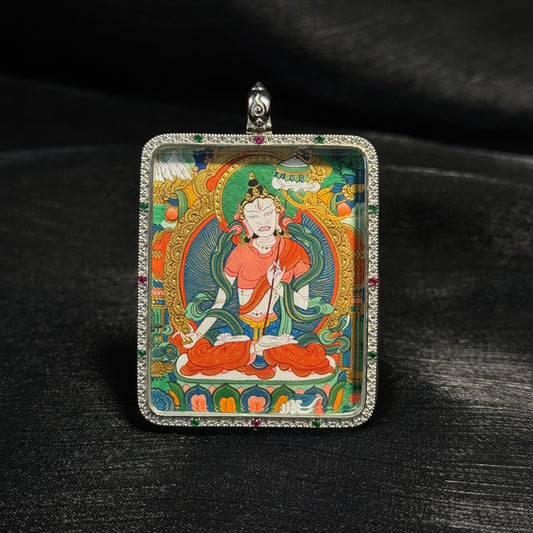
Sitatapatra (White Umbrella Deity) Mini Thangka Pendant Hand-Painted • Mineral Pigments & Gold Powder • Tibetan Origin • 4 × 5 cm
Regular price
$8,000.00 USD

This Sitatapatra (White Umbrella Deity) Mini Thangka Pendant is a finely crafted sacred artwork inspired by the Tibetan painting tradition associated with the Khyentse lineage style. Created in Tibet, the miniature thangka is fully hand-painted using natural mineral pigments and gold powder, reflecting the meticulous techniques preserved in Himalayan Buddhist art.
Presented in a compact pendant format, the artwork combines devotional symbolism with refined craftsmanship. The smooth brushwork, precise line structure, and layered mineral colors demonstrate the artistic discipline characteristic of traditional Tibetan thangka painting.
Sitatapatra, often known as the White Umbrella Deity, is an important protective deity in Vajrayana Buddhism. She is regarded as an emanation of the Buddha’s compassionate wisdom, appearing as a powerful female manifestation who safeguards practitioners and sentient beings.
Iconographically, Sitatapatra is depicted with multiple faces and numerous arms, holding sacred implements such as hooks, swords, bows, and lotus symbols. The white parasol she holds represents protective compassion, spiritual clarity, and enlightened wisdom, symbolizing the Buddha’s ability to shelter beings from harm and confusion.
In Vajrayana Buddhist practice, Sitatapatra is traditionally associated with protection, the removal of obstacles, and the purification of negative influences. Devotional contemplation of this deity encourages practitioners to cultivate courage, wisdom, and compassionate intention.
Her white umbrella symbolizes the protective field of enlightened awareness, which in Buddhist interpretation reflects the power of wisdom to dispel confusion, fear, and harmful influences. Such sacred imagery supports practitioners in developing clarity of mind and inner stability through faith and disciplined practice.
Not applicable
This piece represents a single deity depiction.
This thangka originates from Tibetan artistic tradition, where sacred painting is preserved through careful adherence to iconographic proportion, symbolic accuracy, and lineage-based training.
The painting style reflects influences associated with the Khyentse artistic lineage, characterized by refined linework, balanced composition, and detailed devotional imagery. Unlike mass-produced prints, each miniature thangka is individually hand-painted, maintaining the spiritual and artistic continuity of Himalayan Buddhist art.
The painting is executed using traditional Himalayan thangka techniques, combining natural pigments with delicate gold detailing.
Key materials and craftsmanship include:
Natural mineral pigments
Gold powder detailing
Fully hand-painted sacred image
Fine brushwork and carefully layered colors
Balanced iconographic proportions following Tibetan artistic conventions
These materials provide long-lasting color stability and subtle texture characteristic of authentic thangka painting.
Painting size: 4 × 5 cm
Format: Mini Thangka Pendant
Origin: Tibet
Technique: Hand-painted mineral pigments with gold powder detailing
Packaging: Presentation gift box with collection certificate
This compact format allows the artwork to function as a portable devotional image or collectible miniature thangka.
This miniature thangka may be suitable for:
Buddhist practitioners who keep portable sacred imagery
Collectors of Himalayan Buddhist art
Personal meditation spaces or travel shrines
Individuals interested in traditional Tibetan thangka craftsmanship
This piece is presented as a traditional cultural and artistic representation of Vajrayana Buddhist sacred imagery. Thangka paintings are historically used as visual supports for meditation, study, and devotional reflection.
Spiritual outcomes are not guaranteed, and the significance of the artwork lies primarily in its cultural heritage, symbolic meaning, and artistic craftsmanship.
For all orders exceeding a value of 100USD shipping is offered for free.
Returns will be accepted for up to 10 days of Customer’s receipt or tracking number on unworn items. You, as a Customer, are obliged to inform us via email before you return the item.
Otherwise, standard shipping charges apply. Check out our delivery Terms & Conditions for more details.
Returns will be accepted for up to 10 days of Customer’s receipt or tracking number on unworn items. You, as a Customer, are obliged to inform us via email before you return the item, only in the case of:
– Received the wrong item.
– Item arrived not as expected (ie. damaged packaging).
– Item had defects.
– Over delivery time.
– The shipper does not allow the goods to be inspected before payment.
The returned product(s) must be in the original packaging, safety wrapped, undamaged and unworn. This means that the item(s) must be safely packed in a carton box for protection during transport, possibly the same carton used to ship to you as a customer.
Here’s some of our most similar products people are buying. Click to discover trending style.