


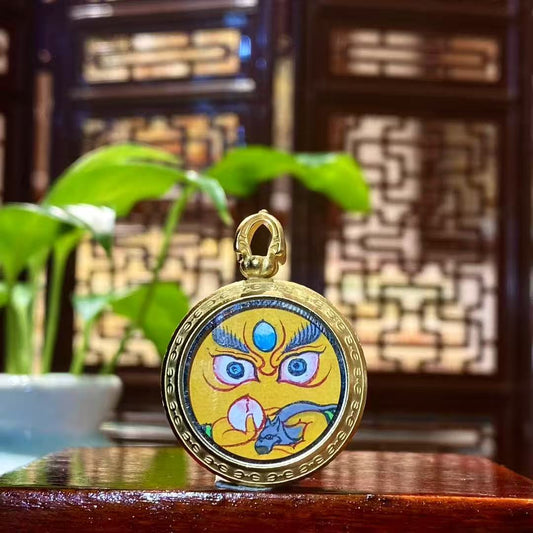
Yellow Jambhala Hand-Painted Thangka Gawu Pendant – Tibetan God of Wealth for Career Success & Prosperity (25 mm)
Regular price
$299.00 USD
This Yellow Jambhala Hand-Painted Thangka Gawu Pendant is a Tibetan Buddhist amulet created to support career stability, professional growth, and the steady expansion of wealth. Encased in a durable titanium steel Gawu box, this pendant combines traditional Himalayan thangka art with a practical, wearable form suitable for everyday life.
With a balanced 25 mm diameter, this piece offers greater visual clarity than smaller pendants while remaining comfortable for daily wear. The image of Yellow Jambhala is fully hand-painted, preserving essential iconography and symbolic detail in a compact yet expressive format.
This pendant is especially suited for individuals focused on long-term career development, business responsibility, and the accumulation of wealth through their primary life path.
Yellow Jambhala is one of the most important wealth deities in Vajrayana Buddhism. In Tibetan, he is known as Norla, meaning “God of Wealth,” and he is also called Dzambhala Serpo or Zangse. He is revered as the foremost among the Five Jambhalas—White, Yellow, Red, Green, and Black—and is honored across all major Tibetan Buddhist traditions.
Yellow Jambhala is traditionally associated with wealth that grows through rightful effort, responsibility, and perseverance rather than speculation or sudden gain. He is invoked to support stable income, professional success, and the strengthening of material foundations that allow one to live with dignity and continue spiritual practice.
In classical iconography, Yellow Jambhala appears with a golden-yellow complexion symbolizing abundance, nourishment, and stability. He holds a wish-fulfilling jewel in his right hand, representing the illumination of merit and the natural growth of resources. With his left arm, he embraces a jewel-spitting mongoose, a powerful symbol of continuous wealth flow and the transformation of scarcity into abundance. The presence of the mongoose emphasizes prosperity that circulates freely rather than stagnates.
Beyond wealth, Yellow Jambhala is also regarded as a protector deity (Dharmapala), helping to dispel obstacles, counter negative influences, and safeguard one’s career path and life direction.
This pendant is created using traditional Himalayan thangka techniques adapted to a miniature format.
The Yellow Jambhala image is entirely hand-painted with careful brushwork and balanced proportions. The Gawu box is made of titanium steel, selected for its strength, resistance to corrosion, and suitability for daily wear. The reverse side features a traditional Buddhist symbolic engraving, reinforcing the pendant’s protective and stabilizing qualities.
Each piece is individually painted and assembled by hand, ensuring authenticity and subtle uniqueness.
A Gawu is a traditional Tibetan amulet box used to carry sacred images close to the body. For centuries, it has been worn by practitioners, merchants, and travelers as a symbol of continuity, protection, and intention.
This 25 mm Yellow Jambhala Gawu pendant is suitable for:
Daily wear in professional or business settings
Individuals focused on career growth and long-term prosperity
Those seeking steady wealth rather than speculative fortune
A meaningful spiritual gift rooted in Tibetan culture
Its size strikes a balance between presence and comfort, making it easy to integrate into everyday life.
Pendant size: Diameter 25 mm
Format: Hand-painted miniature thangka in Gawu box
Material: Titanium steel
Back design: Traditional Buddhist symbolic engraving
As each pendant is hand-painted, slight variations may occur and are a natural part of its artisanal character.
One Yellow Jambhala Hand-Painted Thangka Gawu Pendant (25 mm)
Protective packaging suitable for gifting or safekeeping
This item is a religious and cultural artwork rooted in Tibetan Buddhist tradition. It does not guarantee specific outcomes. Its value lies in its symbolism, craftsmanship, and cultural authenticity, supporting intention, mindfulness, and respectful spiritual practice.
For all orders exceeding a value of 100USD shipping is offered for free.
Returns will be accepted for up to 10 days of Customer’s receipt or tracking number on unworn items. You, as a Customer, are obliged to inform us via email before you return the item.
Otherwise, standard shipping charges apply. Check out our delivery Terms & Conditions for more details.
Returns will be accepted for up to 10 days of Customer’s receipt or tracking number on unworn items. You, as a Customer, are obliged to inform us via email before you return the item, only in the case of:
– Received the wrong item.
– Item arrived not as expected (ie. damaged packaging).
– Item had defects.
– Over delivery time.
– The shipper does not allow the goods to be inspected before payment.
The returned product(s) must be in the original packaging, safety wrapped, undamaged and unworn. This means that the item(s) must be safely packed in a carton box for protection during transport, possibly the same carton used to ship to you as a customer.
Here’s some of our most similar products people are buying. Click to discover trending style.