


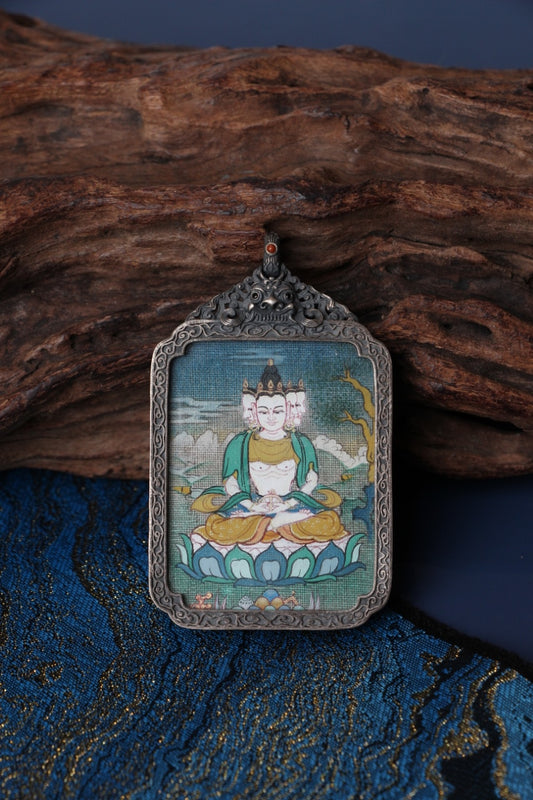
Mahavairocana (Vairocana) Mini Thangka Pendant Hand-Painted • Mineral Pigments • Tibetan Origin • 3.5 × 4.5 cm
Regular price
$5,750.00 USD
This Mahavairocana (Vairocana) Mini Thangka Pendant is a finely crafted Tibetan Buddhist devotional artwork, presented in a compact pendant format. The piece is fully hand-painted by a lineage Tibetan artist using traditional mineral pigments, preserving the layered texture and chromatic depth characteristic of classical thangka painting.
Created in Tibet and housed in a vintage-style silver case, this work represents a high-standard example of portable thangka art, combining orthodox iconography, precise proportions, and enduring materials intended for long-term appreciation rather than decorative use.
Mahavairocana, also known as Vairocana Buddha, is the central Dharmakaya Buddha in Vajrayana Buddhism and the principal deity of both the Womb Realm and Diamond Realm Mandalas. He represents the ultimate nature of reality and the foundational wisdom from which all Buddhas arise.
Symbolically, Mahavairocana embodies wisdom, clarity, and universal awareness. His presence in Buddhist art signifies illumination beyond duality and the harmonization of method and insight within the Buddhist path.
Mahavairocana is traditionally associated with the cultivation of clarity, disciplined awareness, and the alignment of intention with insight. In Vajrayana practice, his imagery supports contemplation on the nature of mind and the integration of wisdom into everyday conduct.
Chinese Zodiac — Sheep & Monkey
Traditionally associated with balanced judgment, adaptability, and inner stability, reflecting Mahavairocana’s symbolism of centered awareness and harmonious engagement with circumstances.
Western Horoscope — Leo (July 23 – August 22)
Associated with clarity, confidence, and leadership grounded in responsibility rather than ego.
Western Horoscope — Aquarius (January 20 – February 18)
Associated with insight, innovation, and reflective understanding aligned with universal principles.
These associations reflect symbolic harmony rather than deterministic claims.
Not applicable.
(This piece depicts a single deity and is not a double-sided or dual-deity composition.)
This mini thangka originates from Tibet and is executed by a traditionally trained Tibetan lineage artist. The work follows established iconometric guidelines, ensuring proportional accuracy and doctrinal consistency.
Each stage of the painting process is completed by hand, reflecting a continuation of classical thangka transmission rather than workshop or factory production.
Fully hand-painted using natural mineral pigments
Layered pigment application for depth and durability
Vintage-style silver case
Traditional thangka painting techniques
No printing, no digital reproduction
Painting size: 3.5 × 4.5 cm
Format: Mini Thangka Pendant
Origin: Tibet
Buddhist practitioners seeking iconographically correct devotional art
Collectors of Tibetan and Vajrayana Buddhist artworks
Meditation, travel, or placement in a personal shrine
This artwork is presented as a religious and cultural object rooted in Tibetan Buddhist tradition. It is intended to support study, contemplation, and artistic appreciation. No spiritual or material outcomes are guaranteed, and the piece should be approached with respect for its cultural and religious context.
For all orders exceeding a value of 100USD shipping is offered for free.
Returns will be accepted for up to 10 days of Customer’s receipt or tracking number on unworn items. You, as a Customer, are obliged to inform us via email before you return the item.
Otherwise, standard shipping charges apply. Check out our delivery Terms & Conditions for more details.
Returns will be accepted for up to 10 days of Customer’s receipt or tracking number on unworn items. You, as a Customer, are obliged to inform us via email before you return the item, only in the case of:
– Received the wrong item.
– Item arrived not as expected (ie. damaged packaging).
– Item had defects.
– Over delivery time.
– The shipper does not allow the goods to be inspected before payment.
The returned product(s) must be in the original packaging, safety wrapped, undamaged and unworn. This means that the item(s) must be safely packed in a carton box for protection during transport, possibly the same carton used to ship to you as a customer.
Here’s some of our most similar products people are buying. Click to discover trending style.