


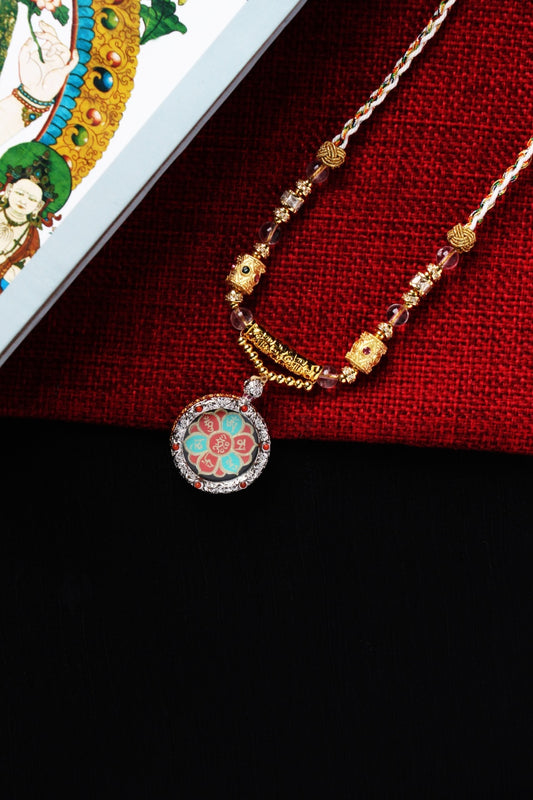
Avalokiteshvara Mantra Mini Thangka Pendant Hand-Painted • Mineral Pigments & Gold Powder • Rebgong Origin • 2.5 cm
Regular price
$450.00 USD

This Avalokiteshvara Mantra Mini Thangka Pendant is a miniature thangka artwork presented in pendant form, meticulously crafted using natural mineral pigments and pure gold powder calligraphy. The composition centers on the sacred six-syllable mantra Om Mani Padme Hum, hand-written in gold over a lotus base, accompanied by the Avalokiteshvara seed syllable, following traditional Tibetan Buddhist visual conventions.
Created in the Rebgong (Amdo) painting tradition, this piece is fully hand-painted rather than digitally printed or factory-produced. It is designed as a refined devotional and collectible object, housed in a jewelry-grade brass case suitable for long-term preservation and personal use.
Avalokiteshvara is a central bodhisattva figure in Mahayana Buddhism, revered as the embodiment of the compassion of all Buddhas. Across Tibetan and Himalayan Buddhist traditions, Avalokiteshvara represents the ideal of altruistic commitment to the welfare of all sentient beings.
Within Buddhist teachings and iconography, Avalokiteshvara is symbolically associated with compassion, empathy, and protective care, serving as a model for cultivating an awakened and benevolent mindset rather than a deity of transactional outcomes.
The mantra Om Mani Padme Hum is traditionally associated with the cultivation of compassion, ethical intention, and mindful awareness. In Buddhist practice contexts, mantra recitation is understood as a supportive method that aligns personal motivation with compassionate values and disciplined reflection.
Rather than functioning as a promise of specific results, the mantra is approached as part of a broader spiritual framework that emphasizes intention, consistency of practice, and personal circumstances. Its meaning unfolds according to individual understanding and engagement.
Not applicable.
This piece features a single mantra-focused composition dedicated solely to Avalokiteshvara.
This artwork originates from the Rebgong region, an area internationally recognized for its deep-rooted Tibetan thangka painting lineage. Rebgong artists are known for their disciplined adherence to traditional proportions, mineral-based palettes, and lineage-based transmission of painting knowledge.
Each piece is entirely hand-painted, emphasizing artistic precision and cultural continuity. The work reflects an artisanal process rooted in tradition rather than mass production.
Natural mineral pigments applied in layered painting technique
Pure gold powder used for hand-written mantra and seed syllable
Fully hand-painted surface, non-printed
Jewelry-grade brass case providing structural protection
The use of mineral pigments and gold powder follows classical Tibetan thangka material standards, valued for durability, visual depth, and archival stability.
Painting size: 2.5 cm
Format: Mini Thangka Pendant
Structure: Single-sided
Outer casing: Jewelry brass housing
Compact in scale, this pendant format is suitable for carrying, travel, or placement on a small personal shrine.
Buddhist practitioners seeking a portable mantra-focused artwork
Collectors of Tibetan and Himalayan religious art
Personal meditation settings, travel use, or private altar display
This item is intended for respectful personal use and collection rather than decorative mass display.
This product is presented as a religious artwork and cultural object rooted in Tibetan Buddhist tradition. It does not guarantee spiritual, material, or personal outcomes. Its value lies in its artistic craftsmanship, cultural authenticity, and its role as a supportive object for individual reflection or practice, depending on personal belief and context.
For all orders exceeding a value of 100USD shipping is offered for free.
Returns will be accepted for up to 10 days of Customer’s receipt or tracking number on unworn items. You, as a Customer, are obliged to inform us via email before you return the item.
Otherwise, standard shipping charges apply. Check out our delivery Terms & Conditions for more details.
Returns will be accepted for up to 10 days of Customer’s receipt or tracking number on unworn items. You, as a Customer, are obliged to inform us via email before you return the item, only in the case of:
– Received the wrong item.
– Item arrived not as expected (ie. damaged packaging).
– Item had defects.
– Over delivery time.
– The shipper does not allow the goods to be inspected before payment.
The returned product(s) must be in the original packaging, safety wrapped, undamaged and unworn. This means that the item(s) must be safely packed in a carton box for protection during transport, possibly the same carton used to ship to you as a customer.
Here’s some of our most similar products people are buying. Click to discover trending style.