


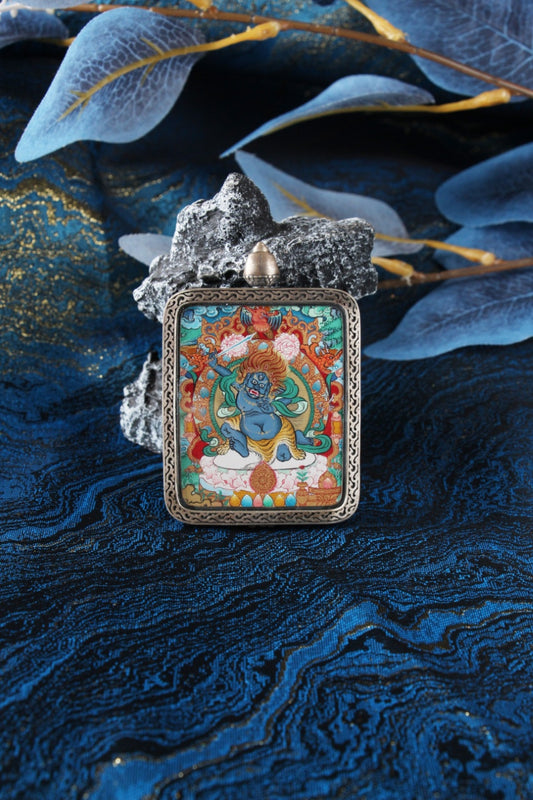
Acalanatha (Fudo Myo-o) Mini Thangka Pendant Hand-Painted • Mineral Pigments • Menri Style • Tibetan Origin • 4 × 5 cm
Regular price
$9,000.00 USD

This Acalanatha (Fudo Myo-o) Mini Thangka Pendant is a finely hand-painted Tibetan thangka created in the Menri (Miansa) style, a classical and highly standardized Tibetan painting lineage known for precise iconometry and disciplined structure. The artwork is rendered using natural mineral pigments and presented in a silver gawu-style case inspired by the Dunhuang Nine-Colored Deer motif.
Designed as a compact card-format thangka, this piece maintains orthodox proportions and clarity, making it suitable for close viewing, portable devotion, and long-term collection.
Acalanatha, also known as Fudo Myo-o, is one of the Five Great Wisdom Kings in Esoteric Buddhism and is regarded as the foremost among them. He is traditionally understood as the embodiment of the enlightened resolve and directive power of Vairocana Buddha.
Acalanatha represents unwavering determination, disciplined resolve, and the fierce clarity that confronts ignorance and inner obstacles directly.
Acalanatha is traditionally associated with steadfastness, self-discipline, and decisive clarity. His symbolism emphasizes remaining unmoved by external disturbances and internal distractions, encouraging practitioners to cultivate firm ethical grounding and focused intention.
In practice logic, devotion to Acalanatha highlights confronting challenges through inner stability, courage, and consistent effort, rather than avoidance or reliance on external assurances.
Not applicable.
This product features a single deity presentation.
This mini thangka originates from Tibet and is painted by a Tibetan lineage artist trained in the Menri (Miansa) style, one of the most orthodox and systematically structured traditions within Tibetan thangka painting.
Menri painting emphasizes strict proportional standards, controlled line work, and visual clarity—qualities especially critical in miniature thangka formats.
Hand-painted with natural mineral pigments
Executed in Menri (Miansa) style
Traditional Tibetan thangka painting techniques
Paired with a silver gawu-style case
Designed for long-term color stability and collection
No modern printing methods or synthetic pigments are used.
Painting size: 4 × 5 cm
Format: Mini thangka card set in a gawu-style pendant case
Presentation: Single-sided painted thangka card
Suitable for:
Practitioners engaged in disciplined Vajrayana-oriented practice
Collectors seeking orthodox Menri-style Tibetan miniature thangka art
Personal shrine placement or portable devotional use during travel
This piece is intended for respectful personal use and artistic appreciation.
This artwork is a cultural and religious object created within the Tibetan Buddhist tradition. It is presented to support cultural understanding, artistic appreciation, and personal reflection.
It does not guarantee specific outcomes and should not be interpreted as a promise of spiritual or life results.
In traditional associations, Acalanatha is linked with the Rooster zodiac, which symbolizes alertness, discipline, and moral clarity—qualities aligned with vigilance and decisive action.
For Aries (March 21 – April 19), Acalanatha’s symbolism resonates with courage, initiative, and resolute direction, emphasizing strength guided by self-control and awareness.
For all orders exceeding a value of 100USD shipping is offered for free.
Returns will be accepted for up to 10 days of Customer’s receipt or tracking number on unworn items. You, as a Customer, are obliged to inform us via email before you return the item.
Otherwise, standard shipping charges apply. Check out our delivery Terms & Conditions for more details.
Returns will be accepted for up to 10 days of Customer’s receipt or tracking number on unworn items. You, as a Customer, are obliged to inform us via email before you return the item, only in the case of:
– Received the wrong item.
– Item arrived not as expected (ie. damaged packaging).
– Item had defects.
– Over delivery time.
– The shipper does not allow the goods to be inspected before payment.
The returned product(s) must be in the original packaging, safety wrapped, undamaged and unworn. This means that the item(s) must be safely packed in a carton box for protection during transport, possibly the same carton used to ship to you as a customer.
Here’s some of our most similar products people are buying. Click to discover trending style.