


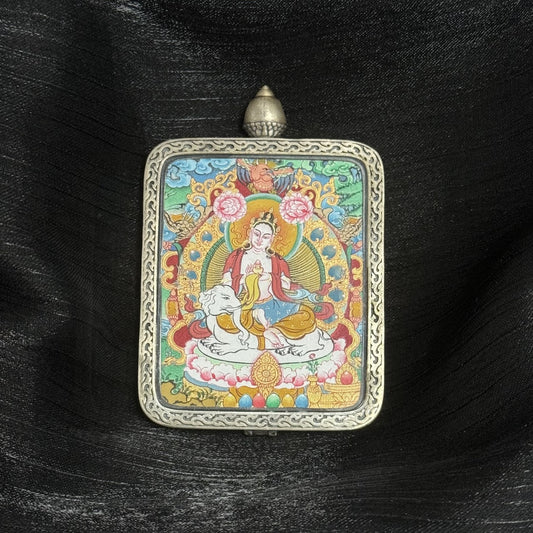
Samantabhadra Bodhisattva Mini Thangka Pendant Hand-Painted • Mineral Pigments • Tibetan Origin • 4 × 5 cm
Regular price
$8,500.00 USD
This Samantabhadra Bodhisattva Mini Thangka Pendant is fully hand-painted in Tibet and presented in a Dunhuang Nine-Colored Deer silver case. Created using natural mineral pigments known for long-term color stability, the piece reflects the discipline and iconographic precision of the Tibetan Miansa (Menri) lineage.
Crafted in a compact 4 × 5 cm painting size, this pendant format preserves traditional sacred proportions while offering portability. It is presented as a collectible devotional artwork suitable for personal practice, travel use, or long-term preservation.
Samantabhadra Bodhisattva is one of the Eight Great Bodhisattvas in Mahayana Buddhism and serves as the right attendant of Shakyamuni Buddha. He represents the embodiment of great conduct and virtuous action, often associated with the perfection of vows and ethical discipline.
He symbolizes integrity, dedication, responsibility, and the realization of truth through practice. In Buddhist doctrine, Samantabhadra expresses the unity of wisdom and action, emphasizing that realization must be grounded in conduct.
Samantabhadra is traditionally associated with righteous action, moral commitment, and the strengthening of personal resolve. His imagery reflects the cultivation of disciplined intention and the steady fulfillment of vows.
Rather than implying guaranteed outcomes, this form serves as a contemplative support for practitioners developing perseverance, responsibility, and alignment between intention and action.
In East Asian Buddhist tradition, Samantabhadra is regarded as the zodiac guardian for those born in the Year of the Dragon and the Year of the Snake.
The Dragon symbolizes strength, ambition, visionary leadership, and expansive progress.
The Snake represents resilience, adaptability, inner wisdom, and steady transformation.
For Capricorn (December 22 – January 19), Samantabhadra resonates with themes of endurance, responsibility, and long-term achievement. Capricorn is associated with patience, discipline, and structured progress—qualities aligned with the bodhisattva’s vow-based practice.
Not applicable.
This piece originates from Tibet and follows the Miansa (Menri) stylistic lineage within Tibetan thangka painting. The composition adheres to established sacred proportions and traditional iconographic standards.
Each detail is fully hand-painted, reflecting lineage-based workshop transmission rather than industrial production. The work embodies regional Tibetan artistic continuity and devotional discipline.
The painting is executed using natural mineral pigments, valued for their layered depth and long-term resistance to fading. The mineral application contributes to tonal richness and structural stability over time.
It is housed in a Dunhuang Nine-Colored Deer silver gawu-style case, providing protective framing while preserving portability. The construction supports long-term collection and potential generational inheritance.
Painting size: 4 × 5 cm
Format: Mini Thangka Pendant
Origin: Tibet
Pigment: Natural mineral pigments
Case: Dunhuang Nine-Colored Deer silver casing
Suitable for:
Buddhist practitioners focused on ethical cultivation and vow-based practice
Collectors of Tibetan devotional art
Personal shrine placement
Travel altar use
Wearable devotional pendant format
This item is presented as a work of Tibetan Buddhist art and devotional craftsmanship. It does not guarantee specific life outcomes or measurable results.
Its significance lies in cultural continuity, artistic tradition, and support for disciplined spiritual reflection and practice.
For all orders exceeding a value of 100USD shipping is offered for free.
Returns will be accepted for up to 10 days of Customer’s receipt or tracking number on unworn items. You, as a Customer, are obliged to inform us via email before you return the item.
Otherwise, standard shipping charges apply. Check out our delivery Terms & Conditions for more details.
Returns will be accepted for up to 10 days of Customer’s receipt or tracking number on unworn items. You, as a Customer, are obliged to inform us via email before you return the item, only in the case of:
– Received the wrong item.
– Item arrived not as expected (ie. damaged packaging).
– Item had defects.
– Over delivery time.
– The shipper does not allow the goods to be inspected before payment.
The returned product(s) must be in the original packaging, safety wrapped, undamaged and unworn. This means that the item(s) must be safely packed in a carton box for protection during transport, possibly the same carton used to ship to you as a customer.
Here’s some of our most similar products people are buying. Click to discover trending style.