


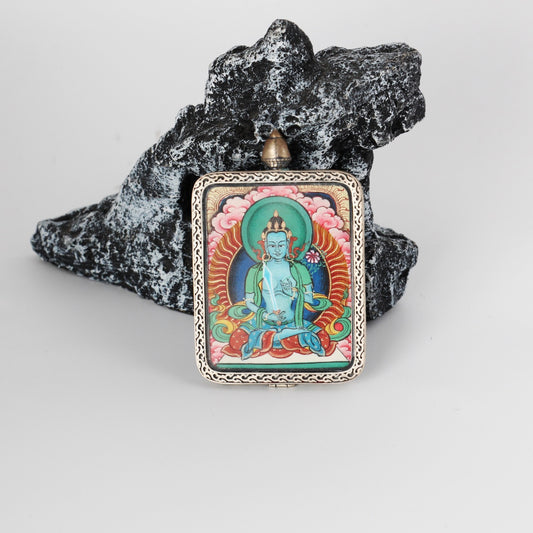
Akashagarbha Bodhisattva Mini Thangka Pendant Hand-Painted • Mineral Pigments • Tibetan Origin • 3.5 × 4.5 cm
Regular price
$4,750.00 USD

This Akashagarbha Bodhisattva Mini Thangka Pendant is a high-standard Tibetan devotional artwork presented as part of the Zangka Red Cloud Series, crafted in pendant form and fully hand-painted in Tibet. Created with natural mineral pigments, it is designed as a refined miniature Thangka artwork rather than a mass-produced religious accessory.
The painting is mounted in a pure silver gawu-style pendant case inspired by the Dunhuang Nine-Colored Deer motif. Combining classical Tibetan iconography with detailed metal craftsmanship, this piece is crafted and presented for collectors and practitioners who value authenticity, lineage-based handwork, and long-term preservation.
Akashagarbha Bodhisattva is a significant bodhisattva in Mahayana Buddhism, traditionally revered as the embodiment of boundless virtue, wisdom, and inexhaustible merit. His name, meaning “Treasury of Space,” reflects the symbolism of limitless capacity and vast spiritual wealth.
Within Buddhist iconography, Akashagarbha Bodhisattva is symbolically associated with wisdom, abundance, protection, and the preservation of merit. He is widely regarded as a guardian bodhisattva connected with fortune, clarity, and the steady accumulation of positive conditions through ethical conduct.
Akashagarbha Bodhisattva is traditionally associated with the cultivation of merit, wisdom, and mindful stewardship of resources. His imagery emphasizes patience, ethical intention, and the gradual accumulation of favorable conditions rather than immediate or guaranteed outcomes.
In traditional symbolic systems, Akashagarbha Bodhisattva is recognized as the guardian deity of the Ox and Tiger zodiac signs. These associations reflect themes of stability, perseverance, confidence, and the ability to navigate challenges while maintaining steady progress.
In certain astrological traditions, qualities associated with Virgo (August 23 – September 22)—such as attentiveness, memory, precision, and disciplined effort—are seen as resonant with Akashagarbha Bodhisattva’s symbolism of careful cultivation and enduring merit.
Not applicable.
This piece features a single deity presentation.
This work originates from Tibet and is painted by a Tibetan lineage-trained artist, following classical Thangka iconographic proportions and traditional painting discipline. As part of the Zangka Red Cloud Series, it emphasizes mineral-pigment layering, balanced composition, and refined detailing rooted in Himalayan Thangka heritage.
Every element is fully hand-painted, reflecting artistic lineage and cultural continuity rather than factory production.
Fully hand-painted by a Tibetan lineage artist
Natural mineral pigments with layered texture
Color stability designed for long-term preservation
Pure silver gawu-style pendant case
Dunhuang Nine-Colored Deer inspired silver housing
Crafted through non-industrial, artisan processes
Painting size: 3.5 × 4.5 cm
Format: Mini Thangka Pendant (Gawu style)
Origin: Tibet
Presentation: Hand-painted Thangka mounted within a silver pendant case
Practitioners seeking a personal devotional image centered on merit, wisdom, and ethical cultivation
Collectors of authentic Tibetan Thangka art
Meditation use, travel carry, or placement on a personal shrine
Suitable for long-term collection and cultural inheritance
Chinese Zodiac Association (Traditional Context):
Ox: associated with steady effort, reliability, and the gradual accumulation of merit and prosperity.
Tiger: associated with confidence, resilience, and the ability to overcome obstacles while maintaining balance.
This artwork is presented as a religious and cultural object intended to support traditional practice, artistic appreciation, and cultural continuity. It does not guarantee specific outcomes or results and should be approached with respect for Tibetan Buddhist traditions.
For all orders exceeding a value of 100USD shipping is offered for free.
Returns will be accepted for up to 10 days of Customer’s receipt or tracking number on unworn items. You, as a Customer, are obliged to inform us via email before you return the item.
Otherwise, standard shipping charges apply. Check out our delivery Terms & Conditions for more details.
Returns will be accepted for up to 10 days of Customer’s receipt or tracking number on unworn items. You, as a Customer, are obliged to inform us via email before you return the item, only in the case of:
– Received the wrong item.
– Item arrived not as expected (ie. damaged packaging).
– Item had defects.
– Over delivery time.
– The shipper does not allow the goods to be inspected before payment.
The returned product(s) must be in the original packaging, safety wrapped, undamaged and unworn. This means that the item(s) must be safely packed in a carton box for protection during transport, possibly the same carton used to ship to you as a customer.
Here’s some of our most similar products people are buying. Click to discover trending style.