


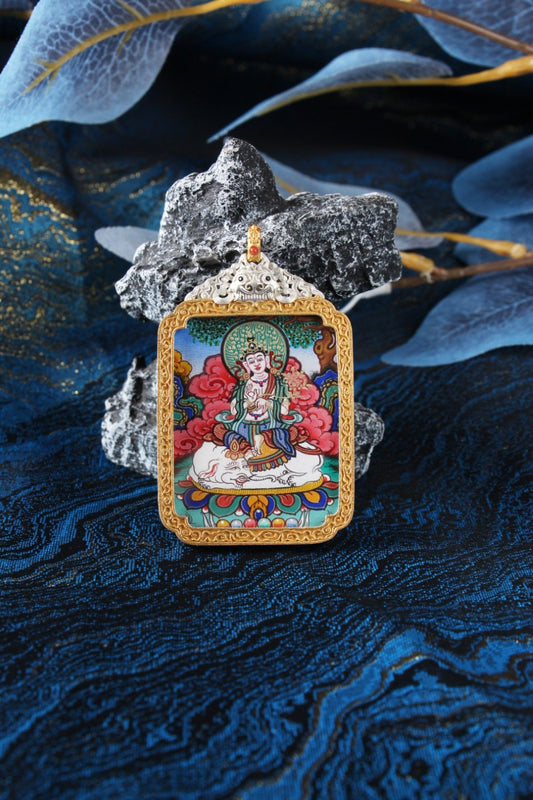
Samantabhadra Bodhisattva Mini Thangka Pendant Hand-Painted • Mineral Pigments • Rebgong Tibetan Origin • 3.5 × 4.5 cm
Regular price
$5,500.00 USD
This Samantabhadra Bodhisattva Mini Thangka Pendant is a high-grade Rebgong-origin Tibetan thangka pendant, crafted as wearable sacred art and presented in a silver-plated protective case. It is fully hand-painted by a lama artist using natural mineral pigments, created in accordance with traditional Tibetan thangka standards.
Part of our Rebgong High-Grade Series, this piece is presented as a premium miniature thangka defined by strict iconographic proportion, full-process hand painting, and lineage-based craftsmanship—created for collectors and practitioners who prioritize authentic Rebgong thangka standards over factory-style production.
Samantabhadra Bodhisattva is a major bodhisattva in Mahayana Buddhism, revered as the embodiment of vast conduct and noble vows. He is traditionally regarded as the right attendant of Shakyamuni Buddha and is especially associated with the ideals of principled practice, moral virtue, and the realization of truth through action.
In Buddhist symbolism, Samantabhadra represents righteous conduct, steadfast virtue, and the compassionate aspiration to benefit beings—often expressed as wisdom in action, disciplined intention, and protective steadiness within the path of practice.
Samantabhadra Bodhisattva is traditionally associated with cultivating right conduct, ethical discipline, and perseverance—aligning intention with action as the foundation of meaningful practice. In practice logic, devotion to Samantabhadra emphasizes strengthening one’s resolve, stabilizing moral direction, and refining daily conduct through consistent cultivation.
In the Huayan (Avatamsaka) tradition, Samantabhadra is closely connected with the bodhisattva vows and the path of comprehensive practice, highlighting sincerity, responsibility, and gradual refinement rather than any promised outcomes.
Not applicable.
(This artwork features a single deity in a single-sided composition.)
This artwork originates from Rebgong, a renowned thangka region recognized for rigorous training systems and adherence to classical Tibetan painting canons. The image is fully hand-painted according to traditional proportional rules and iconographic structure, reflecting lineage-based discipline rather than modern decorative interpretation.
Within the Rebgong High-Grade Series, works are selected for meticulous hand execution, fidelity to traditional standards, and suitability for long-term collection and cultural preservation.
Natural mineral pigments with layered depth
Fully hand-painted by a lama artist (non-factory production)
Silver-plated metal protective case
Traditional Tibetan thangka methods oriented toward durability, preservation, and collection
Painting size: 3.5 × 4.5 cm
Format: Mini Thangka Pendant
Structure: Single-sided painting
Case: Silver-plated metal housing
Practitioners who value discipline, vow-based cultivation, and principled conduct in daily practice
Collectors seeking high-grade Rebgong hand-painted miniature thangkas
Meditation, travel, or a personal shrine where compact sacred art is appropriate
Zodiac & Horoscope Context (Positive Meanings):
Dragon (Chinese Zodiac): Traditionally associated with expansive vision and forward momentum; linked with Samantabhadra, this pairing highlights confident action, long-range aspiration, and constructive drive.
Snake (Chinese Zodiac): Traditionally associated with resilience and adaptability; linked with Samantabhadra, this pairing emphasizes patience, inner steadiness, and the ability to navigate changes with composure.
Capricorn (Western Horoscope): Capricorn is associated with responsibility, endurance, and steady progress; paired with Samantabhadra’s symbolism of virtuous conduct and vows, it highlights persistence, reliability, and completion through disciplined effort.
This pendant thangka is a cultural and religious artwork created within Tibetan Buddhist artistic tradition. It is presented for artistic appreciation, collection, and personal practice support. It does not guarantee specific outcomes or results and should be approached with respect for its cultural and spiritual context.
For all orders exceeding a value of 100USD shipping is offered for free.
Returns will be accepted for up to 10 days of Customer’s receipt or tracking number on unworn items. You, as a Customer, are obliged to inform us via email before you return the item.
Otherwise, standard shipping charges apply. Check out our delivery Terms & Conditions for more details.
Returns will be accepted for up to 10 days of Customer’s receipt or tracking number on unworn items. You, as a Customer, are obliged to inform us via email before you return the item, only in the case of:
– Received the wrong item.
– Item arrived not as expected (ie. damaged packaging).
– Item had defects.
– Over delivery time.
– The shipper does not allow the goods to be inspected before payment.
The returned product(s) must be in the original packaging, safety wrapped, undamaged and unworn. This means that the item(s) must be safely packed in a carton box for protection during transport, possibly the same carton used to ship to you as a customer.
Here’s some of our most similar products people are buying. Click to discover trending style.