


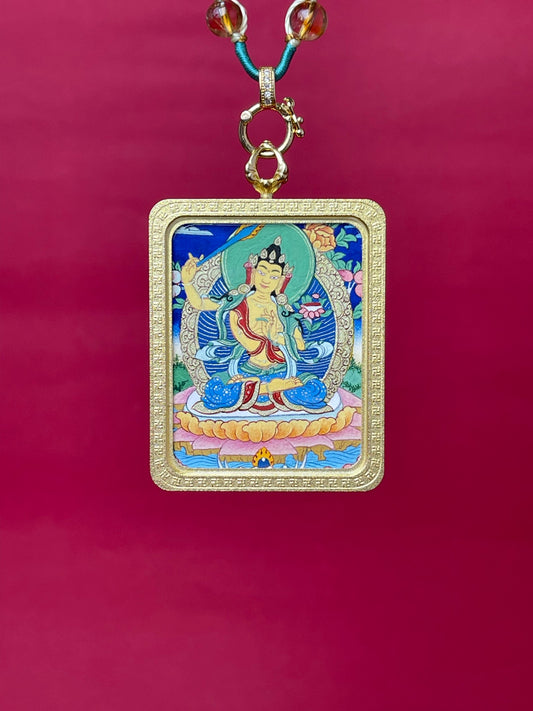
Manjushri Bodhisattva Mini Thangka Pendant Hand-Painted • Mineral Pigments • Tibetan Origin • 3.5 × 4.5 cm
Regular price
$2,100.00 USD

This Manjushri Bodhisattva Mini Thangka Pendant is a finely crafted Tibetan sacred artwork presented in a wearable form. The miniature thangka painting is fully hand-painted using natural mineral pigments and set within a protective traditional copper pendant case, paired with a hand-woven yellow crystal cord.
Created in Tibet, this piece belongs to the Tibetan Mineral Pigment Thangka tradition, known for its layered texture and durable natural pigments. The pendant presents a portable sacred image of Manjushri Bodhisattva, revered in Buddhist tradition as the embodiment of wisdom and insight.
Manjushri Bodhisattva is one of the most important wisdom figures in Mahayana Buddhism and is often referred to as the Bodhisattva of Wisdom. In Buddhist teachings, Manjushri represents the awakened mind that cuts through ignorance and reveals true understanding.
He is commonly depicted holding a flaming sword of wisdom that symbolizes the cutting of ignorance and a prajna scripture, representing transcendent knowledge. Manjushri is widely revered by students, scholars, practitioners, and teachers seeking clarity, learning, and intellectual cultivation.
In Buddhist culture, Manjushri is traditionally associated with wisdom, learning, and insight. Devotion to Manjushri imagery is connected with cultivating clarity of thought, intellectual growth, and the ability to understand teachings deeply.
For practitioners and students, the presence of Manjushri imagery is traditionally regarded as supportive for study, contemplation, and disciplined learning. In Buddhist practice, wisdom develops through intention, study, and continuous cultivation, and sacred images such as this pendant serve as reminders of that path.
Within traditional symbolism, Manjushri is also connected with the Chinese zodiac Rabbit and the Gemini zodiac sign, both of which are culturally associated with intelligence, communication, curiosity, and learning ability.
Not applicable.
This pendant features a single deity depiction of Manjushri Bodhisattva.
This miniature thangka originates from Tibetan thangka painting traditions, where sacred images are created according to established iconographic proportions and artistic lineage.
The work follows the Tibetan mineral pigment painting approach, in which artists apply layered natural pigments to create depth, durability, and distinctive texture. Unlike factory-printed images, each piece is individually hand-painted, reflecting traditional Himalayan sacred art methods.
The pendant combines traditional thangka painting with wearable craftsmanship:
Hand-painted miniature thangka
Natural mineral pigments
Traditional copper protective case
Hand-woven yellow crystal cord
Tibetan portable devotional format
Mineral pigments provide strong color stability and natural texture, allowing the thangka image to maintain its vibrancy over time while preserving the authenticity of traditional Himalayan art materials.
Painting Size: 3.5 × 4.5 cm
Format: Mini Thangka Pendant
Origin: Tibet
Pendant Case: Copper protective frame
Cord: Hand-woven yellow crystal cord
This size makes the pendant suitable for daily wearing or for placement within a small personal altar.
This miniature thangka pendant may be suitable for:
Buddhist practitioners
Collectors of Tibetan sacred art
Students and scholars who appreciate Manjushri symbolism
Individuals seeking a portable sacred image for meditation, travel, or a personal shrine
The compact form allows the pendant to function both as devotional art and as a collectible miniature thangka.
This item is a traditional Tibetan religious artwork and cultural object. In Buddhist culture, sacred images are used as supports for contemplation, study, and spiritual practice.
Any symbolic meanings associated with Manjushri reflect traditional cultural beliefs and Buddhist teachings. This pendant is presented as religious art and cultural heritage, and it does not guarantee specific outcomes or results.
For all orders exceeding a value of 100USD shipping is offered for free.
Returns will be accepted for up to 10 days of Customer’s receipt or tracking number on unworn items. You, as a Customer, are obliged to inform us via email before you return the item.
Otherwise, standard shipping charges apply. Check out our delivery Terms & Conditions for more details.
Returns will be accepted for up to 10 days of Customer’s receipt or tracking number on unworn items. You, as a Customer, are obliged to inform us via email before you return the item, only in the case of:
– Received the wrong item.
– Item arrived not as expected (ie. damaged packaging).
– Item had defects.
– Over delivery time.
– The shipper does not allow the goods to be inspected before payment.
The returned product(s) must be in the original packaging, safety wrapped, undamaged and unworn. This means that the item(s) must be safely packed in a carton box for protection during transport, possibly the same carton used to ship to you as a customer.
Here’s some of our most similar products people are buying. Click to discover trending style.