


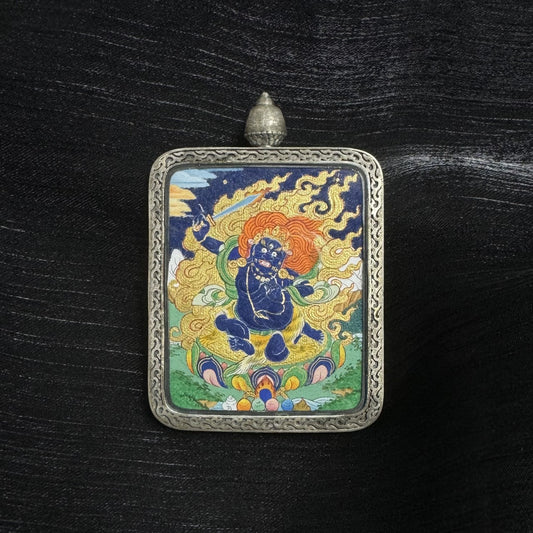
Acalanatha (Fudo Myo-o) Mini Thangka Pendant Hand-Painted • Mineral Pigments • Tibetan Origin • 4 × 5 cm
Regular price
$7,500.00 USD

This Acalanatha (Fudo Myo-o) Mini Thangka Pendant is a traditional Himalayan sacred artwork presented in a portable pendant format. The thangka image is fully hand-painted using natural mineral pigments, following the visual language of Tibetan Buddhist thangka painting. The painting is carefully mounted within a protective silver pendant case, combining devotional symbolism with traditional craftsmanship.
This piece belongs to the Tibetan Mineral Pigment Thangka Series, a collection known for its distinctive use of layered mineral pigments and bold Tibetan visual aesthetics. The series emphasizes traditional thangka proportions, strong mineral pigment textures, and a style rooted in Tibetan sacred art traditions. Mineral pigments are historically valued for their depth of color and durability, allowing such artworks to maintain their visual character across generations.
Acalanatha (Fudo Myo-o) is a major protective deity in Vajrayana Buddhism and is recognized as the chief of the Five Wisdom Kings (Five Vidyarajas). He is regarded as a powerful manifestation of enlightened awareness that appears in a wrathful form to subdue ignorance and protect the teachings of the Buddha.
Despite his fierce appearance, Acalanatha represents unshakable wisdom, spiritual discipline, and unwavering resolve. His iconography symbolizes the determination to confront obstacles directly while guiding practitioners toward clarity, stability, and awakened understanding.
In Buddhist symbolism, Acalanatha is traditionally associated with removing obstacles, strengthening inner discipline, and cultivating courage in the face of difficulties. His imagery encourages practitioners to maintain focus and determination when encountering challenges in both spiritual practice and daily life.
Within traditional cultural symbolism, Acalanatha is also revered as a guardian figure connected with the zodiac year of the Rooster, representing courage, decisiveness, and protective strength.
For individuals associated with the Aries zodiac sign (March 21 – April 19), the symbolism of Acalanatha resonates with themes of decisive action, strong will, and the ability to overcome obstacles, qualities that align with the traditional attributes linked to this sign.
Not applicable.
This artwork features a single deity representation.
This piece follows the artistic traditions of Tibetan thangka painting, a sacred art form developed within Himalayan Buddhist culture. The image is carefully hand-painted according to traditional iconographic proportions, preserving the visual and symbolic standards used in Buddhist sacred imagery.
Such thangka artworks are created through detailed brushwork and disciplined composition rather than industrial reproduction, reflecting the heritage of Himalayan devotional art and the transmission of traditional thangka painting techniques.
The thangka image is painted using natural mineral pigments, a medium historically used in Tibetan thangka art. These pigments create a distinct layered texture and strong color depth, giving the artwork its characteristic visual richness.
Craftsmanship features include:
Fully hand-painted thangka image
Natural mineral pigments
Traditional Tibetan iconographic proportions
Protective silver pendant case
Portable devotional pendant format
Mineral pigments are traditionally known for their color stability, allowing the artwork to maintain its appearance over long periods.
Painting size: 4 × 5 cm
Format: Mini Thangka Pendant
Case material: Silver pendant case
The compact pendant format allows the artwork to be carried or placed within a personal devotional space.
This thangka pendant may be suitable for:
Practitioners who appreciate traditional Buddhist sacred imagery
Collectors of Himalayan and Tibetan Buddhist art
Personal meditation spaces or home shrines
Travel altars and portable devotional settings
This piece is presented as a traditional Buddhist artwork rooted in Himalayan cultural heritage. The symbolism of Acalanatha reflects spiritual teachings and iconography found within Buddhist traditions.
The pendant is intended to serve as a cultural, artistic, and contemplative object. It does not guarantee specific outcomes or results, and its significance may vary depending on personal beliefs, cultural context, and spiritual practice.
For all orders exceeding a value of 100USD shipping is offered for free.
Returns will be accepted for up to 10 days of Customer’s receipt or tracking number on unworn items. You, as a Customer, are obliged to inform us via email before you return the item.
Otherwise, standard shipping charges apply. Check out our delivery Terms & Conditions for more details.
Returns will be accepted for up to 10 days of Customer’s receipt or tracking number on unworn items. You, as a Customer, are obliged to inform us via email before you return the item, only in the case of:
– Received the wrong item.
– Item arrived not as expected (ie. damaged packaging).
– Item had defects.
– Over delivery time.
– The shipper does not allow the goods to be inspected before payment.
The returned product(s) must be in the original packaging, safety wrapped, undamaged and unworn. This means that the item(s) must be safely packed in a carton box for protection during transport, possibly the same carton used to ship to you as a customer.
Here’s some of our most similar products people are buying. Click to discover trending style.