


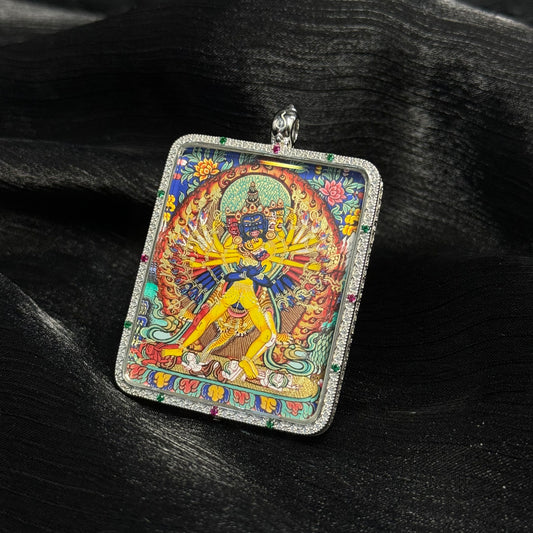
Kalachakra Mini Thangka Pendant Hand-Painted by Rebgong Lama Artist • Mineral Pigments • Rebgong Origin • 4 × 5 cm
Regular price
$9,750.00 USD
This Kalachakra Mini Thangka Pendant is a high-grade sacred artwork crafted in the Rebgong thangka tradition and presented in a portable pendant format. The painting is fully hand-painted by a Rebgong lama artist using natural mineral pigments, then set in a silver case and presented with a certificate and gift box.
Created as a collectible and devotional thangka pendant rather than a factory-made decorative item, this piece reflects the discipline of traditional Himalayan painting. Its refined workmanship, authentic origin, and durable mineral-based color system make it suitable for long-term preservation, collection, and personal practice.
Kalachakra is one of the most advanced principal deities in the Highest Yoga Tantra of Tibetan Buddhism. Within the Vajrayana system, Kalachakra holds a highly important place as a deity connected with profound tantric doctrine, contemplative training, and the understanding of time and reality.
In Buddhist symbolism, Kalachakra is associated with the integration of compassion, wisdom, and merit. The deity is also connected with the unity of past, present, and future, pointing practitioners toward deeper insight into the nature of existence and awakened awareness.
Kalachakra practice is traditionally associated with contemplating time, causality, and the deeper structure of reality. In Buddhist understanding, the symbolism of Kalachakra encourages practitioners to look beyond ordinary attachment to past, present, and future, and to reflect on the nature of mind, perception, and awakening.
This form of practice also emphasizes intention, discipline, and proper karmic connection. Rather than being approached as a shortcut or a promise of fixed outcomes, Kalachakra is understood within the tradition as part of a serious path of cultivation grounded in devotion, correct motivation, and sustained practice.
Not applicable.
This pendant comes from Rebgong, one of the most respected centers of Tibetan thangka painting. Rebgong works are valued for their precise iconography, careful composition, and strong continuity with established Buddhist painting lineages.
The artwork is individually hand-painted by a lama artist, with attention to traditional proportion and sacred visual discipline. It is an artistic work rooted in lineage practice and regional tradition, not a mass-produced factory image.
This piece belongs to the Rebgong high-card Vajra series and is made using natural mineral pigments, a traditional material prized for color richness, depth, and long-term stability. The painting is fully executed by hand, preserving the layered detail and sacred character expected in traditional thangka art.
The pendant is fitted with a silver case for protection and presentation. It also includes a certificate and gift box, making it appropriate for collecting, gifting, and formal presentation. The use of mineral pigments and hand-painted craftsmanship supports both artistic value and long-term preservation.
Painting size: 4 × 5 cm
Format: Mini Thangka Pendant
Origin: Rebgong
Mounting: Silver case
Included: Certificate and gift box
Each piece is individually hand-painted, so slight variations are part of authentic handmade thangka craftsmanship.
This piece is suitable for:
Practitioners who value traditional Vajrayana sacred imagery
Collectors of authentic Tibetan and Himalayan thangka art
Meditation practice, travel use, or a personal shrine
Those seeking a compact sacred artwork with clear lineage and collectible value
This Kalachakra pendant is presented as a work of traditional Buddhist sacred art, cultural heritage, and devotional craftsmanship. In Tibetan Buddhist contexts, such imagery may support contemplation, reverence, and personal practice.
It is not presented as a guarantee of specific results. Its significance lies in its connection to Buddhist culture, thangka artistry, lineage-based symbolism, and its role as a supportive object for spiritual and artistic appreciation.
For all orders exceeding a value of 100USD shipping is offered for free.
Returns will be accepted for up to 10 days of Customer’s receipt or tracking number on unworn items. You, as a Customer, are obliged to inform us via email before you return the item.
Otherwise, standard shipping charges apply. Check out our delivery Terms & Conditions for more details.
Returns will be accepted for up to 10 days of Customer’s receipt or tracking number on unworn items. You, as a Customer, are obliged to inform us via email before you return the item, only in the case of:
– Received the wrong item.
– Item arrived not as expected (ie. damaged packaging).
– Item had defects.
– Over delivery time.
– The shipper does not allow the goods to be inspected before payment.
The returned product(s) must be in the original packaging, safety wrapped, undamaged and unworn. This means that the item(s) must be safely packed in a carton box for protection during transport, possibly the same carton used to ship to you as a customer.
Here’s some of our most similar products people are buying. Click to discover trending style.