


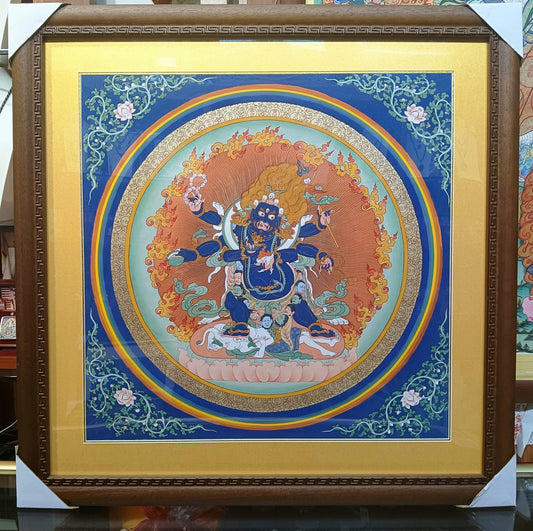
Six-Armed Mahakala Large Thangka Hand-Painted • Tibetan Mineral Pigments • Wooden Frame • Tibet Origin • Painting 50 × 50 cm
Regular price
$12,500.00 USD

This Six-Armed Mahakala Large Thangka is a hand-painted Tibetan thangka created in the Tibetan Mineral Pigment tradition and produced in Tibet by experienced thangka artists. The piece features a powerful depiction of Mahakala rendered with mineral pigments, including lapis lazuli pigments that create a layered, textured surface.
Presented as a framed wall-hanging thangka with a solid wooden frame, the artwork measures 50 × 50 cm for the painting itself, with an overall framed dimension of 66.5 × 66.5 × 3 cm. This work is crafted as a high-quality devotional and collectible thangka, emphasizing traditional Buddhist iconography, mineral pigment artistry, and the visual depth characteristic of Tibetan thangka painting.
Six-Armed Mahakala is one of the most revered protector deities in Tibetan Buddhism and is widely known as a powerful Dharma protector. In Buddhist tradition, Mahakala is considered an emanation of Avalokiteshvara (Chenrezig), appearing in a wrathful form to protect the Dharma and safeguard sincere practitioners.
Mahakala symbolizes protection, strength, and the removal of obstacles on the spiritual path. His imagery embodies the fierce compassion that defends wisdom teachings and supports the continuation of Buddhist practice. For this reason, Mahakala thangkas are often displayed in monasteries and personal practice spaces.
Six-Armed Mahakala is traditionally associated with protection, the removal of negative influences, and the strengthening of favorable conditions for practice and daily life. Within Tibetan Buddhist symbolism, his wrathful appearance represents the dynamic energy that protects the Dharma and clears obstacles.
Such imagery is understood within Buddhist tradition as symbolic support for practitioners rather than a guarantee of specific results. The presence of Mahakala imagery serves as a reminder of courage, determination, and disciplined effort in both spiritual cultivation and worldly responsibilities.
Not applicable.
This thangka originates from Tibet and reflects traditional Tibetan thangka painting methods. The work is hand-painted by Tibetan artists using established iconographic proportions and detailed brush techniques that follow traditional thangka composition standards.
The painting style emphasizes expressive facial features, balanced composition, and strong visual presence. The wrathful expression of Mahakala is carefully rendered to capture both spiritual authority and artistic precision, reflecting the lineage of Tibetan thangka craftsmanship rather than factory-style production.
The thangka is hand-painted using natural mineral pigments, including lapis lazuli pigments that create a distinctive coarse layered texture. These pigments produce rich color depth and subtle tonal variations that are highly valued in traditional thangka painting.
The artwork is mounted in a thick solid wooden frame, providing structural stability and making it suitable for wall display. The combination of mineral pigments, detailed brushwork, and textured layering enhances the three-dimensional presence of the deity image.
Painting size: 50 × 50 cm
Overall framed size: 66.5 × 66.5 × 3 cm
Format: Framed Wall Hanging Thangka
Frame: Solid wood frame
Origin: Tibet
This large thangka is suitable for practitioners who wish to place a powerful protector image within a meditation space, shrine room, or temple environment. It is also appropriate for collectors interested in traditional Tibetan thangka art created with mineral pigments.
Due to its framed wall-hanging format and detailed craftsmanship, the piece can serve as a focal artwork in meditation rooms, study spaces, or cultural collections centered on Buddhist sacred art.
This thangka is presented as a cultural and devotional artwork rooted in Tibetan Buddhist tradition. It is not offered as a guarantee of protection, health, wealth, or other specific outcomes.
The value of the artwork lies in its craftsmanship, religious symbolism, and cultural heritage. Its meaning should be understood within the context of Buddhist philosophy, personal faith, and the appreciation of sacred art traditions.
For all orders exceeding a value of 100USD shipping is offered for free.
Returns will be accepted for up to 10 days of Customer’s receipt or tracking number on unworn items. You, as a Customer, are obliged to inform us via email before you return the item.
Otherwise, standard shipping charges apply. Check out our delivery Terms & Conditions for more details.
Returns will be accepted for up to 10 days of Customer’s receipt or tracking number on unworn items. You, as a Customer, are obliged to inform us via email before you return the item, only in the case of:
– Received the wrong item.
– Item arrived not as expected (ie. damaged packaging).
– Item had defects.
– Over delivery time.
– The shipper does not allow the goods to be inspected before payment.
The returned product(s) must be in the original packaging, safety wrapped, undamaged and unworn. This means that the item(s) must be safely packed in a carton box for protection during transport, possibly the same carton used to ship to you as a customer.
Here’s some of our most similar products people are buying. Click to discover trending style.