


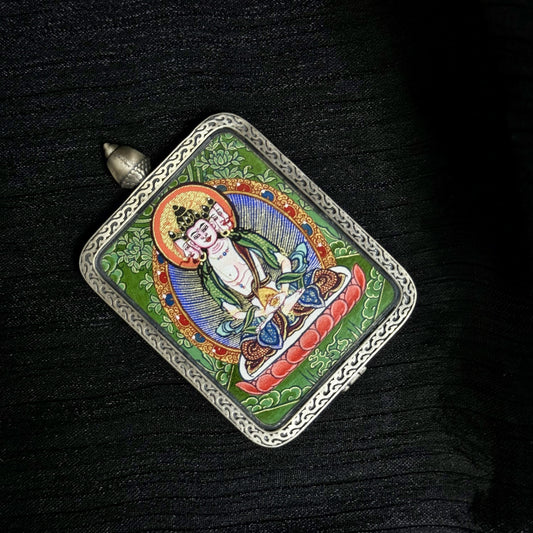
Vairocana Buddha Mini Thangka Pendant Hand-Painted • Mineral Pigments • Rebgong Tibetan Thangka Tradition • 3.5 × 4.5 cm
Regular price
$4,000.00 USD
This Vairocana Buddha Mini Thangka Pendant is a finely crafted devotional artwork originating from the Rebgong (Tongren) Tibetan thangka tradition, an important center of Tibetan Buddhist painting recognized as part of the Regong Art cultural heritage.
The miniature thangka is fully hand-painted by a lama-trained thangka artist using natural mineral pigments and set within a 925 sterling silver pendant frame, presented in a mini thangka pendant format with a painting size of 3.5 × 4.5 cm. The artwork belongs to the Rebgong Cui Tang Series, known for its emerald-toned layered color style and refined Tibetan iconographic composition. Each piece is created as a collectible sacred artwork suitable for long-term preservation and appreciation.
Vairocana Buddha (Mahavairocana) is regarded in Mahayana and Vajrayana Buddhism as the cosmic Buddha representing the ultimate nature of reality and universal wisdom. He is the central Buddha among the Five Dhyani Buddhas, symbolizing the illumination of truth and the transformation of ignorance into wisdom.
In Buddhist iconography, Vairocana represents clarity, insight, and enlightened awareness, embodying the radiance of wisdom that illuminates all directions.
The imagery of Vairocana Buddha is traditionally associated with illumination, wisdom, and the cultivation of clear awareness. In Buddhist practice, Vairocana symbolizes the aspiration to recognize the true nature of reality through wisdom and disciplined contemplation.
Rather than promising specific outcomes, the symbolism of Vairocana encourages practitioners to develop clarity of mind, ethical conduct, and insight through study, meditation, and mindful action, aligning personal understanding with the path of wisdom.
In traditional symbolic interpretation, Vairocana Buddha is regarded as a supportive deity for individuals born in the Chinese zodiac years of the Goat and the Monkey.
The Goat zodiac is often associated with kindness, creativity, and harmony, qualities that resonate with Vairocana’s symbolism of balanced wisdom and compassionate awareness.
The Monkey zodiac represents intelligence, adaptability, and strategic thinking, reflecting the transformative wisdom associated with Vairocana.
In certain cultural interpretations, Vairocana is also connected with the Leo and Aquarius zodiac signs, representing qualities such as leadership, clarity, innovation, and visionary thinking.
This thangka originates from Rebgong (Tongren), Qinghai, a historically respected center of Tibetan Buddhist thangka painting. Rebgong thangkas are known for their precise iconographic proportions, intricate linework, and layered pigment techniques.
The artwork is individually hand-painted by a lama-trained artist, preserving traditional thangka painting methods and ensuring the authenticity of Tibetan sacred art rather than modern factory production.
The painting is created using natural mineral pigments, a traditional material widely used in Tibetan thangka painting for centuries. Mineral pigments are valued for their color depth, durability, and resistance to fading, allowing thangka artworks to maintain their brilliance over time.
The pendant frame is crafted from 925 sterling silver, providing both protection and elegance for the miniature thangka artwork.
Painting size: 3.5 × 4.5 cm
Format: Mini Thangka Pendant
Frame material: 925 sterling silver
Each piece includes:
• Gift presentation box
• Artwork collection certificate
This thangka pendant may be appreciated by:
• Buddhist practitioners who keep sacred imagery for contemplation and meditation
• Collectors of Tibetan thangka art
• Individuals interested in symbolic representations of wisdom and Buddhist culture
Its compact format makes it suitable for personal shrine spaces, meditation areas, travel altars, or private collections.
This thangka is presented as a cultural and artistic representation of Tibetan Buddhist tradition. Sacred imagery in Buddhism functions as a symbolic support for contemplation, meditation, and spiritual inspiration.
Individual experiences with spiritual artwork may vary, and this artwork does not guarantee specific outcomes or results. It should be appreciated primarily as a work of traditional craftsmanship, cultural heritage, and sacred art.
For all orders exceeding a value of 100USD shipping is offered for free.
Returns will be accepted for up to 10 days of Customer’s receipt or tracking number on unworn items. You, as a Customer, are obliged to inform us via email before you return the item.
Otherwise, standard shipping charges apply. Check out our delivery Terms & Conditions for more details.
Returns will be accepted for up to 10 days of Customer’s receipt or tracking number on unworn items. You, as a Customer, are obliged to inform us via email before you return the item, only in the case of:
– Received the wrong item.
– Item arrived not as expected (ie. damaged packaging).
– Item had defects.
– Over delivery time.
– The shipper does not allow the goods to be inspected before payment.
The returned product(s) must be in the original packaging, safety wrapped, undamaged and unworn. This means that the item(s) must be safely packed in a carton box for protection during transport, possibly the same carton used to ship to you as a customer.
Here’s some of our most similar products people are buying. Click to discover trending style.