


White Tara & Lotus 18K Gold Double-Sided Hand-Painted Tibetan Mini Thangka Pendant – Longevity & Awakening (32 mm)
Regular price
$1,800.00 USD
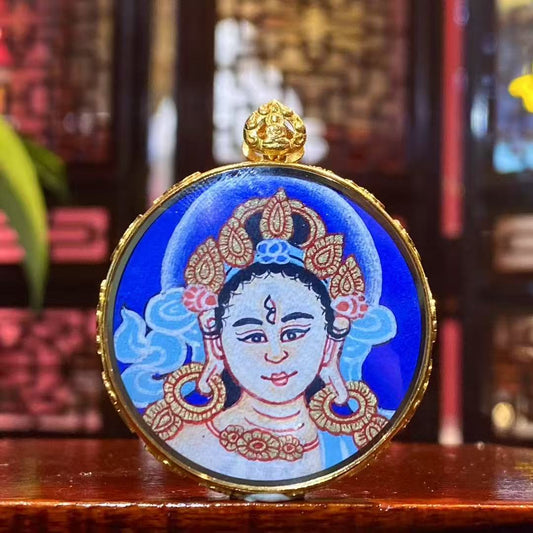
This 18K gold, double-sided, fully hand-painted Tibetan mini thangka pendant features White Tara (Sitatārā) on the front and a Lotus flower on the reverse.
White Tara is one of the Three Long Life Deities in Tibetan Buddhism and a compassionate manifestation of Avalokiteshvara (Chenrezig). Revered for her association with longevity, wisdom, and attentive compassion, she is widely practiced for sustaining clarity of mind and the conditions for spiritual cultivation.
Hand-painted in the Rebgong (Regong / Amdo) thangka tradition and enclosed in an 18K gold gau box with sapphire crystal lens, this piece is designed for devotional focus, meditation, or refined daily wear.
White Tara, known in Tibetan as Drolma Karpo, is one of the Twenty-One Taras and among the most revered female deities in Tibetan Buddhism.
In this thangka, White Tara is depicted according to classical Tibetan canon:
Seven Eyes: One on each hand, foot, and her forehead, symbolizing her ability to perceive the suffering of all beings with unwavering awareness
Body Color: Pure white, representing clarity, purity, and peaceful wisdom
Posture: Seated in a relaxed lotus posture, expressing readiness to respond with compassion
Expression: Calm and luminous, embodying benevolence and insight
In Buddhist understanding, White Tara’s association with longevity refers to the preservation of life force, mental clarity, and the opportunity for continued practice, rather than physical immortality.
The reverse side features the Lotus flower, one of the most profound and universal symbols in Buddhist art.
In Buddhist tradition, the lotus represents:
Purity arising from worldly conditions – blooming unstained from muddy waters
Awakening and enlightenment, emerging from ignorance and attachment
Bodhicitta, the awakened heart and aspiration to benefit all beings
Unity of cause and result, reminding practitioners that cultivation and realization arise together
Different lotus colors carry additional meaning:
White lotus: Buddha-nature and spiritual purity
Red lotus: Compassion and loving-kindness
Blue lotus: Transcendent wisdom, often associated with Manjushri
The lotus appears throughout Buddhist art and scripture, from lotus thrones and temple motifs to hand gestures such as the lotus mudra, and is a central image in texts such as the Lotus Sutra and the Avatamsaka Sutra.
Together, the two sides form a harmonious symbolic pairing:
White Tara (Front): compassion, longevity, attentive awareness
Lotus (Back): purity, awakening, liberation from affliction
This composition is traditionally appreciated by those seeking inner calm, sustained clarity, and a reminder of spiritual aspiration in daily life.
Origin: Rebgong (Amdo / Regong Art)
Technique: Full-detail hand painting (Man Gong)
Materials:
18K gold detailing
Traditional mineral pigments
Format: Double-sided Tibetan mini thangka
Rebgong thangka art is celebrated for its disciplined line work, harmonious composition, and luminous color palette, all clearly visible in this piece.
Each pendant is individually hand-painted, ensuring subtle variation and artistic uniqueness.
Gau Box: 18K gold protective casing
Lens: Sapphire crystal mirror surface
High transparency
Scratch-resistant
Protects fine brush details
Painting size: 32 mm
Format: Double-sided mini thangka pendant
Structure: Sealed artwork in protective gau box
Larger than standard mini pendants, offering enhanced presence while remaining suitable for wear or display.
Devotion to White Tara practices
Meditation and mindfulness support
Symbolic focus on longevity, clarity, and awakening
Cultural and spiritual gifts
Collectors of authentic Tibetan thangka jewelry
This artwork is a religious and cultural art piece. References to longevity, wisdom, or happiness are symbolic and spiritual, reflecting Buddhist teachings on compassion and awakening rather than guarantees of specific outcomes.
For all orders exceeding a value of 100USD shipping is offered for free.
Returns will be accepted for up to 10 days of Customer’s receipt or tracking number on unworn items. You, as a Customer, are obliged to inform us via email before you return the item.
Otherwise, standard shipping charges apply. Check out our delivery Terms & Conditions for more details.
Returns will be accepted for up to 10 days of Customer’s receipt or tracking number on unworn items. You, as a Customer, are obliged to inform us via email before you return the item, only in the case of:
– Received the wrong item.
– Item arrived not as expected (ie. damaged packaging).
– Item had defects.
– Over delivery time.
– The shipper does not allow the goods to be inspected before payment.
The returned product(s) must be in the original packaging, safety wrapped, undamaged and unworn. This means that the item(s) must be safely packed in a carton box for protection during transport, possibly the same carton used to ship to you as a customer.
Here’s some of our most similar products people are buying. Click to discover trending style.