


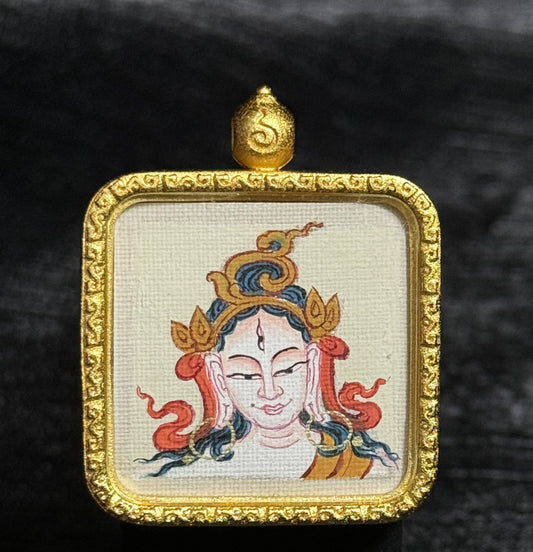
White Tara Mini Thangka Pendant Hand-Painted • Mineral Pigments • Tibetan Origin • 2 × 2 cm
Regular price
$1,150.00 USD

This White Tara Mini Thangka Pendant is a finely crafted Tibetan devotional artwork, presented in a compact portable format. The piece features a fully hand-painted White Tara thangka, created by a traditionally trained Tibetan thangka artist using natural mineral pigments.
Originating from Tibet, the painting follows classical thangka iconographic proportions and traditional brush techniques. Despite its small size, the work maintains the detail and symbolic accuracy associated with authentic Himalayan thangka art, making it suitable for personal devotion, collection, or travel practice.
White Tara is one of the most revered female bodhisattvas in Tibetan Buddhism and is traditionally recognized as an emanation of Avalokiteshvara (Chenrezig). She is also known as one of the Three Long Life Deities in Vajrayana tradition.
White Tara symbolizes compassion, healing, longevity, and spiritual protection. In traditional iconography, she is often depicted with seven eyes, representing her compassionate awareness of suffering across all realms of existence.
In Tibetan Buddhist practice, White Tara is traditionally associated with longevity, healing, and compassionate protection. Devotion to White Tara emphasizes cultivating compassion, mindfulness, and a sincere aspiration for the wellbeing of all sentient beings.
Practitioners often regard White Tara imagery as a reminder to nurture long life dedicated to meaningful practice and beneficial actions, rather than seeking immediate or guaranteed outcomes. The spiritual value of the image is connected to intention, practice, and karmic conditions.
Not applicable.
This thangka painting originates from Tibet, following the long-standing tradition of Himalayan sacred painting. It is hand-painted by a Tibetan lineage thangka artist, adhering to established iconographic proportions and traditional compositional structure.
Unlike factory reproductions or printed images, the work reflects the individual brushwork and discipline of traditional thangka training, preserving the artistic lineage associated with Tibetan Buddhist visual culture.
The painting is created using natural mineral pigments, a traditional material used in Himalayan thangka art for centuries. Mineral pigments are valued for their depth of color, stability, and longevity, allowing the artwork to maintain its appearance over long periods when properly preserved.
The piece is fully hand-painted, with careful layering of pigments and fine brush detailing to maintain clarity and symbolic accuracy within a miniature format.
Product type: Mini Thangka Pendant
Painting size: 2 × 2 cm
Origin: Tibet
Technique: Hand-painted
Pigments: Natural mineral pigments
The compact size allows the piece to function as a portable devotional image while still retaining the visual characteristics of traditional thangka painting.
This piece may be suitable for:
Buddhist practitioners who keep portable sacred imagery
Collectors of Himalayan thangka art
Individuals creating a personal shrine or meditation space
Those who prefer a compact devotional object for travel
This item is presented as a religious artwork and cultural artifact rooted in Tibetan Buddhist tradition. While sacred images hold spiritual significance within Buddhist practice, the object itself does not guarantee specific outcomes or results.
Its value lies in artistic heritage, devotional symbolism, and support for personal spiritual reflection or cultural appreciation.
For all orders exceeding a value of 100USD shipping is offered for free.
Returns will be accepted for up to 10 days of Customer’s receipt or tracking number on unworn items. You, as a Customer, are obliged to inform us via email before you return the item.
Otherwise, standard shipping charges apply. Check out our delivery Terms & Conditions for more details.
Returns will be accepted for up to 10 days of Customer’s receipt or tracking number on unworn items. You, as a Customer, are obliged to inform us via email before you return the item, only in the case of:
– Received the wrong item.
– Item arrived not as expected (ie. damaged packaging).
– Item had defects.
– Over delivery time.
– The shipper does not allow the goods to be inspected before payment.
The returned product(s) must be in the original packaging, safety wrapped, undamaged and unworn. This means that the item(s) must be safely packed in a carton box for protection during transport, possibly the same carton used to ship to you as a customer.
Here’s some of our most similar products people are buying. Click to discover trending style.