


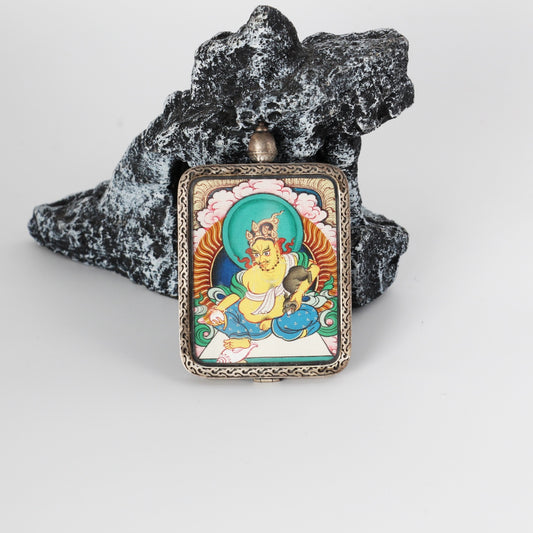
Yellow Jambhala Mini Thangka — Red Cloud Series Hand-Painted • Mineral Pigments • Tibetan Origin • 3.5 × 4.5 cm
Regular price
$4,750.00 USD

This Yellow Jambhala Mini Thangka from the Red Cloud Series is a high-standard Tibetan devotional artwork, created as an unframed miniature thangka and fully hand-painted with traditional mineral pigments. Crafted by a lineage-trained Tibetan artist, the painting follows classical iconographic proportions and emphasizes disciplined hand execution and layered color structure.
Presented as part of the Red Cloud Series, this work reflects a distinctive visual approach within Tibetan miniature thangka art, characterized by rich mineral tones, dense cloud motifs, and a composed yet powerful pictorial balance. It is created and presented as a cultural and artistic object rather than a decorative reproduction.
Yellow Jambhala (Dzambhala) is one of the most revered wealth deities in Tibetan Buddhism and is traditionally regarded as the principal guardian of prosperity grounded in ethical conduct and generosity. He is associated with safeguarding resources and supporting the proper use of material means in alignment with Buddhist values.
Symbolically, Yellow Jambhala represents abundance, stability, and responsible stewardship. His iconography emphasizes generosity, protection of rightful livelihood, and the balance between material support and spiritual integrity.
Yellow Jambhala is traditionally associated with the cultivation of generosity, gratitude, and the accumulation of supportive conditions through ethical intention. In Buddhist practice logic, devotion to Yellow Jambhala emphasizes creating favorable causes through right conduct, mindful offering, and disciplined practice rather than expectation of guaranteed results.
He is also traditionally associated with fostering confidence, stability, and clarity in one’s engagement with responsibilities, encouraging practitioners to align material pursuits with wisdom and compassion.
Not applicable.
This piece depicts a single deity and does not involve a combined or dual-deity practice structure.
This miniature thangka originates from Tibet and is painted by a traditionally trained Tibetan lineage artist. The work adheres to established thangka standards, including proportional accuracy, complete hand-painting, and careful compositional balance.
As part of the Red Cloud Series, the artwork reflects a focused stylistic lineage that emphasizes dense cloud formations, mineral-based color depth, and refined visual rhythm within Tibetan thangka tradition.
The painting is executed using natural mineral pigments, valued for their layered texture and long-term color stability. Every element is fully hand-painted, with close attention to line precision, pigment density, and iconographic clarity.
This miniature thangka may be paired with a sterling silver protective case inspired by the Dunhuang Nine-Colored Deer motif, designed to provide physical protection while preserving visual presentation. (Case presented as a matched option.)
Painting size: 3.5 × 4.5 cm
Format: Mini Thangka (Unframed)
Materials: Natural mineral pigments
Origin: Tibet
The compact scale preserves traditional proportions while allowing flexible display, mounting, or protective housing.
Buddhist practitioners engaged with generosity-centered or contemplative practice
Collectors of Tibetan miniature thangka and series-based works
Personal meditation spaces, travel use, or small personal shrines
This piece is intended for individuals who value cultural authenticity and lineage-based craftsmanship.
This product is presented as a cultural, artistic, and practice-support object rooted in Tibetan Buddhist tradition. It does not guarantee spiritual, material, or personal outcomes and should not be interpreted as a substitute for personal practice, instruction, or financial assurance.
Its significance lies in craftsmanship, cultural heritage, and symbolic meaning, supporting respectful engagement with Buddhist art and tradition.
For all orders exceeding a value of 100USD shipping is offered for free.
Returns will be accepted for up to 10 days of Customer’s receipt or tracking number on unworn items. You, as a Customer, are obliged to inform us via email before you return the item.
Otherwise, standard shipping charges apply. Check out our delivery Terms & Conditions for more details.
Returns will be accepted for up to 10 days of Customer’s receipt or tracking number on unworn items. You, as a Customer, are obliged to inform us via email before you return the item, only in the case of:
– Received the wrong item.
– Item arrived not as expected (ie. damaged packaging).
– Item had defects.
– Over delivery time.
– The shipper does not allow the goods to be inspected before payment.
The returned product(s) must be in the original packaging, safety wrapped, undamaged and unworn. This means that the item(s) must be safely packed in a carton box for protection during transport, possibly the same carton used to ship to you as a customer.
Here’s some of our most similar products people are buying. Click to discover trending style.