


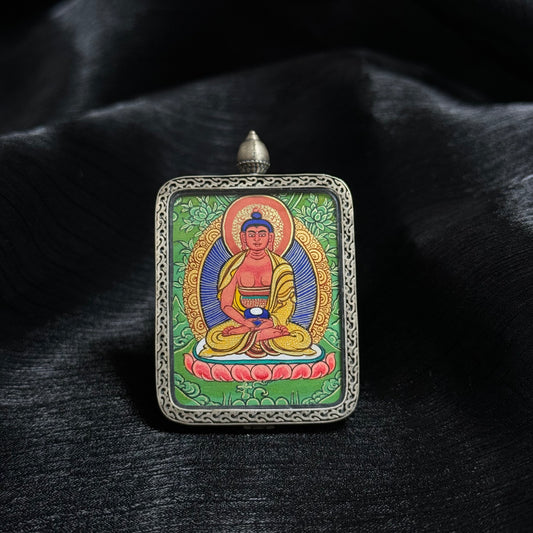
Amitabha Buddha Mini Thangka Pendant Hand-Painted • Mineral Pigments • Rebgong Origin • 3.5 × 4.5 cm
Regular price
$4,000.00 USD

This Amitabha Buddha Mini Thangka Pendant presents the revered Buddha of the Western Pure Land in a finely detailed miniature thangka inspired by the Rebgong (Regong) thangka painting tradition, one of the most respected centers of Tibetan Buddhist sacred art.
The painting is fully hand-painted using natural mineral pigments, ensuring vivid color depth and long-lasting stability. Created by a monastic-trained thangka artist, the artwork reflects the refined craftsmanship and spiritual discipline preserved in the Rebgong artistic lineage.
Part of the Emerald Radiance Thangka Series, the composition features harmonious green tonal elements symbolizing vitality, balance, and spiritual clarity while maintaining traditional iconographic structure.
Amitabha Buddha is one of the most important Buddhas in Mahayana Buddhism and is known as the Buddha of Infinite Light and Infinite Life. He presides over the Western Pure Land (Sukhavati) and represents the boundless compassion and wisdom that guide beings toward liberation.
In Buddhist symbolism, Amitabha embodies purity, compassion, and spiritual awakening, reminding practitioners of the possibility of inner clarity and the cultivation of virtuous intentions.
In Buddhist tradition, Amitabha Buddha is traditionally associated with purification of negative karma, cultivation of compassion, and the aspiration for spiritual clarity and liberation.
In East Asian and Tibetan cultural traditions, Amitabha is also regarded as a guardian deity for individuals born in the Chinese zodiac years of the Dog and the Pig, symbolizing protection, peaceful conditions, and the cultivation of positive merit.
Dog (Chinese Zodiac) — traditionally associated with well-being, removal of worries, and the cultivation of mental clarity and harmonious life conditions.
Pig (Chinese Zodiac) — traditionally associated with increasing good fortune, longevity, and the development of peaceful and stable circumstances.
In Western astrological symbolism, Sagittarius (November 22 – December 21) is sometimes connected with Amitabha qualities such as purity of intention, harmonious relationships, and the development of beneficial connections.
These associations reflect cultural traditions that link Amitabha with compassion, spiritual clarity, and supportive life conditions.
Not applicable.
This thangka depicts a single deity composition.
This miniature thangka originates from Rebgong (Regong), Amdo, a region internationally recognized for preserving traditional Tibetan Buddhist thangka painting.
Rebgong thangka art is renowned for its precise linework, luminous mineral pigments, and harmonious compositions. Each piece follows traditional iconographic proportions and is carefully painted by hand, preserving the continuity of Himalayan sacred art traditions.
The painting is fully hand-painted using natural mineral pigments, materials historically valued in thangka art for their vivid color intensity and long-term durability.
Through careful layering of pigments and meticulous brushwork, the artwork achieves rich visual depth while maintaining the delicate detail characteristic of Rebgong thangka craftsmanship.
Mineral pigments are known for maintaining their brilliance over time, making the piece suitable for both devotional appreciation and long-term collection.
Painting size: 3.5 × 4.5 cm
Format: Mini Thangka Pendant
Each piece is individually hand-painted and may present slight variations, reflecting the authentic nature of traditional thangka craftsmanship.
Included with the piece:
Gift box and certificate of collection
This miniature thangka pendant is suitable for:
Buddhist practitioners maintaining devotional imagery
Collectors of Himalayan thangka art
Individuals creating a portable meditation or personal shrine
The compact format allows the sacred image to accompany daily life while preserving the integrity of traditional thangka art.
This thangka pendant is presented as a religious artwork rooted in Tibetan Buddhist culture and the Rebgong thangka tradition.
Its meaning is connected to symbolic representation, artistic heritage, and devotional practice. It is not intended to guarantee specific outcomes, but to serve as a cultural and contemplative object supporting appreciation of Himalayan sacred art.
For all orders exceeding a value of 100USD shipping is offered for free.
Returns will be accepted for up to 10 days of Customer’s receipt or tracking number on unworn items. You, as a Customer, are obliged to inform us via email before you return the item.
Otherwise, standard shipping charges apply. Check out our delivery Terms & Conditions for more details.
Returns will be accepted for up to 10 days of Customer’s receipt or tracking number on unworn items. You, as a Customer, are obliged to inform us via email before you return the item, only in the case of:
– Received the wrong item.
– Item arrived not as expected (ie. damaged packaging).
– Item had defects.
– Over delivery time.
– The shipper does not allow the goods to be inspected before payment.
The returned product(s) must be in the original packaging, safety wrapped, undamaged and unworn. This means that the item(s) must be safely packed in a carton box for protection during transport, possibly the same carton used to ship to you as a customer.
Here’s some of our most similar products people are buying. Click to discover trending style.