
Marici Devi: The Buddhist Guardian of Invisible Light
Understanding Marici Devi Beyond Myth
Marici Devi, known in Sanskrit as Marīcī, is a significant protective figure in Mahayana and Vajrayana Buddhism. Her name means “ray of light” or “solar radiance,” and her symbolism centers on a unique idea:
light that moves unseen.
According to Buddhist tradition, Marici Devi travels ahead of the sun itself—able to see everything while remaining invisible. Rather than representing escape or illusion, this concept reflects a deeper philosophical meaning: clarity without exposure, protection without confrontation, and awareness that precedes danger.
Origins in Buddhist Thought
Marici Devi appears in early Buddhist scriptures as a celestial protector endowed with extraordinary spiritual ability. Texts describe her as a being who cannot be seen, restrained, or harmed, while possessing complete awareness of her surroundings.
In later Buddhist interpretation, she is sometimes regarded as a manifestation of Vairocana Buddha, the cosmic Buddha associated with universal truth and illumination. This association positions Marici Devi not merely as a guardian figure, but as an expression of enlightened light functioning in the world.
Marici Devi in Vajrayana and Tibetan Buddhism
As Buddhism developed within the Vajrayana tradition, especially in Tibet, Marici Devi took on more complex and symbolic forms.
She is often depicted with:
-
Multiple faces and arms
-
One face appearing as a boar, symbolizing the power to overcome ignorance
-
A chariot drawn by seven or nine wild boars, representing unstoppable momentum
-
Ritual objects such as a vajra, bow, needle, rope, or sun wheel
These visual elements do not suggest aggression, but rather precision, speed, and unobstructed movement—a protector who neutralizes obstacles before they fully arise.
The Meaning of “Invisibility” in Buddhist Context
One of the most misunderstood aspects of Marici Devi is the idea of “invisibility.” In Buddhist philosophy, this does not imply literal disappearance, but rather a state beyond interference.
Symbolically, Marici Devi represents:
-
Acting without attracting hostility
-
Remaining unharmed amid conflict
-
Moving through uncertainty with clarity
-
Protection through awareness rather than force
This interpretation explains why Marici Devi was historically revered by travelers, warriors, and individuals facing unstable or dangerous conditions—particularly in East Asian esoteric traditions.
Cross-Traditional Influence in East Asia
As Buddhism entered China, Marici Devi became associated with Doumu Yuanjun (斗姥元君) in Daoist cosmology, a primordial celestial mother linked to the stars and cosmic order. This blending reflects a broader East Asian approach to spiritual symbolism, where protective and cosmic figures often overlap across traditions.
Rather than diluting her identity, this integration reinforced Marici Devi’s role as a guardian of cosmic balance and unseen order.
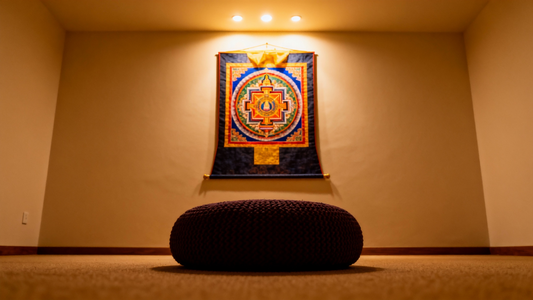
Marici Devi in Himalayan Thangka Art
In Himalayan Buddhist art, Marici Devi is a rare and sophisticated subject. Traditional Thangka paintings follow strict iconographic systems, ensuring that every posture, object, and expression conveys specific meaning.
A Marici Devi Thangka often emphasizes:
-
Dynamic movement and directional flow
-
Controlled yet radiant use of color
-
A balance between serenity and strength
-
Precision aligned with spiritual lineage
These artworks are not created as decorative images alone, but as visual expressions of Buddhist philosophy, offering contemplation through form and symbolism.
You can explore Marici Devi Thangka artworks curated by deity here:
👉 https://thangkamarket.com/collections/shop-thangka-by-deity-marici-devi
Learning More About Buddhist Deities
For those interested in understanding Marici Devi within the broader Buddhist cosmological system—alongside Buddhas, Bodhisattvas, and protective figures—you may explore our Learning Center Deity Encyclopedia, which presents traditional knowledge in a structured, accessible way:
👉 https://thangkamarket.com/collections/learning-center-deity-encyclopedia
Marici Devi in a Modern Context
Today, Marici Devi can be appreciated not as a figure of superstition, but as a symbol of mindful protection, strategic awareness, and inner clarity.
She embodies an idea that resonates deeply in the modern world:
Strength does not always need visibility.
Protection does not require confrontation.
Awareness often works best when it remains quiet.
Through sacred art and cultural study, Marici Devi continues to offer insight into how ancient Buddhist wisdom understood resilience, perception, and presence.
Final Thoughts
Marici Devi stands apart in Buddhist tradition as a guardian of unseen light—a reminder that clarity can exist without exposure, and protection can arise from awareness rather than force.
For collectors, scholars, and practitioners alike, engaging with Marici Devi through Thangka art is an invitation to explore Himalayan Buddhist culture with depth, respect, and discernment.
Previous
Vajrasattva: The Root of Purification in Vajrayana Buddhism Understanding the Deity of Pure Awareness and Inner Transformation
Next
Akashagarbha Bodhisattva The Bodhisattva of Infinite Wisdom, Merit, and Abundance
Related articles
Long-term Preservation
Dec 14 2025