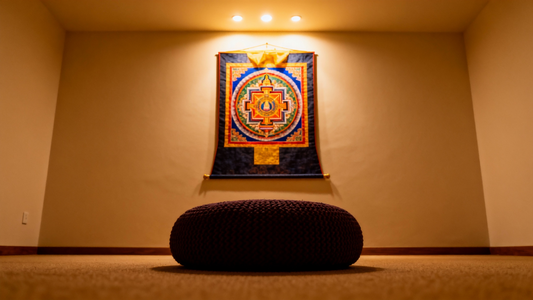

Thangka Quality & Price Factors: What Determines Their Value?
For anyone interested in collecting or purchasing Thangkas, understanding the relationship between quality and price is essential to avoid overpaying or missing out on valuable pieces. A Thangka’s value is not arbitrary—it is jointly determined by five core factors: artist level, pigment quality, gold usage, precision of linework, and regional craftsmanship traditions. These elements interact with each other, forming the "value system" of Thangkas. This blog will deeply explore how each factor influences quality and price, helping you accurately judge the value of a Thangka.
1. Artist Level: The Core Driver of Value
In the Thangka art world, an artist’s level and lineage directly determine the ceiling of a work’s value. Thangka creation requires long-term rigorous training, and artists with formal inheritance and rich experience can create works with higher artistic and spiritual value. The price gap between different levels of artists is often huge.
1.1 Master-Level Artists (Top Tier)
Master-level artists have clear and prestigious lineages (e.g., Rebgong master-apprentice lineage, Menri monastic lineage) and decades of creation experience. They are not only proficient in traditional techniques but also have unique artistic expressions. Their works often take 6 months to several years to complete, and each piece is a masterpiece with strict iconographic accuracy and exquisite craftsmanship.
• Quality Performance: Iconography is absolutely accurate, lines are fluid and precise, color matching is harmonious and vivid, and gold application is elegant and layered. Works have strong spiritual resonance and artistic uniqueness.
• Price Range: Small works (20-50cm) start at $5,000; medium works (50-100cm) range from $10,000 to $50,000; large masterpieces (over 100cm) can exceed $100,000. Their works often have certificates of authenticity with detailed lineage records and are highly collectible.
Thangkamarket:Masterpiece Collection – ThangkaMarket
1.2 Senior Artists (Mid-High Tier)
Senior artists have 10-20 years of experience and formal training background. They are proficient in all creation processes and can independently complete high-quality Thangkas. Their works are the main force in the mid-to-high-end market, balancing craftsmanship, authenticity, and cost-effectiveness.
• Quality Performance: Iconography is accurate, lines are stable and uniform, pigments are of high quality (natural mineral pigments), and gold application is standardized. Works have good artistic expression and no obvious flaws.
• Price Range: Small works (20-50cm) are $1,500-$5,000; medium works (50-100cm) are $5,000-$15,000; large works (over 100cm) are $15,000-$50,000.
1.3 Emerging Artists (Entry-Mid Tier)
Emerging artists have 3-10 years of experience, mastered basic techniques, and often work under the guidance of senior artists. Their works are suitable for beginners’ practice, daily decoration, or entry-level collection.
• Quality Performance: Iconography meets basic standards, lines are relatively smooth, pigments are mostly natural mineral pigments (partially mixed with plant pigments), and gold application is simple. Works have no major flaws but lack unique artistic expression.
• Price Range: Small works (20-50cm) are $300-$1,500; medium works (50-100cm) are $1,500-$5,000.
2. Pigment Quality: The Foundation of Long-Lasting Value
Pigment is the "soul" of Thangka’s color. The type, purity, and processing technology of pigments directly affect the work’s brightness, durability, and value. High-quality Thangkas always use natural mineral/plant pigments, while low-cost works often use synthetic pigments.
2.1 Natural Mineral/Plant Pigments (High Quality)
Natural pigments are extracted from rare minerals (lapis lazuli for blue, malachite for green, cinnabar for red, realgar for orange) and precious plants (saffron for yellow, indigo for purple). They need to go through complex processes such as selection, cleaning, grinding, and purification—some mineral pigments are ground into ultra-fine powder (2000+ mesh) to ensure vividness and uniformity.
• Quality Advantages: High color saturation, unique luminous texture, strong resistance to fading and oxidation. Under proper care, the color can remain vivid for decades or even centuries (antique Thangkas with bright colors are mostly made of natural pigments).
• Impact on Price: Natural pigments are expensive (e.g., high-purity lapis lazuli pigment costs $500-$1,000 per 100g) and increase the creation cost significantly. Thangkas using 100% natural mineral pigments are 2-5 times more expensive than those using synthetic pigments of the same size.
Thangkamarket:Mineral Pigment Thangka – ThangkaMarket
2.2 Synthetic Pigments (Low Quality)
Synthetic pigments are chemical dyes (e.g., industrial organic dyes). They are cheap and easy to use, but their performance is far inferior to natural pigments.
• Quality Disadvantages: Color is flat and lack of luster, easy to fade, discolor, or crack when exposed to light. Most synthetic pigments will fade significantly within 1-5 years, and the work’s value will plummet.
• Price Position: Thangkas using synthetic pigments are low-cost products, mostly for temporary decoration. Small works (20-50cm) are $20-$100, and large works (over 100cm) are $100-$300.
3. Gold Usage: The "Value Enhancer" of Sacredness
Gold is an important decorative element in Thangkas, symbolizing light and sacredness. The purity, usage, and application technique of gold directly affect the work’s visual effect and value. High-quality gold application can significantly enhance the work’s sacred atmosphere and collection value.
3.1 Gold Purity & Form
• 24K Gold Leaf/Powder (High Quality): High-end Thangkas use 24K pure gold (gold content ≥99.9%). Gold is processed into thin gold leaf (thickness ≤0.1μm) or ultra-fine gold powder. It has a warm, radiant glow and will not fade or tarnish.
Thangkamarket:Gold Thangka – ThangkaMarket
• Low-Purity Gold/Metallic Ink (Low Quality): Low-cost works use low-purity gold (18K or lower) or metallic ink (synthetic materials imitating gold). Metallic ink has a cold, reflective sheen and is easy to fade, with no value retention.
3.2 Application Techniques & Usage
• Hot Gilding (High Cost): Used for large-area gold decoration (halos, lotus thrones). Gold leaf is applied to heated animal glue, forming a firm, luminous layer. Multiple layers of gold leaf can be applied to enhance the three-dimensional effect. This technique is complex and time-consuming, increasing the work’s cost by 30%-50%.
• Cold Gilding (Medium Cost): Used for detailed decoration (jewelry, floral motifs). Gold powder is mixed with animal glue to make paste, applied with fine brushes. The effect is precise but less luminous than hot gilding.
• Minimal/No Gold (Low Cost): Some entry-level Thangkas use little or no gold, focusing only on basic color decoration. Their value is mainly determined by other factors (artist, linework).
4. Precision of Linework: The "Touchstone" of Craftsmanship
Linework is the core of Thangka craftsmanship—all figures, patterns, and structures are built on lines. The precision, fluidity, and uniformity of lines directly reflect the artist’s skill level and determine the work’s artistic quality. In traditional Thangka creation, line drawing often takes 30%-40% of the total time.
4.1 High-Precision Linework (High Quality)
High-quality Thangkas have ultra-fine, fluid lines with subtle thickness changes. For example:
• Rebgong style’s "silk-thread lines" (thickness ≤0.1mm) are smooth and delicate, showing the texture of fabric and jewelry;
• Menri style’s "iron lines" are bold and unbroken, highlighting the solemnity of deities;
• Newar style’s decorative lines are precise and dense, with no smudges or breaks.
Artists need to hold their breath when drawing, and a single mistake may ruin the entire work. High-precision linework requires long-term training, making the work’s price 2-3 times higher than that of works with rough lines.
4.2 Low-Precision Linework (Low Quality)
Low-quality Thangkas have rigid, uneven lines with obvious smudges or retouches. Repeated patterns (floral motifs) are inconsistent, and deity facial features are distorted. Such works are mostly created by unskilled artists or mass-produced, with low value (small works ≤$300).
5. Regional Craftsmanship Traditions: The "Unique Value" of Cultural Characteristics
Different regions have unique Thangka craftsmanship traditions, which form distinct artistic styles. These traditions affect the work’s quality characteristics and market positioning, and some regional styles are more valuable due to their uniqueness and scarcity.
|
Regional Style |
Core Craftsmanship Characteristics |
Impact on Quality & Price |
|
Rebgong (Amdo) |
Ultra-fine silk-thread lines, bright natural mineral pigments, elegant gold application, balanced composition |
High demand in the market due to precise craftsmanship and vivid colors. Works of the same level are 10%-20% more expensive than other styles. Master works are highly collectible. |
|
Menri (Miansa) |
Bold iron lines, symmetrical composition, restrained gold use, solemn color palette (pure mineral pigments) |
Orthodox monastic style, high recognition in the spiritual practice market. Works with clear monastic lineage are valuable, mid-range works (50-100cm) $5,000-$20,000. |
|
Karma Gadri |
Fluid lines, soft color gradients (plant-mineral mixed pigments), spacious landscape composition |
Popular in the decorative market due to naturalistic style. Works with exquisite landscape details are more valuable, entry-level works $300-$1,500, senior works $1,500-$10,000. |
|
Newar (Nepal) |
Exquisite layered gold work, dense decorative patterns, luminous deity expressions, Hindu-Buddhist fusion elements |
Gold craftsmanship is the core value. Works with extensive gold decoration are 30%-50% more expensive than other styles. High-end works (with complex gold patterns) $10,000-$50,000. |
Summary: How to Judge Thangka Value Through Quality Factors?
To accurately judge a Thangka’s value, you need to comprehensively evaluate the five factors above, not just a single one. Here’s a practical judgment framework for beginners:
1. First, check the artist’s background: Ask for certificates of authenticity to confirm lineage and experience—this is the primary basis for value judgment.
2. Second, identify pigment quality: Observe the color’s luster (natural pigments have subtle shimmer), and use a cotton swab to gently wipe (no color transfer for natural pigments).
3. Third, evaluate line precision: Use a mobile phone to zoom in on details (eyelashes, jewelry) to check if lines are smooth and precise, with no smudges.
4. Fourth, check gold usage: Observe the gold’s glow (warm for 24K gold, cold for metallic ink) and ask about the application technique (hot gilding is more valuable).
5. Fifth, confirm the regional style: Understand the style’s unique craftsmanship (e.g., Newar’s gold work) and compare the market price of the same style and level.
Conclusion: Quality Is the Core of Long-Term Value
A Thangka’s price is a direct reflection of its quality. Artist level determines the "base value," pigment and gold quality determine the "material value," line precision determines the "craftsmanship value," and regional traditions determine the "cultural value." For collectors, focusing on high-quality works (clear artist lineage, natural pigments, precise lines) can ensure long-term value retention; for beginners, understanding these factors can help avoid buying fake or overpriced works.
Remember, the most valuable Thangka is not necessarily the most expensive one, but the one with excellent craftsmanship, authentic materials, and clear value logic. If you have more questions about specific Thangka works’ quality and price evaluation, feel free to leave a comment below or contact our Thangka experts for personalized advice.
Previous
Hand-painted vs Printed Thangkas: Key Differences & Selection Guide
Next
How to Care for a Thangka: Essential Guidelines for Preservation
Related articles
Long-term Preservation
Dec 14 2025