
Yamantaka (Vajrabhairava): The Wrathful Wisdom That Conquers Death and Fear
In Tibetan Buddhism, few figures are as visually overwhelming—and as deeply misunderstood—as Yamantaka, also known as Vajrabhairava.
With multiple faces, many arms, fierce expressions, and an aura of fire and power, Yamantaka is often mistaken for a violent or fearsome deity meant to intimidate. In reality, he represents something far more profound:
The ultimate expression of wisdom confronting death, fear, and ignorance—without compromise.
This article explores who Yamantaka truly is, why wisdom appears wrathful in his form, and how his symbolism continues to resonate in both spiritual practice and sacred art today.
Yamantaka and Manjushri: Why Wisdom Appears Wrathful
At the heart of Yamantaka lies a crucial truth:
Yamantaka is the wrathful manifestation of Manjushri, the Bodhisattva of transcendent wisdom.
Manjushri embodies clarity, insight, and understanding. Yamantaka embodies the same wisdom, but expressed in its most forceful and uncompromising form. The wrathful appearance is not anger—it is decisive compassion.
When ignorance, fear, or delusion cannot be dissolved gently, wisdom appears fierce.
This is why, in traditional iconography, Yamantaka’s most wrathful form still reveals Manjushri’s calm and compassionate face at the highest level—a reminder that all power here is guided by wisdom, not rage.
Why Yamantaka Conquers Death
The name Yamantaka literally means:
-
Yama — the lord of death
-
Antaka — the ender or destroyer
Yamantaka is therefore “the one who ends the power of death.”
This does not mean immortality. Instead, Yamantaka confronts the fear of death, which in Buddhism is the deepest root of attachment, ego, and suffering.
By trampling Yama beneath his feet, Yamantaka symbolizes the realization that:
Death loses its power when ignorance is overcome.
This is why Yamantaka occupies a central position in advanced Vajrayana practice—he represents wisdom that does not turn away from fear, but walks directly through it.
Understanding Yamantaka’s Iconography
Nine Heads, Thirty-Four Arms, One Message
Yamantaka’s complex imagery is not decorative excess. Every detail carries meaning.
-
Nine heads arranged in three tiers represent the complete mastery of wisdom across all realms and perspectives.
-
The uppermost central head of Manjushri, calm and compassionate, confirms that wrath is guided by insight.
-
Thirty-four arms hold numerous ritual implements, symbolizing the many methods wisdom uses to dismantle ignorance.
-
Flames, skulls, and dynamic movement all express urgency and fearlessness, not cruelty.
For artists, this iconography is among the most difficult to execute correctly. For viewers, it offers a powerful visual teaching:
wisdom must sometimes be fierce to be effective.
Is Yamantaka a Protector or a Deity?
Yamantaka is often confused with protector deities such as Mahakala. The distinction is important.
-
Protector deities guard the Dharma and remove obstacles.
-
Yamantaka, however, is a highest-level tantric deity whose role is to transform the practitioner’s relationship with fear and death itself.
In Tibetan Buddhism, Yamantaka belongs to the Anuttarayoga Tantra, the most advanced level of Vajrayana practice. His imagery and symbolism reflect this depth.
This is why Yamantaka thangkas are traditionally not casual devotional objects, but advanced contemplative artworks.
Who Yamantaka Is For — and Who He Is Not For
Yamantaka is not meant for everyone, and acknowledging this is a sign of respect rather than exclusion.
He may resonate with those who:
-
Are facing major life transitions or deep inner fears
-
Seek clarity rather than comfort
-
Are drawn to wisdom traditions that emphasize direct insight
-
Appreciate sacred art with profound symbolic depth
He is not intended for those who:
-
Seek quick blessings or superficial protection
-
Prefer gentle devotional imagery
-
Are uncomfortable with confronting difficult truths
This clarity helps preserve the integrity of Yamantaka’s role within Buddhist tradition.
Yamantaka in Thangka Art: Why It Is So Difficult to Paint
From an artistic perspective, Yamantaka is among the most demanding subjects in Tibetan thangka painting.
-
The complex iconography leaves no room for improvisation.
-
Proportions, gestures, and symbolic placement must follow strict canonical guidelines.
-
The artist must maintain both technical mastery and mental discipline to avoid distortion of meaning.
In regions such as Rebgong (Amdo), known for rigorous thangka training, Yamantaka paintings are often considered tests of an artist’s maturity and understanding rather than beginner works.
This is why authentic Yamantaka thangkas are rare—and why they are deeply respected by collectors and practitioners alike.
Yamantaka and Contemporary Life
While few people today formally practice tantric rituals, Yamantaka’s symbolism remains surprisingly relevant.
Modern life often confronts us with:
-
Fear of failure
-
Fear of loss
-
Fear of uncertainty
Yamantaka does not promise comfort. He offers clarity, courage, and responsibility—the strength to face what we would rather avoid.
For some, this relationship is explored through study.
For others, through meditation.
And for some, through sacred art as a daily reminder of fearless wisdom.
Those interested in Yamantaka-related artworks and interpretations connected to Manjushri can explore curated pieces here:
👉 https://thangkamarket.com/collections/shop-thangka-by-deity-manjushri
Learning More About Yamantaka and Other Deities
Understanding Yamantaka benefits from broader knowledge of Buddhist iconography and philosophy.
If you wish to explore other major deities, their symbolism, and how they are traditionally understood, you may find this learning resource helpful:
👉 https://thangkamarket.com/collections/learning-center-deity-encyclopedia
Approaching these figures with curiosity and respect allows their deeper meanings to unfold naturally over time.
Final Thoughts
Yamantaka is not a figure of intimidation, but of uncompromising wisdom.
He reminds us that fear does not disappear through avoidance, and that clarity often requires strength. In a world full of distraction and uncertainty, this message remains timeless.
Wisdom that dares to face fear is wisdom that liberates.
Previous
Long-term Preservation
Next
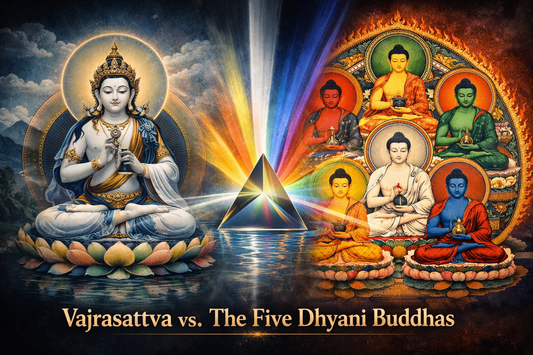
Vajrasattva vs. the Five Dhyani Buddhas Understanding Purification and Enlightenment Structure in Vajrayana Buddhism
Related articles
Long-term Preservation
Dec 14 2025