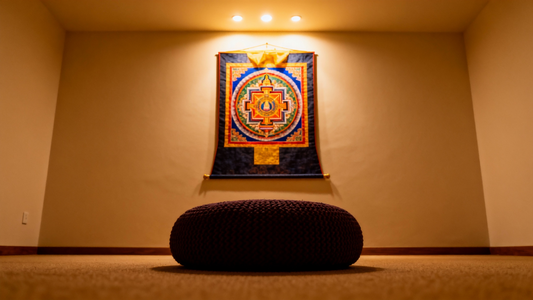

Vajrasattva vs. the Five Dhyani Buddhas Understanding Purification and Enlightenment Structure in Vajrayana Buddhism
Introduction: Why Vajrasattva Is Often Confused with the Five Buddhas
In Vajrayana Buddhism, newcomers frequently encounter two closely related yet fundamentally different concepts: Vajrasattva and the Five Dhyani Buddhas, also known as the Five Wisdom Buddhas.
Because Vajrasattva is often described as “the embodiment of all Buddha wisdom”, many people naturally ask:
-
Is Vajrasattva one of the Five Dhyani Buddhas?
-
If not, how exactly are they related?
The short answer is no—but the deeper explanation reveals one of the most important structural principles in Vajrayana Buddhist practice.
The Five Dhyani Buddhas: The Architecture of Enlightened Wisdom
The Five Dhyani Buddhas represent the structured expression of enlightenment. Each Buddha embodies a specific aspect of awakened awareness, transforming a particular mental affliction into wisdom.
They are traditionally presented as:
-
Vairocana – All-encompassing wisdom
-
Akshobhya – Mirror-like wisdom
-
Ratnasambhava – Wisdom of equanimity
-
Amitabha – Discriminating wisdom
-
Amoghasiddhi – All-accomplishing wisdom
Together, they form a cosmic mandala, mapping:
-
The five directions
-
The five aggregates (skandhas)
-
The five poisons and their transformation
If you would like a detailed explanation of each Buddha, their symbolism, colors, and associated wisdoms, you can read our in-depth guide here:
👉 Five Dhyani Buddhas Explained
https://thangkamarket.com/blogs/learning-center/five-dhyani-buddhas
You may also explore our curated collection of Five Dhyani Buddhas thangkas and mandala artworks here:
👉 Shop Five Dhyani Buddhas Thangka Collection
https://thangkamarket.com/collections/shop-thangka-by-deity-five-dhyani-buddhas
Vajrasattva: Not One of the Five, but Their Source
Vajrasattva is not counted as one of the Five Dhyani Buddhas.
Instead, he represents something more fundamental:
The primordial purity from which the wisdom of the Five Buddhas arises.
In Vajrayana understanding, Vajrasattva embodies:
-
Original, unstained awareness
-
The union of wisdom and method
-
The state before differentiation into the five wisdoms
For this reason, Vajrayana texts often describe Vajrasattva as:
“The essence of all Tathāgatas.”
While the Five Dhyani Buddhas represent differentiated expressions of enlightenment, Vajrasattva represents undivided clarity itself.
Practice Perspective: Why Vajrasattva Comes First
This distinction becomes especially clear when viewed from a practitioner’s perspective.
Before engaging in:
-
Five Buddha mandala practices
-
Deity yoga related to specific wisdom Buddhas
-
Advanced Vajrayana empowerments
Practitioners almost always begin with Vajrasattva purification practice.
The purpose of this practice is to:
-
Purify karmic obscurations
-
Restore broken vows and commitments
-
Establish ethical and mental clarity
In Vajrayana logic:
Without purification, the wisdom of the Five Buddhas cannot be fully embodied.
For this reason, Vajrasattva is often considered the gateway to Vajrayana practice rather than its final expression.
Mandala Symbolism: Center vs. Structure
In mandala iconography, the relationship between Vajrasattva and the Five Buddhas becomes visually clear:
-
The Five Dhyani Buddhas define the structured geometry of enlightenment
-
Vajrasattva appears as:
-
The underlying purity of the mandala
-
Or the central clarity presupposed by the entire structure
-
This does not place Vajrasattva “above” the Five Buddhas in a hierarchical sense.
Instead, it indicates a difference in function: source versus expression.
A Helpful Analogy for Modern Readers
A simple, non-religious analogy can help clarify the distinction:
-
Vajrasattva is like perfectly clear water
-
The Five Dhyani Buddhas are like light refracted into five distinct colors
The colors cannot appear without clarity—but clarity itself is not any single color.
Key Differences at a Glance
| Aspect | Vajrasattva | Five Dhyani Buddhas |
|---|---|---|
| Category | Root purification deity | Wisdom Buddhas |
| Role | Source of purity | Structured wisdom |
| Practice focus | Purification & foundation | Transformation & realization |
| Symbolism | Undivided awareness | Differentiated enlightenment |
| Position | Before structure | Within structure |
Art, Devotion, and Practical Use
Understanding this distinction is especially helpful when choosing Buddhist art for practice or collection.
-
Vajrasattva thangkas are often selected for:
-
Daily practice
-
Retreat settings
-
Ethical renewal and inner purification
-
-
Five Buddha mandalas and thangkas are typically used for:
-
Advanced visualization practices
-
Cosmological contemplation
-
Complete enlightenment frameworks
-
Each serves a different but complementary role.
If you are interested in a Vajrasattva thangka created specifically for purification practice and daily devotion, you may explore this double-sided piece featuring Vajrasattva with Mahakala as a protective companion:
👉 Vajrasattva & Mahakala Double-Sided Thangka Pendant
https://thangkamarket.com/collections/shop-thangka/products/vajrasattva-mahakala-double-sided-thangka-pendant-18k-gold-rebgong-hand-painted
Conclusion: Foundation and Fulfillment
To summarize clearly:
Vajrasattva is not one of the Five Dhyani Buddhas.
He represents the purified ground from which their wisdom unfolds.
In Vajrayana Buddhism:
-
Vajrasattva symbolizes returning to clarity
-
The Five Dhyani Buddhas symbolize living clarity in full expression
Understanding both allows practitioners and collectors alike to appreciate the complete Vajrayana path—from purification to realization.
Further Reading
-
Vajrasattva and the Hundred-Syllable Mantra
-
The Five Wisdoms and the Five Aggregates
-
How Vajrayana Mandalas Function in Practice
Previous
Yamantaka (Vajrabhairava): The Wrathful Wisdom That Conquers Death and Fear
Next
Vajrasattva: The Root of Purification in Vajrayana Buddhism Understanding the Deity of Pure Awareness and Inner Transformation
Related articles
Long-term Preservation
Dec 14 2025