
Cultural Significance of Thangka Painting | History, Art & Himalayan Heritage
Cultural Significance of Thangka Painting: A Comprehensive Educational Guide
Thangka painting is one of the most distinctive visual traditions of the Himalayan region, encompassing Tibet, Nepal, and the culturally rich Rebgong area. Today, Thangka is widely studied and appreciated for its artistic, historical, anthropological, and cultural value.
This article offers a science-based, museum-style overview of the cultural significance of Thangka—covering its history, materials, craftsmanship, psychological impact, and regional variations—without promoting religious practice or superstition.
Key Takeaways
-
Thangka is a major cultural heritage form that documents history, art, and philosophical systems across the Himalayan world.
-
Its significance is multi-layered: historical, religious-cultural (in an anthropological sense), economic, artistic, psychological, and regional.
-
Thangka craftsmanship reflects advanced knowledge of natural pigments, proportion systems, and pre-modern material science.
-
Different regions—Nepal, Tibet, and Rebgong—developed distinct aesthetic styles shaped by cultural exchange.
-
Modern interest in Thangka spans museums, collectors, design fields, and mindfulness-related environments.
1. Historical Significance: A Visual Archive of Himalayan Civilization
Thangka paintings often function as visual records of historic events, cultural interactions, and social life across different dynasties.
Representing major cultural exchanges
Examples include depictions of the historic Tibetan-Chinese marriage alliance involving Princess Wencheng, commonly found in the Jokhang Temple and Potala Palace murals. These works illustrate diplomatic relations, clothing styles, and ceremonial customs of the period.
Recording political and ceremonial activities
In the Red Palace of the Potala, the celebrated work The Fifth Dalai Lama’s Audience with Emperor Shunzhi visually documents 17th-century protocol, architecture, and intercultural court interactions.
Why this matters
For historians and anthropologists, Thangka serves as:
-
a cross-cultural historical resource
-
a visual supplement to limited written documentation
-
evidence of long-distance exchange across Central Asia and the Himalayas
As a result, Thangka is studied not only as art but also as historical data.
2. Religious-Cultural Significance (Anthropological Perspective)
While Thangka imagery originates in Buddhist traditions, its cultural role can be explained objectively without describing supernatural functions.
A teaching tool in pre-modern societies
In historical Himalayan communities where literacy rates were limited, Thangka functioned as:
-
a visual teaching aid
-
a method for communicating philosophical ideas
-
a standardized system of symbolic representation
Its structured imagery made abstract concepts easier to understand.
Portability in nomadic contexts
Because Thangka can be rolled and transported, it played a practical role in:
-
nomadic pastoral societies
-
cultural transmission across regions
-
temporary ritual and educational spaces
This portability distinguishes Thangka from murals and large-format religious art.
A key element of monastic visual culture
Large monasteries served as preservation centers for Thangka, where the artworks:
-
standardized iconographic conventions
-
preserved artistic knowledge
-
contributed to the development of regional styles
In this sense, the “religious value” of Thangka is more accurately understood as a cultural, educational, and institutional significance.
3. Economic Significance: From Heritage Object to Global Art Market
Though Thangka has a long cultural history, it only entered the modern art market relatively recently.
Early market development
In the 1980s and early 1990s, Thangka prices in domestic Chinese markets were modest. As interest in Himalayan art grew, more collectors and museums began acquiring them, leading to a steady rise in value.
Influence of Intangible Cultural Heritage policies
After Thangka was included in China’s National Intangible Cultural Heritage list in 2006, public awareness increased significantly, elevating both cultural status and market demand.
Auction records & international recognition
Major auction houses have played a key role in bringing Thangka to global attention:
-
In 2008, a Ming-dynasty Medicine Buddha Thangka sold for RMB 15.4 million.
-
In 2014, a Ming Yongle silk Thangka—known as the “King of Thangka”—sold for HKD 348 million in Hong Kong, after circulating internationally for decades.
What this means academically
Economists and art historians view Thangka as:
-
a case study in cultural-economy interaction
-
an example of how heritage crafts gain global market significance
-
a reflection of changing cultural appreciation patterns in Asia and the West
4. Artistic & Aesthetic Significance: Proportion, Pigments & Craftsmanship
Thangka is highly valued for its refined artistic system and complex制作 technique.
4.1 Proportion & Composition (Iconometry)
Thangka relies on mathematically structured proportions derived from classical manuals. This ensures:
-
visual harmony
-
spatial clarity
-
consistent iconographic standards
It represents an advanced pre-modern system of design and visual logic.
4.2 Natural Mineral Pigments
Traditional pigments include:
-
lapis lazuli
-
cinnabar
-
malachite
-
gold powder
-
plant-based dyes
These materials exhibit:
-
long-term color stability
-
rich chromatic depth
-
unique surface textures
Research conservators frequently cite Thangka as an important example of pre-industrial color technology.
4.3 Labor-intensive craftsmanship
A completed Thangka may require:
-
months or years of skilled labor
-
extensive color layering
-
detailed linework
-
delicate gold outlining
This makes Thangka both an artistic achievement and an expression of specialized technical knowledge.
5. Mindfulness & Psychological Significance: Visual Structure and Cognitive Focus
Modern cognitive research indicates that:
-
symmetrical patterns
-
highly structured compositions
-
repetitive visual motifs
can support attention, calmness, and visual clarity.
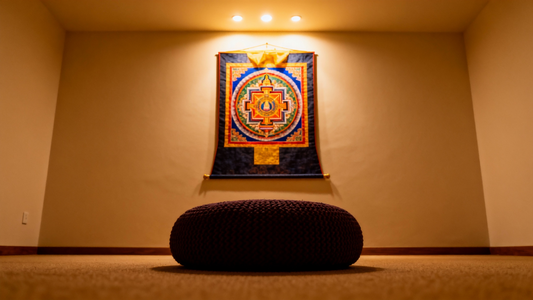
Thangka’s composition—especially mandala forms—reflects these principles. As a result, Thangka is often used in contemporary interiors as:
-
a focal point for mindful spaces
-
a design element that supports concentration
-
an object that promotes visual balance
These uses do not rely on religious interpretation, but on aesthetic psychology.
6. Regional Cultural Significance: Nepal, Tibet, and Rebgong
Thangka styles vary widely across regions, reflecting historical exchange and local artistic preferences.
6.1 Nepal (Newar School)
Characteristics:
-
extremely fine linework
-
ornamental density
-
extensive use of gold
-
influence from manuscript and metalwork traditions
6.2 Tibet (Menri & Gadri Schools)
Menri:
-
balanced composition
-
clearly defined forms
-
traditional mineral palette
Gadri:
-
influenced by Chinese brushwork
-
softer lines and naturalistic landscapes
6.3 Rebgong (Amdo Region)
Rebgong Thangka is recognized for:
-
bright, saturated colors
-
expressive figures
-
layered decorative patterns
-
a blend of Tibetan and Chinese aesthetics
These variations make Thangka an important tool for studying cultural diffusion in the Himalayan region.
Recommended Thangka Examples From Our Collection
(Aligned with educational tone — demonstrating styles, not promoting beliefs)
Medicine Buddha Thangka — Nepal/Tibet Style
A strong example of blue mineral pigment use, balanced composition, and classical iconometric structure.
👉 Medicine Buddha – ThangkaMarket
Black Jambhala Thangka
Demonstrates high-contrast aesthetics, dynamic posture, and detailed ornamentation typical of Tibetan styles.
👉 Wealth & Prosperity – ThangkaMarket
Miansa (Menri) Style Thangka
Represents classical Tibetan proportion systems and harmonious visual structure.
👉 Miansa / Menri Style – ThangkaMarket
Newar Thangka — Nepal Fine Detail Tradition
Useful for studying micro-linework and gold ornamentation techniques.
👉Newar Style – ThangkaMarket
Rebgong Thangka
Highlights vivid color transitions and culturally blended aesthetics.
👉 Rebgong Style – ThangkaMarket
❓ FAQ (Non-religious, SEO Friendly)
Q1: Why is Thangka culturally significant?
Because it preserves artistic, historical, regional, and material knowledge accumulated over centuries in the Himalayan region.
Q2: What makes Thangka unique compared to other Asian art forms?
Its structured proportions, natural mineral pigments, and transportable format distinguish it from other traditional paintings.
Q3: Do regional styles differ?
Yes. Nepal, Tibet, and Rebgong developed distinct visual languages shaped by local materials, trade routes, and artistic traditions.
Q4: How is Thangka used in modern contexts?
In museums, cultural education, interior design, and visual mindfulness settings.
About This Tradition
Thangka painting represents a refined intersection of material science, artistic discipline, cultural history, and regional craftsmanship. Each work serves as a repository of knowledge that connects contemporary viewers with centuries of Himalayan heritage.
Final Thoughts
The cultural significance of Thangka lies in its multidimensional value—historical, artistic, psychological, economic, and regional. Understanding Thangka through a scientific and cultural lens offers deeper insight into one of the most important artistic traditions of the Himalayas.
Continue exploring in our Learning Center:
👉 Learning Center – ThangkaMarket
Previous
Thangka Painting History & Origin Explained | History Guide & Key Theories
Next
White Tara: The Seven-Eyed Goddess of Longevity, Compassion & Healing in Himalayan Buddhism
Related articles
Long-term Preservation
Dec 14 2025