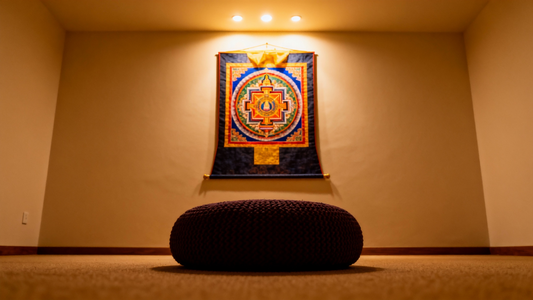

Shakyamuni Buddha: The Life, Enlightenment, and Legacy of the Historical Buddha
Shakyamuni Buddha — born as Siddhartha Gautama around 623 BCE — is the historical founder of Buddhism and one of the most influential spiritual teachers in human history. His teachings on compassion, wisdom, and the nature of suffering have shaped the cultural and philosophical foundations of Asia and continue to inspire millions around the world.
His life story, from prince to enlightened teacher, is not only a spiritual narrative but also a profound human journey of inquiry, courage, and awakening.
To explore traditional Himalayan depictions of the Buddha, view our:
Shakyamuni Buddha – ThangkaMarket
Birth of the Buddha: A Sacred Beginning in Lumbini
Siddhartha Gautama was born in Lumbini (modern-day Nepal) into the royal Shakya clan. His parents were King Śuddhodana and Queen Māyādevī of Kapilavastu.
According to Buddhist tradition, Queen Māyā experienced a prophetic dream of a white elephant entering her right side — symbolizing the descent of an extraordinary being.
During her journey home, she gave birth to Siddhartha standing under a sal tree, a moment honored across Buddhist cultures. Seven days later, Queen Māyā passed away, and the infant prince was raised by her sister, Mahāprajāpatī.
From childhood, Siddhartha demonstrated remarkable intelligence, compassion, and physical strength. Yet, despite a life of privilege, he was deeply reflective and sensitive to the nature of human suffering.
The Four Encounters: The Beginning of His Search for Truth
At age 29, Siddhartha encountered four sights that forever changed his life:
-
An old man → the inevitability of aging
-
A sick man → the reality of illness
-
A corpse → the certainty of death
-
A wandering ascetic → the possibility of liberation from suffering
These encounters awakened a deep existential question:
Why do beings suffer, and is there a path that leads beyond suffering?
This moment is known as the Four Encounters, marking the beginning of the Buddha’s spiritual quest.
Renunciation and the Path of Discipline
Moved by compassion and the desire to understand life’s true nature, Siddhartha renounced his royal life. Leaving behind his palace, wife Yasodharā, and newborn son Rāhula, he embarked on a journey to seek truth.
For six years he practiced extreme asceticism, following traditions of the time. Yet he discovered that self-torment could not lead to liberation.
This realization became the root of one of Buddhism’s most important principles:
The Middle Way — avoiding extremes of indulgence and self-mortification.
Enlightenment Under the Bodhi Tree
At age 35, Siddhartha sat beneath a Bodhi Tree in Bodh Gaya and vowed not to rise until he attained the truth. After a night of profound meditation, he awakened to the ultimate nature of reality, becoming the Buddha — the Enlightened One.
His insights formed the foundations of Buddhism:
The Four Noble Truths
-
Life contains suffering (Dukkha)
-
Suffering has causes (attachment, ignorance)
-
Suffering can be overcome
-
The Eightfold Path leads to liberation
The Eightfold Path
Ethical conduct, mental discipline, and wisdom — a practical guide to freedom.
Three Marks of Existence
-
Impermanence
-
Non-self
-
Nirvana (peace beyond suffering)
These teachings represent a comprehensive understanding of the human condition and continue to guide spiritual seekers today.
Teaching for Forty-Five Years: From Deer Park to the Ganges Plain
The Buddha’s first sermon took place in Deer Park, Sarnath, known as the Turning of the Wheel of Dharma. He taught the Five Ascetics, who became the first Buddhist monks.
For the next 45 years, the Buddha traveled through northern India, teaching kings, merchants, scholars, and ordinary villagers. He established the Sangha, a community of monks and nuns, and emphasized that awakening is available to all, regardless of caste, gender, or background.
At age 80, the Buddha entered Parinirvana under a pair of sal trees in Kushinagar, bringing his earthly life to a peaceful close.
Shakyamuni Buddha in Himalayan Thangka Art
In traditional Nepalese, Tibetan, and Rebgong Thangka painting, Shakyamuni Buddha is depicted with highly symbolic attributes:
✦ Golden Body
Symbolizes wisdom, purity, and enlightened nature.
✦ Right Hand: Bhumisparsha Mudra (Earth-Touching Gesture)
The Buddha calls the earth to witness his victory over illusion and fear.
✦ Left Hand Holding a Begging Bowl
Represents simplicity, discipline, and compassion for all beings.
✦ Monastic Robes
Symbolize renunciation of worldly attachments.
✦ Seated on a Lotus Throne
The lotus represents wisdom arising unstained from the world.
Different regions portray him with subtle variations in color, posture, and ornamentation.
👉 Learn more about regional art styles:
Style Guide – ThangkaMarket
If you're curious how Nepal, Tibet, and Rebgong differ in depicting the Buddha:
👉 Nepal vs Tibet vs Rebgong – ThangkaMarket
The Ten Epithets of the Buddha: A Complete Expression of Awakening
In Buddhist tradition, the Buddha is praised with ten titles, each reflecting an aspect of his supreme qualities:
-
Tathāgata (The Thus-Gone One)
-
Arhat (Worthy of Offerings)
-
Samyak-saṃbuddha (Perfectly Enlightened)
-
Vidyācarana-saṃpanna (Perfect in Knowledge & Conduct)
-
Sugata (Well-Gone)
-
Lokavid (Knower of the World)
-
Anuttara (Unsurpassed One)
-
Purusha-damya-sārathi (Trainer of Beings)
-
Śāstā Deva-Manuṣyāṇām (Teacher of Gods & Humans)
-
Buddha Bhagavān (The Blessed Enlightened One)
These titles represent the spiritual and philosophical completeness of the Buddha.
Cultural & Philosophical Legacy of Shakyamuni Buddha
Shakyamuni’s influence extends far beyond religion. His insights have shaped:
Psychology
Mindfulness and compassion-based therapy originate from his teachings.
Philosophy
The idea of interdependence (Pratītyasamutpāda) is foundational to many Eastern philosophies.
Art & Architecture
Buddhist caves, stupas, murals, Thangka paintings, and temples are rooted in his legacy.
Ethics
Nonviolence, compassion, and wisdom-based ethics have influenced cultures worldwide.
His teachings continue to serve as a guide for those seeking meaning, inner peace, and transformation.
Why Shakyamuni Buddha Remains a Timeless Symbol
People across cultures are drawn to the Buddha because he represents:
-
Wisdom available to everyone
-
Freedom from suffering
-
Compassion without boundaries
-
Balance through the Middle Way
-
Human potential for awakening
In Himalayan art, his image is not only venerated but also appreciated as a profound cultural and philosophical symbol.
👉 Explore hand-painted Shakyamuni Buddha Thangka created by master artists:
Shakyamuni Buddha – ThangkaMarket
Conclusion
The life of Shakyamuni Buddha — his birth, renunciation, enlightenment, and teachings — stands as one of humanity’s most extraordinary stories.
His insights into the nature of suffering, compassion, and liberation continue to illuminate the path for millions.
Whether approached as a spiritual guide, cultural icon, or figure of artistic inspiration, the Buddha remains a timeless source of wisdom and peace.
Previous
White Tara: The Seven-Eyed Goddess of Longevity, Compassion & Healing in Himalayan Buddhism
Next
Medicine Buddha: The Master of Healing, Lapis Light & Compassion in Himalayan Buddhism
Related articles
Long-term Preservation
Dec 14 2025