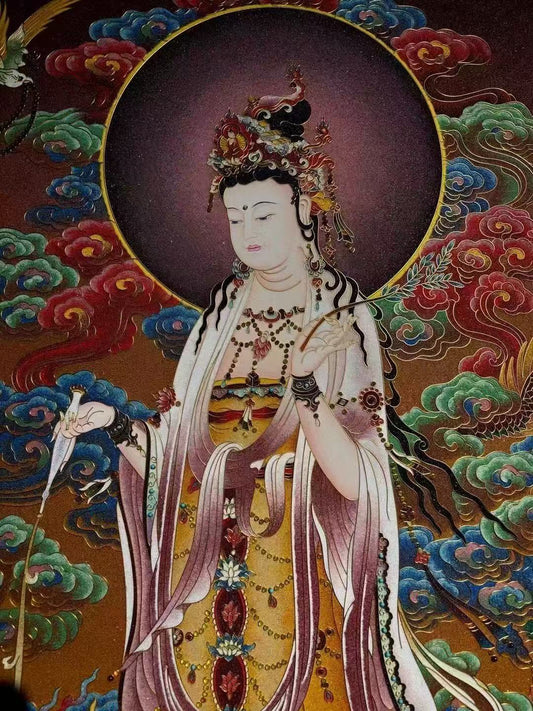

Shakyamuni Buddha: Wisdom, Awakening, and the Art of Rebgong Gemstone Thangka
Shakyamuni Buddha:
Wisdom, Awakening, and the Art of Rebgong Gemstone Thangka
Among all figures in Buddhist tradition, Shakyamuni Buddha holds a unique and foundational place. Unlike symbolic or celestial beings, Shakyamuni represents a historical human journey—one that moves from ordinary life toward awakening through insight, discipline, and compassion.
When depicted through the demanding and refined tradition of Rebgong gemstone thangka, the image of Shakyamuni Buddha becomes more than representation. It becomes a visual reflection on wisdom itself: calm, luminous, and enduring.
The Historical Buddha and the Meaning of Awakening
Shakyamuni Buddha, born as Siddhartha Gautama, lived in ancient India more than 2,500 years ago. His life story is not one of divine intervention, but of conscious choice.
After witnessing suffering—aging, illness, and death—Siddhartha renounced royal life in search of understanding. Through years of meditation and inquiry, he arrived at awakening beneath the Bodhi tree. This awakening was not an escape from the world, but a deep understanding of it.
In Buddhist thought, Shakyamuni Buddha embodies three essential qualities:
-
Renunciation – the courage to step beyond attachment
-
Wisdom – insight born from observation and reflection
-
Compassion – action guided by awareness of others’ suffering
These qualities form the foundation of Buddhist practice across cultures and centuries.
Visual Language of Shakyamuni Buddha in Art
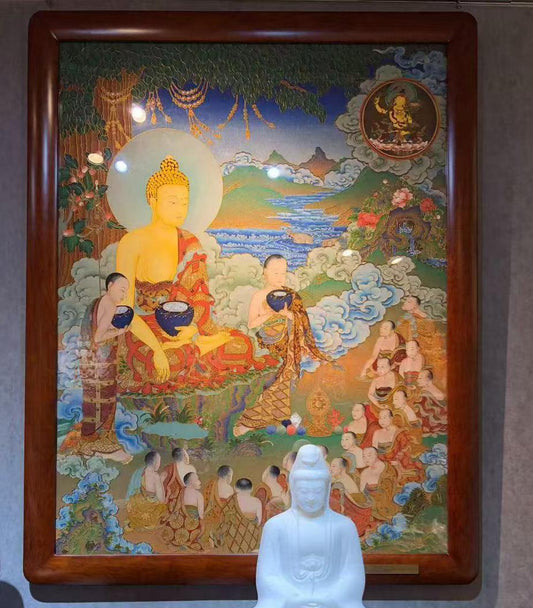
In thangka painting, Shakyamuni Buddha is often depicted seated in a stable, grounded posture, radiating quiet clarity rather than dramatic power.
Common symbolic elements include:
-
Earth-touching gesture (Bhumisparsha Mudra) – witnessing awakening
-
Calm, symmetrical posture – balance and inner stability
-
Simple robes – renunciation and humility
-
Halo or radiance – wisdom illuminating the world
The visual restraint of Shakyamuni Buddha is intentional. Unlike dynamic protector deities or multi-armed bodhisattvas, this image invites stillness. It asks the viewer not to react, but to observe.
Rebgong: Where Discipline Meets Devotion
To understand this artwork, one must understand Rebgong.
Located in the Amdo region of the Tibetan Plateau, Rebgong has long been recognized as one of the most important centers of traditional thangka painting. The region is known for preserving classical techniques with minimal compromise, even as modern materials and shortcuts became widely available elsewhere.
Rebgong artists undergo years—often decades—of training. Precision in proportion, color harmony, and iconographic accuracy is not optional; it is essential.
UNESCO has recognized Rebgong art as Intangible Cultural Heritage, acknowledging not only its visual beauty but also its role in preserving cultural knowledge across generations.
What Is a Gemstone Thangka?
A Gemstone Thangka refers to a traditional painting method that uses natural mineral pigments ground from precious stones and minerals.
This process is slow and demanding:
-
Minerals such as lapis lazuli, malachite, and cinnabar are carefully cleaned
-
They are ground, washed, and refined into usable pigments
-
Colors are applied in layers, sometimes over months
Unlike synthetic paints, mineral pigments are exceptionally stable. Many ancient thangkas painted with gemstone pigments still retain their brilliance centuries later.
In gemstone thangka art, color is not surface decoration—it is depth, weight, and structure.
Why Gemstone Pigments Matter for Shakyamuni Buddha
The image of Shakyamuni Buddha depends on subtlety.
The calm expression, gentle shading, and balanced tones require pigments that can hold depth without harsh contrast. Gemstone pigments provide exactly this quality.
-
Blues and greens suggest vastness and clarity
-
Warm earth tones ground the figure in humanity
-
Soft transitions preserve the Buddha’s composed presence
The result is an image that feels steady and luminous without being overpowering—an ideal visual expression of wisdom.
The Aspiration Behind the Image
Traditional Buddhist art often carries with it an unspoken aspiration—an intention rather than a promise.
This Shakyamuni Buddha gemstone thangka reflects a classical wish found in Buddhist teachings:
-
May beings awaken the courage to step beyond suffering
-
May wisdom arise through listening, learning, and reflection
-
May compassion guide every action
-
May the Buddha’s light reach all corners of the world
These are not guarantees of outcome, but reminders of direction.
Pisces and the Symbolic Guardian Association
In traditional cultural interpretation, Shakyamuni Buddha is also regarded as a symbolic guardian associated with Pisces in Western astrology.
This association reflects shared qualities rather than fate or prediction:
-
Empathy and compassion
-
Emotional depth and sensitivity
-
A natural inclination toward reflection and spiritual inquiry
For individuals who identify with Pisces, this connection can add a personal layer of meaning to the artwork—without turning it into superstition.
Art as Presence, Not Promise
One of the most important aspects of Buddhist art is what it does not claim.
A thangka does not promise protection, success, or transformation. Instead, it offers:
-
A visual anchor for contemplation
-
A reminder of values such as wisdom and compassion
-
A connection to centuries of artistic and philosophical tradition
Placed in a study, meditation room, or living space, a large-format thangka becomes part of daily rhythm—quietly present, never demanding.
A Contemporary Rebgong Masterpiece
Large gemstone thangkas require time, discipline, and rare materials. As a result, they are increasingly uncommon in the modern world.
This Shakyamuni Buddha Rebgong Gemstone Thangka, with a painting size of 128 × 75 cm, represents the continuation of a living tradition rather than a reproduction of the past.
For those interested in viewing the complete artwork and its details, the full piece can be found here:
👉 https://thangkamarket.com/collections/shop-thangka/products/shakyamuni-buddha-rebgong-gemstone-thangka-hand-painted-with-natural-mineral-pigments-pisces-guardian-128-75-cm
Choosing Wisdom as a Daily Companion
In an age defined by speed and distraction, traditional thangka art offers something rare: stillness with depth.
Shakyamuni Buddha reminds us that wisdom is not sudden revelation, but a process—one that unfolds through awareness, restraint, and compassion.
A Rebgong gemstone thangka does not ask to be believed in.
It asks only to be seen, reflected upon, and lived with.
Previous
Dragon-Riding Avalokiteshvara: Compassion, Protection, and the Art of Rebgong Gemstone Thangka
Next
Green Tara in Rebgong Gemstone Thangka: Compassion in Action, Preserved in Mineral Color