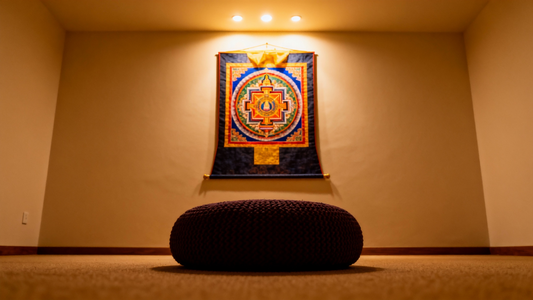

Avalokiteshvara (Chenrezig): The Bodhisattva of Infinite Compassion & the Universal Listener of the World
Avalokiteshvara — known as Chenrezig in Tibetan Buddhism and Guanyin in East Asian traditions — is the most widely revered bodhisattva in Mahayana Buddhism. He embodies the infinite compassion of all Buddhas, the unshakeable commitment to relieve suffering, and the ability to appear in any form to help beings in need.
His name means “The One Who Perceives the Sounds (or Cries) of the World,” reflecting his vow to respond to the suffering of every living being.
👉 Explore Avalokiteshvara / Chenrezig Thangkas:
Avalokiteshvara (Chenrezig) – ThangkaMarket
1. Name & Meaning: Avalokiteshvara → Avalokita → Guanyin → Chenrezig
The evolution of Avalokiteshvara’s name tells a rich story of linguistic, cultural, and philosophical transformation.
✦ Avalokita — “One who gazes upon”
✦ Ishvara — “Lord” or “Master” (later avoided to prevent misunderstanding)
Thus, the original Sanskrit meaning is “The One Who Looks Down with Compassion.”
In China, the early translation “Guanyin” meant “Perceiver of the World’s Sounds.”
Later, to avoid implying sound only, it evolved into “Guanzizai” — “One who observes with perfect freedom.”
In Tibet, he became Chenrezig, meaning “The One with an All-Seeing, Compassionate Gaze.”
This linguistic journey reflects a profound truth:
Compassion has no fixed form. It adapts to every culture, every language, every heart.
2. The Origin Story: Avalokiteshvara’s Compassion Overflows
Stories throughout Buddhist traditions describe Avalokiteshvara’s origin as a symbol of infinite compassion.
✦ He vowed never to rest until all beings were liberated.
When he saw the world’s suffering was endless, his body broke open — not in despair, but in overwhelming compassion.
✦ From this, the manifestations of Tara emerged.
Green Tara and White Tara are considered emanations of his compassion, acting swiftly to rescue beings.
This myth expresses that:
-
Compassion multiplies
-
Compassion transforms
-
Compassion gives rise to new ways of helping
3. The Universal Responder: Avalokiteshvara’s “33 Forms of Manifestation”
In the Universal Door Chapter of the Lotus Sutra, Avalokiteshvara appears in any form necessary to help beings:
-
King, minister, monk, Brahmin
-
Woman, girl, mother, elder
-
Warrior, deity, youth
-
Even in terrifying or humble forms
This is one of Avalokiteshvara’s most important doctrines:
✔ Compassion takes the form you need
✔ Help arrives in the language you understand
✔ There is no “fixed shape” to mercy
It also explains why:
-
Tibet worships Chenrezig as a gentle male figure
-
China worships Guanyin as a compassionate female form
-
Nepal reveres him as both a bodhisattva and a deity of protection
He is universal by design.
4. Avalokiteshvara and Amitabha: Father, Teacher, and Source
In Buddhist cosmology:
-
Avalokiteshvara is the emanation of Amitabha Buddha
-
Amitabha serves as his spiritual root and source of compassion
-
Avalokiteshvara and Mahasthamaprapta form the Three Saints of the Western Pure Land
This relationship is key to understanding the Avalokiteshvara family:
✔ Amitabha = Infinite Light & Wisdom
✔ Avalokiteshvara = Compassion in Action
✔ Mahasthamaprapta = Spiritual Strength & Insight
This triad is one of the most common themes in Himalayan and East Asian art.
5. The Many Iconic Forms of Avalokiteshvara
🔹 Two-Armed Avalokiteshvara (Simple Form)
Peaceful, white-bodied, holding a lotus — symbolizing pure compassion.
🔹 Four-Armed Chenrezig
The most beloved form in Tibet.
His four arms represent the Four Immeasurables:
-
Love
-
Compassion
-
Joy
-
Equanimity
He often holds:
-
A crystal rosary (unceasing compassion)
-
A lotus (purity)
-
Hands in the prayer gesture (loving commitment)
🔹 Eleven-Headed Avalokiteshvara
Created to see all realms of suffering simultaneously.
The topmost head is Amitabha, symbolizing Avalokiteshvara’s origin.
🔹 Thousand-Armed, Thousand-Eyed Avalokiteshvara
Each of the thousand hands contains an eye — meaning:
-
He sees all suffering
-
He responds to all suffering
-
He protects all beings
This is one of the most important tantric forms and symbolizes omnipresent compassion.
6. The Six-Syllable Mantra: OM MANI PADME HUM
Avalokiteshvara’s mantra is the most famous in Tibetan Buddhism.
OM MANI PADME HUM
A traditional interpretation:
-
OM → Universal sacred sound
-
MANI (“jewel”) → Compassion
-
PADME (“lotus”) → Wisdom
-
HUM → Unity of both qualities that transforms the heart
Together, the mantra means:
“May compassion and wisdom bloom in the heart of every being.”
Its rhythm and sound structure make it widely used in meditation worldwide.
7. Iconography in Himalayan Thangka Art
Avalokiteshvara’s artistic symbolism is rich and refined:
✦ White body
Represents purity, empathy, and unconditional kindness.
✦ Lotus flower
Indicates compassion arising unstained from worldly conditions.
✦ Deer-skin shawl
Symbolizes gentleness and non-harm.
✦ Crown and jewels
Show his role as a Bodhisattva who actively engages with the world.
✦ Peaceful gaze
Indicates deep listening and presence.
To explore style differences across Nepal, Tibet, and Rebgong:
Nepal vs Tibet vs Rebgong – ThangkaMarket
To understand the artistic systems (Menri, Gadri, Newar styles):
Style Guide – ThangkaMarket
8. Avalokiteshvara in China: From Bodhisattva to Guanyin
Your PDF highlights Guanyin’s special status in Chinese culture:
-
One of the Four Great Bodhisattvas
-
Protector of sailors, fishermen, travelers
-
Patron of mothers, children, and families
-
Appears in countless folk stories
-
Worshipped in temples, households, and shrines across East Asia
Important dates:
-
2/19: Birth
-
6/19: Enlightenment
-
9/19: Renunciation
Guanyin’s shift from male to female form in China symbolizes:
✔ Compassion as nurturing
✔ Mercy as motherly
✔ Caring wisdom made approachable
This gender transformation is one of the most fascinating cultural evolutions in Buddhism.
9. The Psychological & Modern Interpretation of Avalokiteshvara
Today, Avalokiteshvara resonates globally because he represents:
✔ Deep listening
✔ Emotional safety
✔ Empathy without judgment
✔ Courage in the face of suffering
✔ Compassionate action
In modern psychology, he can be seen as:
-
The archetype of empathetic presence
-
A symbol of secure attachment
-
A reminder to remain open-hearted
-
An image for compassion meditation
His mantra is used not only in religious contexts but also in mindfulness, wellness, and sound healing.
10. Why Collectors Love Avalokiteshvara Thangka
✓ Universally recognized symbol of compassion
✓ Beautiful white and gold palette
✓ Powerful emotional presence
✓ Rich traditional iconography
✓ Central figure in Tibetan culture and the Dalai Lama lineage
Browse the collection:
Avalokiteshvara (Chenrezig) – ThangkaMarket
Conclusion: The Heartbeat of Compassion in the Buddhist World
Avalokiteshvara is more than a deity — he is a timeless reminder that compassion is both:
✦ the root of wisdom
✦ and the path to freedom
He listens to every cry, responds to every need, and appears in every form required.
Whether approached as a spiritual protector, cultural icon, or masterpiece of Himalayan art, Avalokiteshvara remains the world’s most enduring symbol of unconditional compassion.
Previous
Green Tara: The Swift Liberator, Mother of Compassion & Fearless Protector in Himalayan Buddhism
Next
Manjushri: The Bodhisattva of Transcendent Wisdom, Brilliant Insight & Fearless Clarity
Related articles


Long-term Preservation
Dec 14 2025