

Manjushri: The Bodhisattva of Transcendent Wisdom, Brilliant Insight & Fearless Clarity
Manjushri — Sanskrit Mañjuśrī, meaning “Gentle Glory” or “Wondrous Auspiciousness” — is one of the most revered Bodhisattvas in Mahayana Buddhism. He embodies Prajñā, the perfection of wisdom, and represents the deep insight that realizes the nature of reality beyond illusion, conceptual thought, and dualistic perception.
Recognized across India, Tibet, Nepal, and East Asia, Manjushri is celebrated as:
-
The Bodhisattva of Supreme Wisdom
-
The Teacher of Past Buddhas
-
The Personification of Prajñāpāramitā
-
The Guide who illuminates the path to enlightenment
In Chinese Buddhism, he is one of the Four Great Bodhisattvas, representing wisdom just as Avalokiteshvara embodies compassion, Samantabhadra represents practice, and Kṣitigarbha represents vows.
👉 Explore the Manjushri Thangka Collection:
Manjushri – ThangkaMarket
1. Origin & Scriptural Role: The Voice of Wisdom in the Mahayana Canon
Manjushri appears in many of the most influential Mahayana sutras, often engaging in profound philosophical dialogues with the Buddha. He is a central figure in:
-
The Prajñāpāramitā Sutras
-
The Avatamsaka (Flower Garland) Sutra
-
The Lotus Sutra
-
The Vimalakīrti Sutra
In these texts, Manjushri serves as a:
✔ Debater of emptiness
✔ Instructor of Bodhisattvas
✔ Revealer of non-duality
✔ Clarifier of ultimate reality
He is also described as “teacher of the seven past Buddhas”, highlighting his timeless, primordial nature. In many traditions, he is considered a manifestation of the wisdom essence of all Buddhas.
2. Meaning of His Name: Gentle, Auspicious Wisdom
The Sanskrit components of his name convey a deep philosophical meaning:
-
mañju — gentle, harmonious, beautiful
-
śrī — glory, virtue, auspiciousness
Manjushri is therefore not harsh or destructive.
He represents:
✦ Wisdom that is elegant
✦ Insight that is luminous
✦ Clarity that is fearless yet gentle
This helps Western readers understand why his sword symbolizes not violence but illumination.
3. Iconography: The Philosophical Language of Manjushri’s Form
Manjushri’s imagery is among the most symbolically sophisticated in Buddhist art.
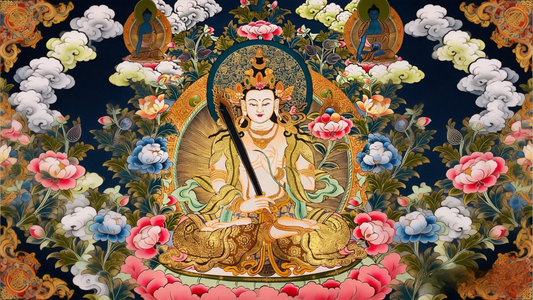
The Flaming Sword of Wisdom (Khādga)
-
Held in the raised right hand
-
Cuts through ignorance, illusion, and conceptual fixation
-
Flame symbolizes self-arising insight and penetrating clarity
-
Represents the “lion’s roar” of truth
This is not a weapon, but a metaphor for transformative understanding.
The Lotus and Prajñāpāramitā Sutra
The left hand holds a lotus, upon which rests the Book of Wisdom.
This text represents:
-
Perfect wisdom
-
Non-dual reality
-
The philosophical foundation of Mahayana Buddhism
Youthful Appearance — The Child of Wisdom
Manjushri is portrayed as young because:
-
True wisdom is pure, fresh, uncorrupted
-
Insight is open and flexible
-
A child’s mind symbolizes the “original mind” free from bias
Lion Mount
The lion signifies:
-
Courage of truth
-
Majestic confidence
-
Fearlessness in proclaiming wisdom
To explore artistic style differences:
https://thangkamarket.com/collections/learning-center-origin-comparison-nepal-vs-tibet-vs-rebgong
https://thangkamarket.com/collections/learning-center-style-guide
4. The Three Qualities of Manjushri: Wisdom, Eloquence, Courage
Drawing from traditional commentaries and your PDF, Manjushri embodies three core virtues:
1️⃣ Wisdom
Understanding emptiness, dependent origination, and the true nature of phenomena.
2️⃣ Eloquence
His speech clarifies subtle truths, dispels confusion, and articulates the Dharma with luminous precision.
3️⃣ Courage
The bravery to confront ignorance without hesitation.
Wisdom requires moral and intellectual courage — Manjushri represents this fearless clarity.
5. Manjushri as the Personification of Prajñāpāramitā (The Mother of All Buddhas)
In Mahayana philosophy, Prajñāpāramitā (the Perfection of Wisdom) is considered the “mother of all Buddhas.”
Manjushri is often regarded as:
-
The embodied form of Prajñāpāramitā
-
The active wisdom that guides beings on the path
-
The source of Buddha-knowledge
Thus, he does not simply teach wisdom — he is wisdom.
6. Manjushri in the Vimalakīrti Sutra: The Great Debate
One of Manjushri’s most famous appearances is in the Vimalakīrti Sutra, where:
-
He engages in a profound dialogue on non-duality
-
Only he dares question the lay sage Vimalakīrti
-
Their conversation reveals the essence of emptiness and the limits of conceptual thought
This episode is treasured by Buddhist philosophers and academics worldwide.
7. Manjushri’s Ten Great Vows
Traditional texts describe his aspirations, including:
-
Perfect wisdom
-
Unblocked eloquence
-
Fearless teaching
-
Liberation of all beings
-
Perpetual clarity of mind
-
Mastery of meditation
-
Skillful means and compassion
These vows underline his role as both a teacher and a guide.
8. The Manjushri Mantra: The Seed of Wisdom
The most famous mantra is:
OM AH RA PA TSA NA DHIH
-
“AH RA PA TSA NA” represents the five syllables of wisdom
-
“DHIH” is the essence of Manjushri’s enlightened mind
Traditionally believed to:
-
Enhance memory and intelligence
-
Deepen meditation
-
Support academic study
-
Increase clarity and eloquence
It is one of the most widely recited mantras by students and scholars in Buddhist cultures.
9. The Triad: Manjushri, Samantabhadra, and Avalokiteshvara
Together, they symbolize the three pillars of Buddhist practice:
| Bodhisattva | Symbolizes |
|---|---|
| Manjushri | Wisdom |
| Samantabhadra | Virtue & practice |
| Avalokiteshvara | Compassion |
This triad represents the complete path to enlightenment.
10. Manjushri in Tibetan, Nepalese & Chinese Buddhism
In Tibet
Manjushri is revered as the primary source of wisdom for scholars, monks, and meditators. Many Tibetan intellectual lineages trace their origin to him.
In Nepal
He is associated with the mythic draining of Kathmandu Valley, symbolizing wisdom shaping civilization.
In China
He is the patron Bodhisattva of Mount Wutai, where countless monasteries honor his presence.
This geographical diversity reflects his universal appeal.
11. Why Manjushri Remains Timeless
For contemporary readers, Manjushri symbolizes:
-
Intellectual clarity
-
Emotional intelligence
-
Courageous self-honesty
-
The ability to see things as they truly are
His sword still speaks to modern challenges:
The real ignorance to cut through is confusion, bias, fear, and false certainty.
12. Why Collectors Love Manjushri Thangka Art
✓ Powerful, iconic symbolism
✓ Philosophically profound
✓ Visually striking (sword, book, lion, youthful form)
✓ Ideal for study rooms, meditation halls, academic settings
✓ Represents clarity and insight — qualities valued globally
👉 Explore Manjushri artworks:
Manjushri – ThangkaMarket
Conclusion: Manjushri as the Radiant Wisdom of the Buddhist World
Manjushri stands as the luminous embodiment of transcendental wisdom.
He represents the clarity that dissolves confusion, the insight that reveals the nature of reality, and the courage to face truth directly.
Where compassion hears and responds, wisdom sees and understands.
Manjushri is the illuminated mind that guides beings on the path to awakening — timeless, fearless, and forever youthful.
Previous
Avalokiteshvara (Chenrezig): The Bodhisattva of Infinite Compassion & the Universal Listener of the World
Next
Guru Rinpoche (Padmasambhava): The Second Buddha, Tantric Master & Protector of the Himalayas
Related articles
Long-term Preservation
Dec 14 2025