

Mahakala (The Great Black Protector): The Supreme Guardian of Tibetan Buddhism
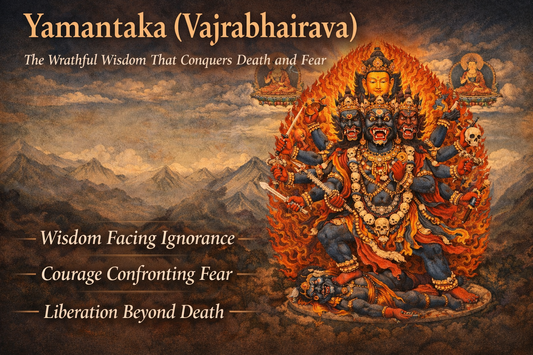
Mahakala — known as Gonpo, “The Great Protector,” in Tibetan — is one of the most powerful and revered Dharma Guardians (Dharmapālas) in Vajrayana Buddhism. His terrifying appearance hides a profound truth: Mahakala is compassion transformed into unstoppable protective power.
His most iconic form is the Six-Armed Mahakala (Shadbhuja Mahakala), the principal protector of many Tibetan lineages and the guardian deity of monasteries across the Himalayas.
👉 Explore the Mahakala Thangka Collection:
Mahakala – ThangkaMarket
1. The True Nature of Mahakala: Why Wrath = Great Compassion
To the untrained eye, Mahakala appears fearsome — flames burn around him, fangs protrude, and his hands grasp fierce implements.
But in Vajrayana Buddhism:
Wrath is compassion in its most active form.
Mahakala is not angry at beings — he is angry for beings, destroying what harms them.
His wrath is the energetic force that:
✦ Cuts through ignorance
✦ Removes obstacles
✦ Protects practitioners
✦ Guards the continuity of the Dharma
This is why he is called the King of Protectors.
2. Mahakala’s Origins: Three Major Lineages of His Identity
Your PDF highlights three equally important origins, explaining why Mahakala has many faces across Buddhist cultures.
1. Wrathful Manifestation of Avalokiteshvara (Chenrezig)
This is the most widespread Tibetan belief.
Compassion transforms into fierce energy to fight ignorance.
2. Subjugated Form of Shiva (Maheshvara)
Indian Buddhist scriptures describe the transformation of Shiva into a Dharma Protector.
This symbolizes converting outer power into inner wisdom.
3. Wrathful Form of Vajrapani or Other Tantric Deities
Some esoteric texts associate Mahakala with fierce expressions of Vajrapani, the embodiment of Buddha’s power.
Together, these origins reflect Mahakala’s multi-layered nature — compassionate, protective, fierce, and cosmic.
3. Scriptural Sources: Where Mahakala Appears in Tantric Texts
The PDF mentions that Mahakala’s rituals and iconography derive from key tantric texts, including:
-
The Great Black One’s Manifestation Tantra (Mahakala Sādhanā)
-
The Origin Tantra of the Great Black One
-
The Ācārya Rituals of Mahakala
These texts describe:
-
His form
-
His mantra
-
His offerings
-
His wrathful dance
-
His function in monastic and tantric practice
This establishes Mahakala as a classical tantric deity with a stable textual foundation.
4. Why He Has Six Arms: The Secret Symbolism
The six arms of Mahakala represent far more than strength.
✔ Six Perfections (Pāramitās)
-
Generosity
-
Ethics
-
Patience
-
Diligence
-
Meditation
-
Wisdom
✔ Six Realms of Existence
Mahakala liberates beings from all cycles of samsara.
✔ Six Forms of Enlightened Action
Compassion that reaches in all directions.
Thus, the six arms symbolize the totality of awakened activity.
5. The Six Implements: Tools of Transformation
The PDF gives a detailed explanation of each item.
In Mahakala’s six hands, he holds:
1. Chopper (Kartika)
Cuts ego, attachment, and delusion.
2. Skull Cup (Kapala)
Overflows with the nectar of transformed ignorance.
3. Trident (Trishula)
Destroys the three poisons: desire, anger, ignorance.
4. Noose
Captures and tames harmful forces.
5. Drum (Damaru)
Its sound summons wisdom and dispels illusion.
6. Rosary or Hook
Continuous compassionate activity that draws beings to liberation.
These items encode Mahakala’s entire spiritual function into symbolic form.
6. Iconography: Understanding His Wrathful Form
Every element of Mahakala’s appearance carries spiritual meaning:
Black/Dark Blue Body
Symbolizes:
-
Infinite consciousness
-
Ability to absorb negative energies
-
Vast emptiness from which wisdom arises
Flaming Aura
Wisdom fire consuming ignorance.
Three Eyes
Sees past, present, and future simultaneously.
Tiger Skin Garment
Represents fearlessness and mastery over desire.
Human-Skin Shawl
Represents the stripping away of ego and ignorance.
Garland of Fifty Skulls
Letters of the Sanskrit alphabet → transformation of speech into mantra.
Crown of Five Skulls
Represents the transformation of the five poisons into five wisdoms.
This is why Mahakala Thangkas are among the most symbolically rich artworks in Vajrayana.
To compare painting styles:
Nepal vs Tibet vs Rebgong – ThangkaMarket
To learn more about Thangka styles:
Style Guide – ThangkaMarket
7. The Many Forms of Mahakala
Your PDF emphasizes that Mahakala appears in multiple forms, including:
✔ Two-Armed Mahakala
Compact, fierce, popular in Karma Kagyu.
✔ Four-Armed Mahakala
Associated with stability and ritual protection.
✔ Six-Armed Mahakala
The universal protector, central in Tibetan monasteries.
✔ Regional Forms
-
Bull-mounted Mahakala
-
Cloaked Mahakala
-
Dancing Mahakala
Each serves a unique cultural and ritual function.
8. Mahakala’s Role in Ritual: The Four Enlightened Activities
Mahakala is invoked for the Four Activities of Vajrayana:
1. Pacifying (Shanti)
Removing obstacles, illness, fear, environmental negativity.
2. Increasing (Pushti)
Enhancing prosperity, health, longevity, and wisdom.
3. Magnetizing (Vashya)
Attracting positive opportunities, harmony, and cooperation.
4. Subjugating (Rudra)
Overcoming powerful negative forces, inner or outer.
Few protectors can perform all four — Mahakala is one of them.
9. Mahakala in Tibetan Monasteries
Your PDF vividly describes real-life devotion:
✔ Placed at monastery entrances
✔ Daily “morning Mahakala offerings”
✔ Ritual dances depicting his protector form
✔ Fire offerings (Homa) for purification
✔ Black offerings (black foods, black incense)
✔ Guardian of monks during retreats
✔ Protector invoked during empowerments
This makes him a living deity, not merely symbolic.
10. Mahakala in the “Bardo” (Tibetan Book of the Dead)
PDF notes that Mahakala appears in the after-death intermediate state as:
-
A wrathful form guiding the deceased
-
A force that helps recognize the true nature of mind
-
A protector who cuts through illusions of the bardo
His wrath is meant to awaken, not to frighten.
11. Why Mahakala Is the Most Popular Protector Deity
Mahakala is found in:
-
Homes
-
Monasteries
-
Mountain passes
-
Trade routes
-
Nomadic tents
-
Ritual arenas
-
Pilgrimage sites
Reasons for popularity:
✔ Removes everyday obstacles
✔ Protects travelers
✔ Safeguards wealth & livestock
✔ Guards spiritual lineage teachings
✔ Neutralizes harmful spirits
This real-world relevance is why Mahakala is so beloved.
12. Mahakala vs. Black Jambhala: Common Misunderstanding
PDF suggests clarifying this distinction:
Mahakala
-
Protector deity
-
Wrathful form of Avalokiteshvara
-
Removes obstacles and negative forces
Black Jambhala
-
Wealth deity
-
Grants prosperity
-
Not a Dharma Protector
They look similar but belong to different lineages.
13. Transmission Masters & Lineage
Many great masters practiced Mahakala, including:
-
Naropa
-
Shantideva
-
Longchenpa
-
Milarepa (in some stories)
-
Numerous Tertons who revealed protector practices
His teachings spread across the Nyingma, Kagyu, Sakya, and Gelug traditions.
14. Why Collectors Love Mahakala Thangkas
✓ Bold, dramatic visual impact
✓ Deep symbolic meaning
✓ Strong protective presence
✓ Highly revered across all Tibetan schools
✓ Complex iconography ideal for study
👉 View Mahakala artworks:
Mahakala – ThangkaMarket
Conclusion: Mahakala, the Fierce Heart of Compassion
Mahakala embodies the truth that awakening requires courage.
His flames burn away illusion.
His chopper cuts through ego.
His roar shakes ignorance to its core.
He is:
✦ The protector of wisdom
✦ The guardian of practitioners
✦ The transformer of negativity
✦ The fierce expression of boundless compassion
Mahakala remains one of the most powerful, beloved, and essential deities in Vajrayana — a reminder that true compassion sometimes must be fierce, and true wisdom sometimes must take a terrifying form to protect the Dharma.
Previous
Guru Rinpoche (Padmasambhava): The Second Buddha, Tantric Master & Protector of the Himalayas
Next
What is Mandala?The Ultimate Guide to Mandala Sacred Geometry, Himalayan Wisdom, and the Inner Path to Awakening
Related articles
Long-term Preservation
Dec 14 2025