If you're captivated by the intricate beauty of Thangka art and are considering acquiring one for collection or home decor, you’ll likely encounter three main styles: Nepalese Thangka, Tibetan Thangka, and Rebgong Thangka. Each style carries unique cultural roots, artistic characteristics, and value positioning—making them particularly important for collectors exploring the world of sacred Eastern art.
This article will delve into the core differences between Nepalese, Tibetan, and Rebgong Thangka, covering artistic styles, production techniques, cultural significance, and collector value. Whether you are a first-time buyer or an experienced collector, this guide will help you make an informed decision. Additionally, we will share practical tips on how to authenticate and maintain Thangkas over time.
What is Thangka Art? A Brief Introduction
Thangka (often translated as Thangka or Thanka in English) is a traditional Tibetan Buddhist scroll painting originally created as a visual aid for religious practices and meditation. Over hundreds of years, it has become a highly respected art form, spreading across the Himalayas and Tibetan regions, gradually forming different regional styles.
Nepal, Tibet, and Rebgong (a region in Qinghai, China) are the three main centers for Thangka production. Each style reflects the local culture, religious traditions, and artistic techniques, making them distinct in appearance and value. Below, we will explore their unique features in greater detail.
Nepal vs Tibet vs Rebgong Thangka: Core Differences
1. Cultural Origins and Religious Significance
Nepalese Thangka: The "Origin Influencer" of Hindu-Buddhist Fusion
Nepal is widely regarded as one of the birthplaces of Thangka art, with roots dating back to the Licchavi Dynasty (5th-7th centuries). Unlike the other two styles, Nepalese Thangka blends Hindu and Buddhist imagery—reflecting Nepal’s syncretic religious culture.
-
Cultural Features: Early Nepalese Thangka had a profound influence on the development of Tibetan Thangka. Today, Nepalese Thangka places more emphasis on decoration rather than strict religious orthodoxy, making it more accessible to global art enthusiasts who appreciate its aesthetic appeal without deep knowledge of Tibetan Buddhism.
- Our Nepal thangka:Nepal Thangka – ThangkaMarket
Tibetan Thangka: The Orthodox Sacred Art of Tibetan Buddhism
Tibetan Thangka originated in the 7th century during the Tibetan Empire, specifically created to promote Tibetan Buddhism. It strictly adheres to the “Iconometric Texts” (sacred scriptures that define the proportions of deities), emphasizing religious piety and orthodoxy.
-
Cultural Features: Tibetan Thangka is closely tied to the various Tibetan Buddhist sects (e.g., Gelug, Kagyu, Sakya), each with its own distinct imagery traditions. Its religious significance far exceeds its decorative value, making it the preferred choice for devout practitioners and seasoned collectors.
- Our Tibetan Thangka:Tibet Thangka – ThangkaMarket
Rebgong Thangka: UNESCO Intangible Cultural Heritage of Tibetan-Han Fusion
Rebgong Thangka emerged in the 15th century in the Huangnan Tibetan Autonomous Prefecture of Qinghai, China. It is renowned for blending Tibetan Buddhist art, Han Chinese painting techniques, and local ethnic elements, and is recognized as an intangible cultural heritage by UNESCO.
-
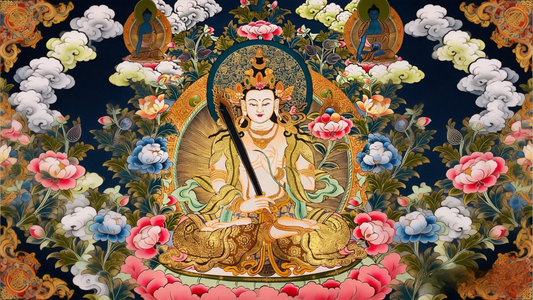
Cultural Features: Rebgong Thangka balances sacredness with artistic expressiveness, incorporating landscapes of the Qinghai-Tibet Plateau (snow-capped mountains, grasslands) and Han Chinese decorative motifs (cloud patterns, peonies). This fusion makes it highly attractive to collectors seeking cultural depth and visual impact.
- Our Rebgong Thangka: Rebgong Thangka (Amdo) – ThangkaMarket
2. Artistic Style: How to Differentiate the Three Visually
For collectors, visual differences are often the most obvious distinction. To clarify the characteristics of each style, we compare them across three dimensions: deity representation (including non-human subjects), color schemes, and composition and background.
Deity Representation (Human and Non-Human Subjects)
| Style |
Core Features |
Human Deity Details |
Non-Human Subjects (e.g., Mandalas/Symbols) |
| Nepalese Thangka |
Primarily human deities, minimal non-human subjects |
Faces are rounded and full, eyes are soft and kind, female deities have graceful poses, male deities are gentle without strong authority |
Non-human symbols are simple, such as simplified dharma wheels and lotus patterns; mandalas are rare and simple, used as background elements |
| Tibetan Thangka |
Equal emphasis on human and non-human subjects, with mandalas being prominent |
Faces are solemn and symmetrical, posture is calm and authoritative, clothing is rigid to highlight sanctity |
Mandalas are meticulously symmetrical, symbolizing cosmic order, often with deities and religious symbols at the center; ritual items like vajras are included |
| Rebgong Thangka |
Detailed human deities with rich non-human subjects, blending sacredness with artistry |
Faces are soft yet dignified, with exquisite detail on eyes and hair, poses are both static and dynamic |
Mandalas are intricate, layered with Tibetan mountain landscapes and Han cloud patterns, filled with religious symbols like the Eight Auspicious Symbols |
3. Color Scheme and Artistic Techniques
| Style |
Main Color Scheme |
Preferred Colors |
Paint Texture & Color Gradients |
Color Meaning & Atmosphere |
| Nepalese Thangka |
Soft, warm tones, predominantly light shades |
Pale gold, pink, light blue, off-white, with minimal use of gold |
Light, thin pigments create soft gradients, natural transitions |
Soft gold represents holiness, pink symbolizes gentleness, and light blue evokes tranquility, creating a warm and inviting atmosphere |
| Tibetan Thangka |
Rich, deep tones with high contrast |
Lapis lazuli blue, malachite green, vermilion red, ochre brown, with 24K gold highlights |
Heavy mineral paints with clear boundaries, strong contrast |
Lapis blue represents wisdom, malachite green for nature, vermilion for sanctity, gold for divine light, creating a solemn and sacred atmosphere |
| Rebgong Thangka |
Bright and vivid, high saturation without being gaudy |
Sapphire blue, emerald green, rose red, with prominent gold accents |
Fine, rich pigments create smooth transitions and brilliant effects |
High saturation colors symbolize vitality and divine light, with gold enhancing sacredness and festive atmosphere |
4. Composition & Background
| Style |
Core Composition Logic |
Background Elements |
Spatial and Narrative Elements |
Decorative Elements |
| Nepalese Thangka |
Simple, central deity with minimal background clutter |
Background often includes South Asian motifs like temple spires and tropical flowers |
Flat space with little depth or narrative, primarily focusing on the central deity’s posture |
Simple geometric patterns, flowing lines surrounding the deity |
| Tibetan Thangka |
Strict, formal composition with clear hierarchy, often with mandalas |
Background is minimal, with mountain or cloud motifs from the Tibetan plateau |
Strong sense of stability and solemnity, minimal narrative scenes |
Ritual symbols like dharma wheels and vajras, neatly placed around the deity |
| Rebgong Thangka |
Rich, dynamic composition with layers of elements around the central deity |
Background combines Tibetan landscapes and Han decorative elements, such as peonies and cranes |
Strong narrative elements, often depicting complete religious stories or folk scenes |
Elaborate and detailed decorative elements, such as jewelry, robes, and symbolic motifs |
3. Craftsmanship & Materials: Key Factors for Authenticity
The materials and techniques used in crafting Thangka directly impact its value, durability, and authenticity—this is a key concern for collectors. Here’s a comparison of the craftsmanship for each style:
-
Nepalese Thangka: Uses synthetic paints (acrylic, gouache) and substitutes cheaper metallic powders for real gold, making it affordable but less durable. Commonly printed with hand-coloring and takes around 20 days to complete a single piece.
-
Tibetan Thangka: Uses pure mineral paints (gold, silver, pearls, lapis lazuli) and 24K gold. The painting process is sacred, involving rituals before the artwork. These Thangkas are built to last and can remain vibrant for hundreds of years.
-
Rebgong Thangka: Known for exquisite craftsmanship using gemstone-quality minerals (malachite, lapis lazuli). The gold linework is intricate, and the canvas is treated multiple times for smoothness, ensuring excellent durability.
4. Which Thangka is Right for You? A Collector's Buying Guide
First-time Buyers and Budget-conscious Collectors ($100-$500)
-
Recommended Wall Thangka: Nepalese Thangka, affordable and great for home decor (suitable for minimalist or Nordic styles). Small sizes (30x40 cm, 40x60 cm) with popular subjects like Guanyin or Lakshmi are ideal.
-
Recommended Pendant Thangka: Affordable and versatile, these pendants (usually $50-$200) are perfect for everyday wear and spiritual purposes. Opt for simple designs, such as mini Guanyin or Buddha heads, for daily use.
Experienced Collectors and Religious Practitioners ($2000+)
-
Recommended Wall Thangka: Tibetan Thangka, ideal for serious collectors due to its authenticity and potential for value increase. Choose from certified Tibetan artists with proof of authenticity.
-
Recommended Pendant Thangka: High-end collector’s pieces with miniature hand-painted Thangka pendants made from the same minerals as large Thangkas (lapis lazuli, malachite) and 24K gold highlights.
Home Decor & Balanced Value Seekers ($500-$2000)
-
Recommended Wall Thangka: Choose Rebgong Thangka, which offers stunning decorative effects and rich cultural heritage. It is also suitable for daily religious practice. Popular themes include Sukhavati (depictions of the vibrant Buddhist paradise) and the life story of the Buddha. These narrative works make excellent conversation starters.
-
Recommended Pendant Thangka: You can opt for finely crafted pendant Thangkas for everyday wear, hand-painted with mineral pigments, and paired with gold-plated or sterling silver bases. They are comfortable to wear and have outstanding texture. Some models offer custom themes (such as a personal zodiac-related Buddha pendant), perfect for everyday wear, casual social settings, and various occasions. These pieces offer a balance of decoration, modest collectibility, and practicality for everyday wear. They can also serve as small matching items for home decor, creating a unified Thangka art atmosphere.
Frequently Asked Questions: Common Concerns from Collectors
Q1: Do I need to be a Buddhist to collect Thangkas?
No, you don’t need to! Nepalese and Rebgong Thangkas are often appreciated for their artistic value and decorative charm. As for Tibetan Thangkas, you only need to observe basic placement etiquette (avoid placing them in bedrooms, bathrooms, or other unclean areas)—no need for religious practice.
Q2: How can I distinguish between hand-painted Thangkas and printed Thangkas?
-
Hand-painted: The lines are unique and without repetition; the colors naturally penetrate the back of the canvas; slight differences in details (no “identical Buddha faces”).
-
Printed and filled-in: The lines are stiff and uniform; no color penetration on the back; the design of multiple pieces is identical.
Q3: How should I maintain my Thangka?
-
Mineral pigment Thangkas (Tibetan/Rebgong): Avoid direct sunlight and humid environments; gently wipe once a year with a dry cloth—can remain vibrant for decades.
-
Synthetic pigment Thangkas (Nepalese): Keep away from sunlight; store in a dry place—can last 5-10 years.
Q4: How should I care for a Thangka pendant that I wear daily?
Since Thangka pendants are often worn daily, and their small size and materials (which may include precious metals or gems) require more delicate care, pay close attention to protection during wear and storage:
-
Daily wear: Make sure to remove it when bathing, exercising, or swimming to avoid fading or metal corrosion. Avoid rubbing or colliding with hard objects to prevent damage.
-
Storage: When not wearing, store the pendant in a sealed jewelry box (with soft cloth lining), avoiding pressure, collisions, and damp environments.
-
Cleaning: Dust the surface with a soft brush. Use a special silver cloth or gold cloth for metal parts, and never wash directly with water or use chemical cleaners.
Conclusion: Embrace the Beauty of Thangka Art
Nepalese, Tibetan, and Rebgong Thangkas each open a unique window into the Himalayas and Tibetan culture. Whether you are drawn to the delicate elegance of Nepalese Thangkas, the sacred solemnity of Tibetan Thangkas, or the exquisite fusion of Rebgong Thangkas, the key is to select a piece that resonates with you. Always buy from a trusted seller to ensure authenticity certification.
If you have more questions about selecting or maintaining Thangkas, feel free to leave a comment below or contact our Thangka expert team. We wish you happy collecting!
-