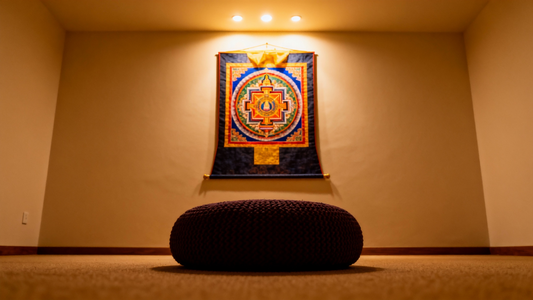

Mandala in Meditation Practice – A Complete Guide
Mandala meditation is a time-honored practice that uses visual form, geometry, and symbolic order to support concentration and inner clarity.
Across spiritual traditions, mandalas have been used not as decoration, but as structured tools for contemplation, helping practitioners organize attention and reflect on the relationship between the inner mind and the outer world.
This complete guide explores mandalas from an educational and practical perspective, explaining what mandalas are, how they function in meditation, and why they remain relevant today — especially through traditional Mandala Thangka art.
What Is a Mandala in Meditation Practice?
The word mandala originates from Sanskrit and broadly means “center” or “that which surrounds a center.”
In meditation, a mandala functions as a visual focus object, guiding attention through symmetry, repetition, and spatial balance.
Rather than attempting to suppress thought, mandala meditation works by:
-
Giving the mind a clear structure
-
Reducing cognitive overload
-
Encouraging gradual inward focus
This makes mandalas especially suitable for practitioners who find purely breath-based or silent meditation difficult.
Historical and Cultural Background
Mandala in Buddhist Traditions
In Tibetan Buddhism, mandalas represent enlightened realms and are used in visualization practices, ritual teachings, and meditation training.
They are often preserved in Thangka paintings, where precise geometry and symbolic color systems are carefully maintained.
Mandala in Other Cultural Contexts
-
Indian traditions use mandalas as symbolic representations of cosmic order
-
East Asian traditions emphasize harmony and balance
-
Modern mindfulness practices adopt mandalas as neutral visual anchors for focus
Across cultures, the common thread is clear: mandalas provide order, orientation, and meaning.
Why Mandalas Support Meditation and Focus
The Role of Geometry
Mandala designs typically feature:
-
A defined center
-
Radial symmetry
-
Repeating geometric patterns
-
Layered structure (center → middle → outer)
This geometry naturally draws attention inward and supports sustained focus without strain.
Order and the Mind
From a cognitive perspective, the human mind responds positively to structured visual systems.
Mandalas provide a sense of completeness and containment, which helps stabilize attention during meditation.
Core Mandala Meditation Approaches
1. Mandala Gazing (Visual Contemplation)
This is the most traditional form of mandala meditation.
General method:
-
Sit comfortably with a straight spine
-
Place the mandala slightly below eye level
-
Begin by observing the center, then slowly trace outward
-
When attention wanders, gently return to the image
Over time, practitioners may close their eyes and mentally reconstruct the mandala, strengthening inner visualization.
2. Mental Visualization of Mandalas
Visualization involves holding the mandala in the mind rather than relying on an external image.
This practice:
-
Trains attention stability
-
Enhances mental imagery
-
Encourages inward reflection
Visualization is widely used in traditional Buddhist meditation systems.
3. Creating Mandalas as a Meditative Process
Mandala creation can also function as a contemplative practice.
Two common approaches:
-
Free-form mandalas — intuitive drawing within a circular boundary
-
Structured mandalas — coloring or drawing within predefined geometric patterns
The emphasis is not artistic skill, but mindful engagement with form and process.
Mandala and Emotional Awareness (Educational Perspective)
In mandala practice, color and form are often discussed symbolically.
Common cultural associations include:
-
Blue — calm and reflection
-
Green — balance and harmony
-
Yellow — clarity and alertness
-
Red — energy and intensity
-
Purple — contemplation and intuition
Rather than diagnosing or treating emotions, mandalas provide a non-verbal way to observe inner states.
Mandala Meditation and Concentration Training
Center-Point Focus
Resting attention on the mandala’s center trains sustained concentration and reduces mental scattering.
Radial Awareness
Following lines outward and back inward aligns attention with breath and rhythm, supporting calm alertness.
These methods are especially useful for beginners developing focus skills.
Mandala and Movement-Based Meditation
Mandala meditation is not limited to seated practice.
Walking Mandala Meditation
By slowly tracing mandala-like paths, practitioners integrate:
-
Body awareness
-
Spatial perception
-
Attention continuity
This approach is particularly effective for those who struggle with stillness.
Mandala vs. Other Meditation Supports
| Method | Primary Focus | Key Difference |
|---|---|---|
| Mandala Meditation | Visual structure | Uses form and geometry |
| Breath Meditation | Sensation | Non-visual |
| Mantra Meditation | Sound | Auditory repetition |
| Candle Gazing | Flame | Single-point focus |
Mandalas are unique in combining visual, symbolic, and spatial awareness.
Is Mandala Meditation Religious?
Historically, mandalas originate within religious traditions.
However, using a mandala as a visual focus tool does not require religious belief.
Today, mandalas are widely used in:
-
Art-based meditation
-
Mindfulness education
-
Cultural and academic study
Context determines meaning — not the form itself.
Mandala Thangka vs. Decorative Mandala Designs
This distinction is especially important for collectors and practitioners.
Mandala Thangka
-
Follows traditional iconographic systems
-
Uses precise geometry and symbolism
-
Painted with mineral pigments and gold
-
Designed for study and meditation
Decorative Mandalas
-
Often purely aesthetic
-
No fixed symbolic system
-
Flexible proportions
Understanding this difference helps users choose mandalas aligned with their intention.
👉 Related Mandala Thangka Collection: Mandala – ThangkaMarket
Who Is Mandala Meditation Suitable For?
Mandala meditation is accessible to:
-
Meditation beginners
-
Visual learners
-
Artists and designers
-
Students of Buddhist philosophy
-
Collectors of sacred art
It requires no special initiation when practiced as visual contemplation.
Key Terms Explained
-
Mandala — A centered symbolic design used for contemplation
-
Visualization — Holding imagery in the mind to stabilize attention
-
Center-point — The focal origin of a mandala
-
Symmetry — Balanced repetition that supports focus
Frequently Asked Questions
What does a mandala represent in meditation?
A mandala represents order, balance, and a focal point for awareness.
Do I need to understand all symbols to use a mandala?
No. Mandalas can support focus even without symbolic knowledge.
Can mandala meditation be practiced daily?
Yes. Short, consistent sessions are generally more effective than occasional long ones.
Are mandalas only used in Buddhism?
No. Mandalas appear across cultures and are widely used in modern mindfulness contexts.
Conclusion
Mandala meditation offers a structured, accessible path to focus and inner clarity.
By combining geometry, symbolism, and visual engagement, mandalas help practitioners cultivate attention without force.
Whether studied academically, practiced meditatively, or appreciated through Mandala Thangka art, mandalas continue to serve as enduring tools for contemplation and understanding.
👉 Learn more about Mandalas and Buddhist Art: Mandala Guide – ThangkaMarket
Previous
Kalachakra Mandala Explained: Meaning, Structure, and Symbolism in Tibetan Thangka Art
Next
Nepal vs Tibet vs Rebgong Thangka: A Complete Guide for Art Collectors & Buyers
Related articles
Long-term Preservation
Dec 14 2025