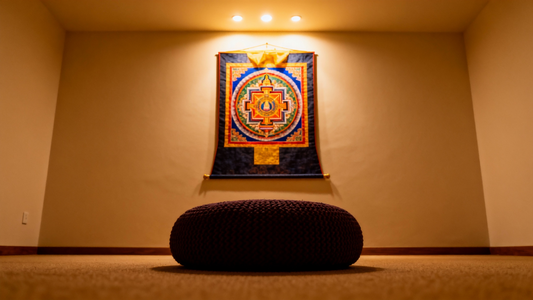

Thangka Gold Gilding Techniques: The Sacred 24K Gold Art in Masterpieces
In the sacred art of Thangka, 24K gold gilding is not just a decorative technique—it is the embodiment of divinity, piety, and supreme craftsmanship. High-level master Thangkas are renowned for their exquisite gold applications: fine line gilding as thin as hair, raised gold relief with strong three-dimensionality, and halo illumination that radiates sacred light. These techniques, combining natural 24K gold with the artist’s decades of skill, endow Thangkas with an irreplaceable noble temperament and long-lasting value. For collectors and art lovers, understanding Thangka gold gilding techniques is the key to appreciating the "sacred luster" of Himalayan art. This article will deeply explore the core techniques of Thangka gold gilding, uncovering the secrets of how 24K gold becomes a carrier of faith in master works.
I. Why 24K Gold Is the Irreplaceable Choice for High-Level Thangkas?
Traditional Thangka masters have always insisted on using 24K pure gold (gold leaf or gold powder) for gilding, rejecting cheap substitutes such as copper powder, alloy powder, or synthetic gold paint. The reason lies in the unique properties of 24K gold and its profound religious and artistic connotations:
1. Religious Symbolism: The Light of the Buddha Incarnated
In Tibetan Buddhism, gold symbolizes the "unblemished and eternal Buddha-nature"—it is pure, indestructible, and radiant, just like the wisdom and compassion of the Buddha. Gilding with 24K gold on Thangkas is a way to "invite the Buddha’s light"—the golden halos, patterns, and decorations are not just visual elements, but the materialization of religious faith. Before gilding, masters must go through strict purification rituals (bathing, fasting, chanting sutras) to ensure that the process is pious and pure, making the gold gilding a part of religious practice.
2. Unique Aesthetic Value: Noble Luster That Transcends Time
24K gold has a warm, soft, and dynamic luster that no synthetic material can replicate. Unlike the dull or harsh shine of copper powder, 24K gold’s luster changes with light angles—sometimes bright and solemn, sometimes gentle and serene. This luster can harmonize with natural mineral pigments (lapis lazuli, malachite, cinnabar), enhancing the layering and sacredness of the Thangka. Even after hundreds of years, the gold gilding on ancient Thangkas still retains its original luster, which is the charm of 24K gold.
3. Supreme Craftsmanship Carrier: Testing the Master’s Skill
Gold gilding is one of the most difficult techniques in Thangka creation. The softness of gold requires the artist to have extremely precise control over strength and speed—whether it is fine line gilding or raised gold relief, a single mistake can ruin the entire work. High-level masters often spend months or even years on the gold gilding part of a single Thangka, which is why 24K gold gilding has become a symbol of the highest craftsmanship level of Thangkas.
4. Long-Term Value Preservation: The Dual Value of Art and Precious Metals
24K pure gold is a precious metal with inherent value, and its value will not depreciate with time. Thangkas with exquisite 24K gold gilding not only have high artistic collection value but also have the property of preserving and appreciating value due to the precious metal itself. This is why high-level gold-gilded Thangkas have always been the top choice for senior collectors.
thangkamarket Gold Thangka – ThangkaMarket
II. Core Gold Gilding Techniques in High-Level Master Thangkas
High-level master Thangkas are distinguished by their diverse and exquisite gold gilding techniques. Among them, fine line gilding, raised gold relief, and halo illumination are the three most representative techniques. Each technique has strict requirements for tools, materials, and operation:
1. Fine Line Gilding: Gold Threads as Thin as Hair
Fine line gilding is the most delicate technique in Thangka gold gilding, mainly used to depict details such as the hair, eyelashes, jewelry patterns, and clothing textures of deities. It requires the artist to have extraordinary patience and control ability:
• Special Tools & Materials: Uses 24K gold powder (ground into ultra-fine particles) mixed with high-purity animal glue (adjusted to a viscous but fluid consistency). The brush is a special "goat hair micro-brush" with only a few hairs at the tip (some even have a single hair), which can draw lines as thin as 0.1mm.
• Operation Process: First, the artist outlines the detail lines with light ink (the ink will be covered by gold and not visible). Then, the gold paste (gold powder + animal glue) is dipped with the micro-brush, and the lines are drawn along the ink outline with uniform strength. The key is to ensure that the gold lines are continuous, smooth, and uniform in thickness—no breaks or unevenness are allowed. For extremely fine details (such as eyelashes), the artist must hold their breath and complete a single line in one go.
• Artistic Effect: The gold lines are as thin as hair, bright and delicate, making the details of the deities more vivid and three-dimensional. For example, the hair of the Buddha depicted by fine line gilding is dense and orderly, showing a soft and natural texture; the jewelry patterns are clear and exquisite, highlighting the noble temperament of the deities.
2. Raised Gold Relief: Sculptural Sense in Two-Dimensional Art
Raised gold relief is a high-level gilding technique that creates a three-dimensional effect on the flat Thangka surface, mainly used to depict important elements such as Buddha halos, lotus thrones, and ritual tools. It is a combination of painting and sculpture, requiring the artist to have a strong sense of space:
• Special Tools & Materials: Uses 24K gold leaf (thickness of 0.1-0.2mm) and a special "gold paste base" (mixed with animal glue, gypsum powder, and a small amount of plant extract to enhance thickness and adhesion). The tools include a relief comb, a small spatula, and a soft brush.
• Operation Process: First, the artist applies a layer of gold paste base on the area to be reliefed, and uses a small spatula to shape the three-dimensional outline (such as the arc of the halo, the layers of the lotus throne) while the base is still wet. Then, the base is dried to a semi-solid state, and 24K gold leaf is carefully pasted on the surface. After the gold leaf is attached, a relief comb is used to press the details (such as the texture of the halo) to ensure that the gold leaf fits closely with the base and does not bubble. Finally, the excess gold leaf is trimmed with a sharp knife.
• Artistic Effect: The gilded area is raised from the canvas, with a strong sculptural sense. When light shines on it, the relief creates obvious light and shadow changes, making the Buddha halo look like it is emitting light, and the lotus throne look lifelike. This technique greatly enhances the sense of hierarchy and sacredness of the Thangka.
3. Halo Illumination: Creating the "Divine Light" of Deities
Halo illumination is a gilding technique specifically for depicting the halos of Buddhas and Bodhisattvas. Its core purpose is to "simulate the divine light with gold", making the deities stand out from the background. It is often used in combination with fine line gilding and raised gold relief in high-level master works:
• Special Tools & Materials: Uses 24K gold leaf (for large-area gilding) and 24K gold powder (for edge detail processing). The glue used is a "gradient glue" with different viscosities—higher viscosity in the center of the halo and lower viscosity at the edge, to achieve a natural gradient effect.
• Operation Process: First, the outline of the halo is drawn with ink. Then, the gradient glue is applied from the center to the edge of the halo (the center is thicker, the edge is thinner). When the glue is half-dry, 24K gold leaf is pasted on the center area of the halo (large-area gilding), and gold powder is used to fill the edge area with the micro-brush to create a gradient effect from bright to soft. Some masters will also add a layer of fine gold lines on the edge of the halo to enhance the sense of hierarchy.
• Artistic Effect: The halo is bright in the center and soft at the edge, just like the divine light emanating from the deity. It makes the deity’s image more solemn and sacred, and the visual focus is naturally concentrated on the deity, which conforms to the religious connotation of "respecting the Buddha and emphasizing the sacred".
4. Special Case: Gold Gilding for Mini Thangka Pendants & Talismans
Mini Thangkas (such as pendants, amulets) have more stringent requirements for gold gilding due to their small size (usually 2-10cm). The core challenge is "miniaturizing high-precision techniques"—every operation must be completed under a magnifying glass, and the tools are more refined:
• Ultra-Mini Tools: Uses micro-brush with a single hair (diameter of 0.05mm) for fine line gilding; uses mini spatula (tip size of 1mm) for small-area raised gold relief; uses tweezers with anti-static function to handle ultra-thin gold leaf (thickness of 0.08mm) to avoid damaging the mini canvas.
• Precision Operation: The gold paste is adjusted to a more viscous consistency to prevent overflow on the small canvas. When gilding, the artist uses a magnifying glass (10-20x magnification) to ensure that the gold lines are accurate and the gold leaf is closely attached. For mini halos, a "point-by-point gilding" method is used—each gold dot is as small as 0.2mm, and the dots are connected to form a halo, creating a delicate gradient effect.
• Protective Treatment: After gilding, a layer of ultra-thin natural wax (beeswax) is applied to the surface of the mini Thangka to protect the gold layer from wear and oxidation (especially important for pendants that are often worn close to the body).
The gold gilding of high-end mini Thangkas often takes 1-2 weeks (even longer than the painting time), and the craftsmanship requirement is no less than that of large-scale master works. The exquisite gold gilding makes the mini Thangkas not only decorative but also carry the sacred connotation of traditional Thangkas.
III. Gold Gilding Differences Among Nepal, Tibet, and Rebgong Thangkas
The gold gilding techniques of the three major Thangka schools vary significantly due to differences in religious traditions, craftsmanship inheritance, and market demands. These differences directly determine the quality and value of the Thangkas:
1. Tibet Thangka: Orthodox and Sacred, Minimalist but Noble
Tibet Thangka’s gold gilding adheres to the principle of "sacredness first, simplicity and precision". It only uses 24K pure gold (gold leaf or gold powder) and strictly follows religious norms in the scope and method of gilding. The techniques are mainly fine line gilding and halo illumination—no excessive decoration, focusing on highlighting the sacredness of the deities. The gold layer is uniform and firm, and the luster is solemn and soft. The entire gilding process is accompanied by religious rituals, and the master will chant sutras while gilding, infusing the work with piety. Tibet Thangka’s gold gilding is "less but refined", and each gold line has a strict religious meaning, making it the first choice for devout believers and senior collectors.
Tibetan Thangka:Tibet Thangka – ThangkaMarket
2. Rebgong Thangka: Exquisite and Diverse, Integrating Artistry and Sacredness
Rebgong Thangka’s gold gilding is the pinnacle of "integrating techniques and artistry". It inherits the orthodoxy of Tibet Thangka’s gold gilding and absorbs the delicate techniques of Han Chinese painting, forming a diverse and exquisite style. It is proficient in all three core techniques (fine line gilding, raised gold relief, halo illumination) and often combines them in one work. For example, the deity’s halo uses raised gold relief + gradient illumination, and the jewelry uses fine line gilding to depict textures. Rebgong masters also innovate the gold paste formula by adding local plant extracts to make the gold layer more shiny and durable. The gold gilding of Rebgong Thangka is "exquisite but not gaudy", balancing sacredness and artistic expression, and is deeply loved by collectors who pursue both quality and visual impact.
- Rebgong Thangka: Rebgong Thangka (Amdo) – ThangkaMarket
3. Nepal Thangka: Simplified and Cost-Effective, Decorative-Oriented
Nepal Thangka’s gold gilding is mainly for cost control and mass production, using a large number of substitutes and simplified techniques. It rarely uses 24K pure gold, and mostly uses cheap copper powder mixed with gold paint (simulating gold luster) or low-purity gold alloy powder. The techniques are simple—only basic brush gilding (no fine line gilding or raised gold relief), and the gold layer is uneven and thin. The gilding scope is small, only used to casually embellish the halo or jewelry, and the decorative effect is simple. The gold layer of Nepal Thangka is prone to fading, oxidation, and peeling (copper powder will turn green when oxidized), which determines that it has low collection value and is only suitable for decorative use.
Nepal thangka:Nepal Thangka – ThangkaMarket
IV. Practical Tips: How to Identify 24K Gold Gilding in Thangkas?
For collectors and buyers, distinguishing between 24K pure gold gilding and cheap substitutes is crucial to judging the value of Thangkas. Here are several practical identification tips:
1. Observe the Luster
24K pure gold has a warm, soft, and dynamic luster. When viewed from different angles, the luster changes naturally—bright but not harsh, soft but not dull. Cheap substitutes (copper powder, gold paint) have a single, rigid luster: copper powder is slightly reddish and dull, and synthetic gold paint is too bright and has a "plastic feeling". You can use a flashlight to irradiate the gilded area—24K gold will reflect soft golden light, while substitutes will reflect harsh or uneven light.
2. Touch the Gold Layer
Gently touch the gilded area with your fingers (wear gloves to avoid oil stains). 24K gold leaf/gold powder gilding has a slight "granular texture" (ultra-fine particles, delicate to the touch), and the raised gold relief has a clear three-dimensional sense. The surface of copper powder or gold paint is smooth and flat, with no granular texture, and some will feel sticky (poor drying of synthetic glue).
3. Test with a Magnet
24K pure gold is non-magnetic, while most substitutes (copper powder, alloy powder) contain magnetic metals (such as iron, nickel). Place a small magnet close to the gilded area—if there is no adsorption, it is likely 24K gold; if there is adsorption, it is definitely a substitute. Note: This method is not applicable to gold leaf gilding with a thin layer (the magnet’s adsorption force is weak), and it needs to be combined with other methods.
4. Check for Oxidation Traces
24K pure gold is extremely stable and will not oxidize or discolor even after long-term storage. Cheap substitutes are prone to oxidation: copper powder will turn green or black, and synthetic gold paint will fade or peel. For old Thangkas, if the gilded area is still bright and has no oxidation traces, it is likely 24K gold; if there is obvious discoloration or peeling, it is a substitute.
V. How to Maintain the Gold Layer of Thangkas?
Although 24K gold is stable, improper maintenance will still cause the gold layer to wear, oxidize, or peel. Here are key maintenance tips to protect the "sacred luster" of the gold gilding:
• Avoid Friction and Collision: The gold layer (especially gold leaf) is thin and easy to wear. Do not rub the gilded area with hands or cloth; avoid collision between the Thangka and hard objects. When storing or carrying mini Thangka pendants, put them in a soft jewelry box to avoid friction with other jewelry.
• Keep Away from Chemicals: Do not let the Thangka come into contact with chemicals such as perfume, cosmetics, and detergents—these substances will corrode the gold layer and cause discoloration. When wearing a Thangka pendant, put on the pendant after spraying perfume and applying cosmetics.
• Control Humidity and Temperature: High humidity will accelerate the oxidation of the gold layer (especially the animal glue used in gold paste). Store the Thangka in a dry, ventilated environment with a relative humidity of 50%-60%. Avoid storing it in high-temperature areas (such as near air conditioners or heaters), as high temperature will melt the glue and cause the gold layer to fall off.
• Regular Gentle Cleaning: Use a soft brush (such as a makeup brush) to gently sweep away the dust on the gold layer. Do not use water or chemical cleaners. For mini Thangka pendants that are often worn, you can use a soft cloth (such as a microfiber cloth) to gently wipe the surface after wearing to remove sweat and dust.
VI. Inheritance and Modern Innovation of Thangka Gold Gilding Craftsmanship
As a precious intangible cultural heritage, Thangka gold gilding craftsmanship has gone through hundreds of years of inheritance and is now facing the dual challenges of preserving traditions and adapting to the times. The inheritance of this craftsmanship relies on the traditional master-apprentice system, while modern innovators are exploring ways to integrate it with contemporary aesthetics and applications, allowing the sacred gold luster to shine in new contexts.
1. Traditional Inheritance: The Master-Apprentice System and the Transmission of Piety
The inheritance of Thangka gold gilding craftsmanship has always adhered to the strict master-apprentice system. Apprentices must first learn religious doctrines and moral norms for 1-2 years to cultivate piety, and only after passing the master’s assessment can they start learning gilding techniques. The master teaches by demonstration—apprentices observe the master’s hand movements, strength control, and even breathing rhythm, and practice repeatedly for years. It usually takes 5-8 years for an apprentice to master the basic gold gilding techniques, and only after more than 10 years of practice can they become a qualified master.
In the inheritance process, the "oral teaching and heart-to-heart transmission" of craftsmanship secrets is crucial. For example, the ratio of gold paste, the time to apply glue, and the strength of burnishing are all passed down from master to apprentice without written records. This traditional inheritance method ensures the purity of the craftsmanship but also limits its popularity—many exquisite techniques are at risk of being lost due to the small number of inheritors.
2. Modern Innovation: Adapting to Contemporary Needs Without Losing Tradition
Faced with the changing market and aesthetic needs, modern Thangka artists are carrying out moderate innovations on the basis of inheriting traditional craftsmanship, mainly focusing on two aspects:
• Improvement of Tools and Materials: On the premise of retaining 24K pure gold as the core material, artists use modern precision tools to assist in creation. For example, using ultra-precision micro-scissors to cut gold leaf, using professional magnifying lamps to improve the accuracy of fine line gilding, and using natural plant-based adhesives with better stability to replace traditional animal glue (reducing the impact of humidity on the gold layer). These improvements do not change the core craftsmanship but improve production efficiency and the durability of works.
• Expansion of Application Scenarios: While retaining traditional large-scale Thangka creation, artists extend gold gilding craftsmanship to small-scale cultural and creative products. In addition to mini Thangka pendants and amulets, they also create gold-gilded Thangka decorative paintings, gold-gilded Buddha statues, and even cooperate with jewelry designers to launch Thangka gold-gilded jewelry. These innovative products make the sacred gold gilding craftsmanship integrate into daily life, attracting more young people to pay attention to and love Thangka art.
3. The Balance Between Tradition and Innovation
Modern innovators emphasize that innovation must not deviate from the core of traditional craftsmanship. For example, even if modern tools are used, the basic processes of fine line gilding, raised gold relief, and halo illumination must be retained; even if applied to new products, the religious connotation and aesthetic essence of Thangka must be respected. Many masters also participate in cultural heritage activities, such as holding craftsmanship exhibitions, opening public courses, and recording teaching videos, to promote Thangka gold gilding craftsmanship to the public and expand the team of inheritors.
Conclusion: The Timeless Luster of 24K Gold in Thangka Art
Thangka gold gilding is a combination of craftsmanship, faith, and aesthetics. The fine line gilding as thin as hair, the raised gold relief with strong three-dimensionality, and the halo illumination that radiates sacred light—these techniques make 24K gold not just a precious metal, but a carrier of divine power and artistic value. The orthodox gilding of Tibet Thangka, the exquisite integration of Rebgong Thangka, and the simplified decoration of Nepal Thangka all reflect the different orientations of craftsmanship and market demand.
For collectors, understanding gold gilding techniques helps to accurately judge the quality and value of Thangkas; for art lovers, appreciating the gold luster of Thangkas is a dialogue with traditional masters, feeling their piety and pursuit of craftsmanship. The next time you admire a high-level Thangka, pay attention to the gold gilding details—it is this timeless luster that makes Thangka art endure for centuries and become a treasure of human civilization.
If you have more questions about Thangka gold gilding, such as how to repair worn gold layers or how to identify high-end mini Thangka gilding, please feel free to leave a comment below or contact our professional Thangka expert team.
Previous
Thangka Canvas Preparation: The Handcrafted Foundation for Exquisite Linework
Next
Menri (Miansa) Style Thangka: The Classical Tibetan Monastic Tradition of Balanced Beauty & Deep Symbolism
Related articles


Long-term Preservation
Dec 14 2025