
Menri (Miansa) Style Thangka: The Classical Tibetan Monastic Tradition of Balanced Beauty & Deep Symbolism
In the rich tapestry of Tibetan Thangka art, the Menri (Miansa) style stands as a cornerstone of classical tradition. Hailed as the most widely preserved monastic painting heritage, it is defined by harmonious composition, bold outlines, rigorous iconography, and profound symbolic meaning. For collectors and enthusiasts seeking to understand the essence of authentic Tibetan Thangka, the Menri style offers a window into the sacred artistic traditions of Tibetan Buddhism—one that has endured for centuries through temple workshops and master-apprentice lineages. This article delves into the core characteristics, craftsmanship, cultural significance, and collection value of the Menri style, illuminating why it remains a revered choice for devout practitioners and discerning collectors worldwide.
I. What Is Menri (Miansa) Style? The Origin of a Classical Tradition
The Menri style, also known as Miansa (meaning "measured painting" in Tibetan), traces its roots to the 14th century, emerging from the Menri Monastery in central Tibet—a key center of the Sakya sect of Tibetan Buddhism. Unlike regional styles shaped by folk influences, the Menri tradition was developed and refined within monastic walls, with a singular focus on propagating Buddhist teachings through art. Its core purpose was to create visual aids for meditation and ritual, emphasizing orthodoxy, clarity, and spiritual resonance over decorative flair.
As the most influential monastic painting tradition, Menri spread across Tibet and neighboring Himalayan regions, adopted by countless temples and workshops. Its strict adherence to religious norms and standardized techniques ensured its preservation over centuries—even as other styles evolved or faded, the Menri tradition remained a benchmark of classical Tibetan Thangka art. Today, it is celebrated not only for its historical significance but also for its timeless aesthetic, which balances sacredness with artistic perfection.
Thangkamarket: Miansa / Menri Style – ThangkaMarket
II. Core Characteristics of Menri (Miansa) Style: The Four Pillars of Classical Beauty
The Menri style’s enduring appeal lies in its four defining characteristics, which work in harmony to create a sense of balance, reverence, and symbolic depth:
1. Balanced Composition: Harmony in Symmetry & Order
At the heart of the Menri style is a commitment to balanced, symmetrical composition—reflecting the Buddhist belief in cosmic order and harmony. Unlike the dynamic, narrative-driven layouts of Rebgong Thangka or the minimalist留白 of Nepal Thangka, Menri compositions are structured around a central deity, with auxiliary figures, sacred symbols, and background elements arranged in strict geometric balance.
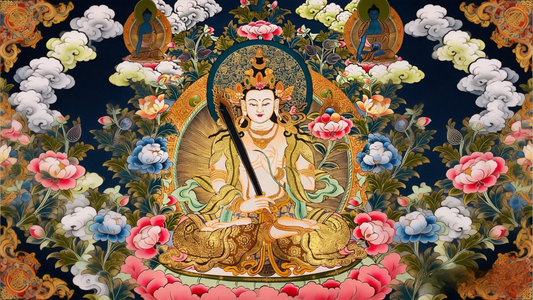
• Central Focus: The main deity (Buddha, Bodhisattva, or Dharma protector) occupies the exact center of the canvas, often seated in a symmetrical posture (e.g., full lotus position) to draw the viewer’s gaze and evoke reverence.
• Hierarchical Arrangement: Auxiliary figures (disciples, Bodhisattvas, or celestial beings) are placed in secondary positions—either flanking the main deity or arranged in upper/lower registers—with their size and placement indicating their religious significance (larger figures = higher status).
• Symmetrical Details: Background elements (mountains, clouds, temples) are mirrored on either side of the central axis, creating a sense of stability and completeness. Even decorative motifs (e.g., lotus petals, auspicious symbols) are repeated in symmetrical patterns.
This balanced composition is not merely aesthetic—it serves a spiritual purpose: to guide the viewer’s mind toward focus and calm, aligning with the meditative intent of Thangka art.
2. Strong Outlines: Bold, Precise Lines That Define Form
The Menri style is instantly recognizable by its bold, unbroken outlines—known as "iron lines" in Tibetan artistic tradition. These lines are the foundation of the style, defining form, separating colors, and conveying a sense of strength and clarity.
• Line Technique: Artists use stiff wolf-hair brushes to create thick, consistent outlines that frame deities, clothing, and sacred symbols. Lines are drawn with a single, confident stroke (no retouching) to ensure fluidity and power—reflecting the artist’s mastery of technique and spiritual focus.
• Contrast & Definition: Outlines are typically rendered in black or deep indigo, creating strong contrast with the rich mineral pigments used for filling. This contrast makes forms stand out sharply, even from a distance, enhancing the Thangka’s visibility during rituals.
• Emotional Resonance: Lines vary slightly in thickness to convey texture—thicker lines for rigid elements (e.g., temple pillars, armor) and slightly thinner lines for soft elements (e.g., fabric, hair). This subtle variation adds depth without compromising the style’s characteristic boldness.
3. Structured Iconography: Strict Adherence to the "Measurement Sutra"
As a monastic tradition, the Menri style places absolute importance on iconographic accuracy—every detail of a deity’s appearance (facial features, posture, attributes) is governed by the Measurement Sutra for Icon Painting (Zaod Xiang Du Liang Jing), a sacred text that standardizes Buddhist iconography to ensure orthodoxy.
• Facial Proportions: Deities’ faces follow strict mathematical ratios—for example, the distance between the eyes equals the width of one eye, the nose length is one-third the height of the face. Features are symmetrical, with solemn expressions (calm eyes, closed lips) that convey wisdom and compassion.
• Attributes & Symbols: Each deity is depicted with specific attributes (e.g., Buddha holds a begging bowl, Guanyin holds a lotus) that are consistent across all Menri works. These attributes are not decorative—they carry precise symbolic meanings, allowing practitioners to identify deities and connect with their energies.
• Posture & Gestures: Deities’ postures (e.g., sitting, standing, reclining) and hand gestures (mudras) are also standardized. For example, the "earth-touching mudra" (Bhumisparsha) of the Buddha symbolizes enlightenment, while the "compassion mudra" (Varada) of Guanyin symbolizes benevolence. These gestures are rendered with exactitude to preserve their spiritual significance.
This strict adherence to iconography makes Menri style Thangkas not just works of art, but reliable tools for religious practice—devotees can trust that the images accurately represent the deities they venerate.
4. Deep Symbolic Meaning: Every Element Tells a Spiritual Story
In the Menri style, no element is arbitrary—every color, symbol, and background detail carries layers of symbolic meaning, reflecting Buddhist philosophy and teachings.
• Colors: Mineral pigments are chosen for their symbolic resonance: gold (Buddha’s light, purity), lapis lazuli blue (sky, wisdom), malachite green (nature, compassion), cinnabar red (life force, sacredness). Colors are applied in solid blocks with minimal blending, emphasizing their symbolic power.
• Sacred Symbols: Backgrounds are adorned with symbols like the Eight Auspicious Symbols (dharmachakra, conch, lotus), which represent aspects of the Buddhist path. For example, the lotus symbolizes purity (growing from mud to bloom), while the dharma wheel symbolizes the Buddha’s teachings.
• Landscapes: Background landscapes are stylized rather than realistic, featuring snow-capped mountains (Tibet’s sacred peaks), calm lakes (purity of mind), and sparse vegetation (detachment from materialism). These elements create a sacred realm that transcends the mundane, inviting viewers to focus on spiritual truths.
III. Craftsmanship of Menri (Miansa) Style: Monastic Rigor & Traditional Techniques
The Menri style’s craftsmanship is as rigorous as its iconography, reflecting the monastic tradition’s commitment to quality and longevity. Every step of the creation process adheres to time-honored techniques, with no shortcuts or modern substitutions:
1. Canvas Preparation: A Foundation of Purity
Menri artists use high-quality linen or cotton canvas, prepared through a complex process that includes stretching, sizing (with animal glue and gypsum), and polishing (with agate or jade). This process takes 7-10 days and is accompanied by religious rituals—artists must purify themselves (bathing, fasting, chanting) to ensure the canvas is a fit vessel for sacred images. The result is a smooth, firm surface that holds mineral pigments and gold leaf without fading or peeling.
2. Pigment Selection: Pure Mineral Colors for Timelessness
Menri style Thangkas use only pure natural mineral pigments—no synthetic substitutes. Artists source high-grade lapis lazuli (from Afghanistan), malachite (from Yunnan, China), cinnabar (from Sichuan, China), and 24K gold powder. Pigments are ground into ultra-fine powder with stone mills, then mixed with animal glue to create a thick, vibrant paste. This commitment to natural materials ensures that Menri Thangkas retain their color for centuries—many 17th-century Menri works are still as vivid as the day they were painted.
Thangkamarket:Mineral Pigment Thangka – ThangkaMarket
3. Gold Application: Restrained yet Sacred
Gold is used sparingly in the Menri style, reserved for key elements like the deity’s halo, jewelry, or sacred symbols. Artists use 24K gold leaf or gold powder, applied with traditional techniques like "cold gilding" (mixing gold powder with animal glue) or "hot gilding" (applying gold leaf to heated glue). The gold layer is thin but uniform, with a soft, solemn luster that contrasts subtly with the bold mineral colors. This restrained use of gold reflects the style’s focus on spiritual meaning over decorative excess.
Thangkamarket:Gold Thangka – ThangkaMarket
IV. Menri Style vs. Other Tibetan Thangka Styles: Key Differences
While the Menri style is a classic Tibetan tradition, it differs significantly from other prominent styles (e.g., Karma Gadri, Rebgong) in terms of purpose, aesthetics, and craftsmanship. The table below highlights the core distinctions:
|
Feature |
Menri (Miansa) Style |
Karma Gadri Style |
Rebgong Style |
|
Origin |
14th-century Menri Monastery (Sakya sect) |
15th-century Karma Kagyu sect |
15th-century Rebgong region (Tibetan-Han fusion) |
|
Composition |
Symmetrical, balanced, central deity focus |
Dynamic, narrative-driven, asymmetrical |
Full, detailed, with rich background stories |
|
Outlines |
Bold, thick, unbroken "iron lines" |
Delicate, fluid lines with shading |
Ultra-fine, detailed lines (like silk) |
|
Iconography |
Strictly adheres to Measurement Sutra |
More creative, with regional variations |
Blends Tibetan norms with Han aesthetics |
|
Purpose |
Monastic ritual, meditation, orthodoxy |
Folk devotion, storytelling |
Decorative, cultural, religious balance |
V. Collecting Menri (Miansa) Style Thangkas: What to Look For
For collectors, Menri style Thangkas are highly sought after due to their historical significance, artistic rigor, and spiritual value. Here are key factors to consider when purchasing:
1. Authenticity: Prioritize Monastic or Master-Apprentice Lineage
Genuine Menri style Thangkas are created by artists trained in the monastic tradition or through strict master-apprentice lineages. Look for certificates of authenticity that confirm the artist’s lineage (e.g., "trained at Menri Monastery" or "disciple of [famous Menri master]"). Avoid works with sloppy iconography (e.g., incorrect hand gestures, mismatched attributes) or synthetic pigments—these are likely modern reproductions.
2. Craftsmanship: Check for Rigorous Technique
• Outlines: Bold, unbroken lines with consistent thickness—no jagged edges or retouching.
• Pigments: Rich, solid mineral colors with a natural luster—avoid faded or uneven colors (signs of synthetic pigments).
• Gold Application: Thin, uniform gold layer with a soft glow—no cheap metal powder (which looks dull or brassy).
• Canvas: Smooth, firm surface with no wrinkles or sagging—indicates proper preparation.
3. Subject Matter: Focus on Core Deities & Symbols
The most valuable Menri style Thangkas feature core Buddhist deities (e.g., Shakyamuni Buddha, Avalokiteshvara, Vajrapani) or mandalas—these subjects are timeless and widely revered. Avoid niche or esoteric subjects unless you are a specialized collector, as they may have limited resale value.
4. Mini Menri Style Pendants: A Accessible Entry Point
For first-time collectors or those seeking daily-wear pieces, mini Menri style pendants are an excellent choice. These pendants replicate the style’s key features (balanced composition, bold outlines, structured iconography) in small sizes (2-5cm), using the same mineral pigments and gold leaf as full-sized Thangkas. They are ideal for spiritual practice, everyday wear, or as a portable piece of sacred art—offering the essence of Menri tradition in a compact form.
VI. How to Care for Menri Style Thangkas
Menri style Thangkas are durable, but proper care is essential to preserve their beauty and spiritual significance:
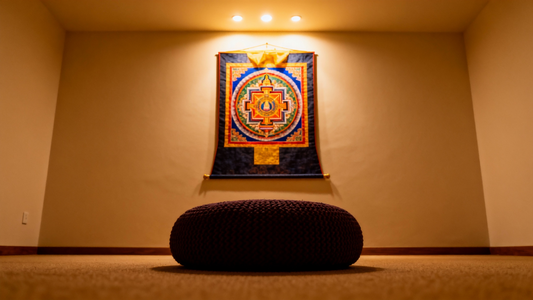
• Avoid Direct Sunlight: Long-term exposure to sunlight will fade mineral pigments and gold leaf. Hang Thangkas in a cool, shaded area away from windows.
• Control Humidity: Keep the environment dry (relative humidity 50-60%) to prevent mold growth and canvas deformation. Avoid hanging in bathrooms or kitchens.
• Handle with Care: Never touch the surface with bare hands (oil and sweat can damage pigments). Use gloves when handling, and avoid folding or rolling the Thangka (frame it or store it flat in a protective case).
• Clean Gently: Dust with a soft brush (e.g., a makeup brush) once a year. Do not use water or chemical cleaners—they will dissolve the animal glue and ruin the pigments.
Conclusion: The Timeless Legacy of Menri (Miansa) Style Thangkas
The Menri (Miansa) style is more than a Thangka tradition—it is a living expression of Tibetan Buddhist faith, craftsmanship, and philosophy. Its balanced composition, bold outlines, structured iconography, and deep symbolism reflect the monastic commitment to orthodoxy and spiritual clarity, making it a revered choice for practitioners and collectors alike.
Whether you are drawn to its classical beauty, its historical significance, or its spiritual resonance, a Menri style Thangka is a timeless investment—one that will retain its value, beauty, and meaning for generations. As the most widely preserved monastic painting tradition, it offers a direct connection to the roots of Tibetan Thangka art, inviting us to appreciate the harmony between art and faith.
If you have more questions about Menri style Thangkas—whether identifying authenticity, choosing a piece, or caring for your collection—please feel free to leave a comment below or contact our team of Thangka experts.
Previous
Thangka Gold Gilding Techniques: The Sacred 24K Gold Art in Masterpieces
Next
Karma Gadri Style Thangka: The Elegant Fusion of Tibetan Spirituality & Chinese Painting Aesthetics
Related articles
Long-term Preservation
Dec 14 2025