
How to Choose a Thangka? A Beginner’s Guide Based on Purpose, Deity, Size, Budget & Style
Choosing a Thangka can be overwhelming for beginners, given the diverse styles, intricate iconography, and varying craftsmanship levels. However, the key to a satisfying purchase lies in aligning your choice with your core needs—whether for spiritual practice, collection, decoration, or daily wear. This guide breaks down the selection process into 5 simple, actionable steps: clarifying your purpose, defining deity intention, selecting the right size, setting a budget, and matching style preferences. Follow this framework to find a Thangka that resonates with you and meets your practical needs.
Step 1: Clarify Your Core Purpose – The Foundation of Choice
Your primary reason for buying a Thangka will determine almost all other choices (deity, size, craftsmanship, budget). Common purposes for beginners include 3 main categories:
1.1 For Spiritual Practice (Meditation & Devotion)
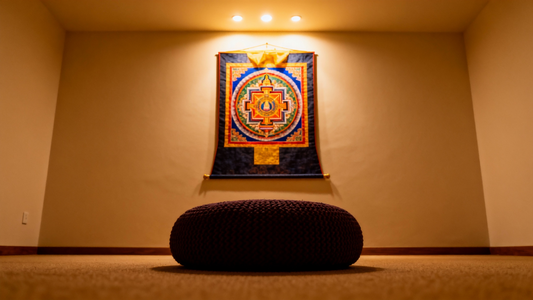
If you plan to use the Thangka for meditation, prayer, or devotional practice, priority should be given to iconographic accuracy and spiritual resonance (not just aesthetics). Key tips:
• Prioritize works that adhere to traditional iconographic standards (e.g., correct mudras, attributes, and proportions of deities) – these are more conducive to focusing your mind during meditation.
• Choose a style with a solemn, sacred atmosphere (e.g., Menri style with its orthodox symmetry) or a gentle, compassionate vibe (e.g., Newar style with luminous deity expressions).
• Consider mini Thangka pendants (2-5cm) for portable practice – they are easy to carry and allow you to connect with the deity’s energy anytime, anywhere.
Thangkamarket:By Meaning – ThangkaMarket
1.2 For Collection & Investment
If you aim to collect Thangkas as works of art or for investment, focus on craftsmanship quality, artist lineage, and style authenticity. Key tips:
• Opt for works from renowned lineages (e.g., Menri monastic lineage, Rebgong master-apprentice lineage) with certificates of authenticity.
• Prioritize styles with strong artistic uniqueness and cultural value (e.g., Newar style with exquisite gold work, Rebgong style with precise linework).
• Start with mid-range pieces (not overly cheap or extremely high-priced) as a beginner – avoid mass-produced imitations, which have no collection value.
• Entry-Level Collection Key Criteria: Use the "from far to near, top to bottom" observation method : From a distance, check if the composition is balanced; up close, inspect mineral pigments (layered shades from the same mineral, lighter when ground finer) and linework. 2. Verify standard mounting: Authentic traditional Thangkas have three-layered borders (red, yellow, blue) with religious significance . 3. Avoid "cheap antique Thangkas" – most are fakes; focus on contemporary works by emerging masters with clear lineage.
• Preservation for Collection: Store unused Thangkas flat in acid-free boxes, keep in a 50-55% humidity environment, and avoid frequent handling (use cotton gloves when necessary).
Thangkamarket:Masterpiece Collection – ThangkaMarket
1.3 For Decoration & Aesthetics
If you want to use the Thangka to decorate your home or office, focus on visual harmony with your space and personal aesthetic preferences. Key tips:
• Match the style to your interior design: Choose Karma Gadri style (soft tones, open landscapes) for minimalist or modern spaces; opt for Rebgong style (bright colors, elegant clarity) for vibrant, warm spaces; select Newar style (ornate gold work) for luxurious, traditional spaces.
• Ensure the Thangka’s color palette complements your furniture and wall colors – avoid clashing with existing decor.
• Consider the size of your space (see Step 3) to avoid a Thangka that is too large or too small for the wall/area.
• Space-Specific Selection: Mandala Thangkas are ideal for entrances (to ward off negative energy), Buddha or Bodhisattva Thangkas suit living rooms/studies (for solemnity), and avoid hanging any Thangka in bathrooms, kitchens, or bedrooms (to respect sacredness) . 5. For humid areas (e.g., southern regions), choose framed Thangkas instead of scrolls to prevent mold and pigment fading .
• Hanging & Maintenance Tips: Hang Thangkas at a height above eye level in a clean, dry, and shaded area – avoid direct sunlight (which causes color cracking) and smoke (which yellows the surface) .
Thangkamarket:Wall Hanging Thangka – ThangkaMarket
Step 2: Define Deity Intention – Choose a Deity That Aligns with Your Wishes
Thangkas primarily depict Buddhist (or Hindu, for Newar style) deities, each with specific symbolic meanings and spiritual energies. As a beginner, focus on commonly used, easy-to-understand deities that align with your wishes (e.g., compassion, wisdom, protection). Here are the most popular choices:
2.1 For Compassion & Blessings: Avalokiteshvara (Guanyin)
Avalokiteshvara is the Bodhisattva of compassion, often depicted with multiple arms (symbolizing the ability to help all beings). This is the most versatile choice for beginners, suitable for those seeking family harmony, emotional peace, or the ability to empathize with others. Most styles (Menri, Karma Gadri, Newar, Rebgong) have classic Avalokiteshvara depictions – look for gentle facial expressions and the lotus attribute.
Thangkamarket:Avalokiteshvara (Chenrezig) – ThangkaMarket
2.2 For Wisdom & Insight: Manjushri
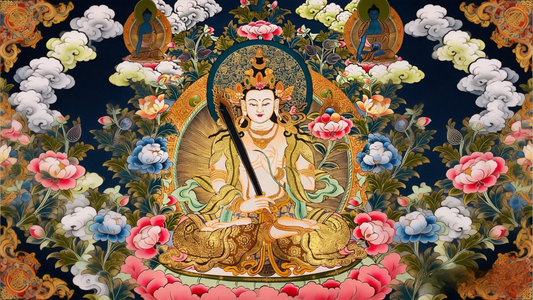
Manjushri is the Bodhisattva of wisdom, typically holding a sword (to cut through ignorance) and a scripture. Ideal for students, professionals, or anyone seeking to enhance their understanding, decision-making, or learning abilities. Choose depictions with clear, focused eyes – Menri or Rebgong styles (with precise linework) are excellent choices for highlighting wisdom.
Thangkamarket:Manjushri – ThangkaMarket
2.3 For Protection & Stability: Vajrapani
Vajrapani is the Bodhisattva of power and protection, holding a vajra (thunderbolt) to ward off negative energies. Suitable for those facing life changes, work pressure, or seeking a sense of security. Look for depictions with a solemn, powerful aura – Newar style (with radiant gold halos) or Menri style (with bold outlines) can emphasize the deity’s protective energy.
Thangkamarket:Protector Deities – ThangkaMarket
2.4 For Universal Blessings: Shakyamuni Buddha
Shakyamuni Buddha (the historical Buddha) represents enlightenment and universal compassion. A safe choice for beginners with no specific deity preference, suitable for any purpose (practice, decoration, collection). Look for depictions with the earth-touching mudra (Bhumisparsha) – this classic gesture symbolizes Buddha’s enlightenment and is widely recognized across all styles.
Thangkamarket:Shakyamuni Buddha – ThangkaMarket
Key Tip for Beginners:
Avoid niche or esoteric deities (with complex iconography) as a first purchase – they are harder to connect with and may have limited practical use. Focus on deities whose meanings you understand and resonate with.
Step 3: Select the Right Size – Match to Your Space & Purpose
Thangka size ranges from mini pendants (2-5cm) to large temple works (over 100cm). The right size depends on your purpose and available space. Here’s a practical size guide for beginners:
3.1 Mini Size (2-5cm): Portable Daily Wear
Format: Pendants or small scrolls. Ideal for:
• Portable meditation or devotional practice (carry in a bag or wear around the neck).
• First-time buyers who want to experience Thangka culture without a large investment.
• Decoration for small spaces (e.g., desks, shelves) or as sacred jewelry.
All four major styles (Menri, Karma Gadri, Newar, Rebgong) have mini pendant versions – choose based on your style preference (e.g., Newar for gold details, Rebgong for bright colors). Special Buying Tips for Daily Wear Pendants: 1. Prioritize pendants with a proper Gau box (a small sacred container) to protect the Thangka, avoiding direct contact with skin, sweat, or water . 2. Check pigment quality: Under light, natural mineral pigments will show a subtle shimmer, while synthetic pigments look flat and dull . 3. Ensure line clarity: Even in mini size, the deity’s facial features and lines should be sharp without smudging. 4. Avoid贴身 wearing during bathing, sleeping, or entering impure places (e.g., bathrooms); cover or reverse the pendant if necessary .
3.2 Small Size (20-50cm): Home Meditation & Small-Space Decoration
Format: Small scrolls or framed works. Ideal for:
• Home meditation corners (place on a small altar or wall near your meditation space).
• Small rooms, desks, or bookshelves (e.g., bedrooms, home offices).
• Beginners who want a visible Thangka for practice without taking up too much space.
3.3 Medium Size (50-100cm): Living Room Decoration & Serious Practice
Format: Standard scrolls or framed works. Ideal for:
• Living rooms, dining rooms, or home altars (the most popular size for home decoration).
• Serious practitioners who want a clear, detailed Thangka for focused meditation.
• Collectors looking for works with sufficient detail to showcase craftsmanship (e.g., Rebgong’s linework, Newar’s gold decoration).
3.4 Large Size (Over 100cm): Collection & Large-Space Decoration
Format: Large scrolls. Suitable for:
• Large spaces (e.g., spacious living rooms, home temples, or offices).
• Serious collectors investing in high-quality works (large sizes often require more craftsmanship and time, increasing their collection value).
Key Tip: Measure your available space before purchasing – leave at least 10-20cm of blank space around the Thangka to avoid a cramped look. For scroll-style Thangkas, ensure you have space to hang them without folding or damaging the edges.
Step 4: Set a Budget – Balance Quality & Affordability
Thangka prices vary widely (from $50 for mini pendants to $10,000+ for masterworks). As a beginner, set a clear budget and focus on value for money – avoid overspending on overly expensive pieces or compromising on quality for ultra-cheap options. Here’s a budget breakdown for beginners:
4.1 Budget Range: $50-$300 (Entry-Level)
Suitable for: Mini pendants, small decorative Thangkas, or beginner practice pieces. Key points:
• Look for works made with natural mineral pigments (avoid synthetic pigments that fade easily).
• Mini pendants in this range should have basic craftsmanship (clear lines, even color application) – prioritize styles you like (e.g., Rebgong for bright colors, Newar for gold accents).
• Avoid "collectible" claims in this range – focus on practical use (wear, small decoration) rather than investment.
4.2 Budget Range: $300-$1,500 (Mid-Range)
Suitable for: Medium-sized practice Thangkas, decorative works with good craftsmanship, or entry-level collectibles. Key points:
• Choose works from established master-apprentice lineages (e.g., Rebgong folk workshops, Newar family workshops) with basic certificates of authenticity.
• Expect high-quality mineral pigments, precise linework, and moderate gold application (e.g., Menri style halos, Rebgong jewelry details).
• This range offers the best balance of quality and affordability for most beginners – suitable for both practice and decoration.
• Entry-Level Collection Budget Focus: Within this range, prioritize craftsmanship over size. A small (20-50cm) well-crafted Rebgong or Newar Thangka with genuine mineral pigments and clear linework is more valuable for collection than a large, low-quality piece. 2. Look for works with artist signatures/seals – these have better potential for value retention.
4.3 Budget Range: $1,500-$5,000+ (High-End/Collectible)
Suitable for: Serious collectors or practitioners seeking masterworks. Key points:
• Prioritize works with official certificates of authenticity, artist signatures/seals, and clear lineage documentation (e.g., Menri monastic artist, renowned Rebgong master).
• Expect exquisite craftsmanship (e.g., Newar’s layered gold work, Rebgong’s 0.1mm silk-thread lines) and long-term collection value.
• Only choose this range if you have a clear understanding of Thangka styles and craftsmanship – consult experts before purchasing.
Key Budget Tip:
Never sacrifice material quality (natural pigments, genuine gold leaf) for a lower price. Synthetic pigments and fake gold not only fade quickly but also lose the spiritual and artistic value of Thangkas. For beginners, it’s better to buy a small, high-quality Thangka than a large, low-quality one.
Step 5: Match Style Preferences – Choose a Style That Resonates with You
As introduced in our previous guides, the four major Thangka styles (Menri, Karma Gadri, Newar, Rebgong) have distinct aesthetics. Your style preference should align with your purpose and personal taste. Here’s a simplified style matching guide for beginners:
|
Style |
Core Aesthetics |
Best For |
|
Menri (Miansa) |
Symmetrical, solemn, bold "iron lines," restrained gold |
Spiritual practice (meditation, orthodoxy), those who prefer sacred, minimalist aesthetics |
|
Karma Gadri |
Soft tones, open landscapes, fluid lines, atmospheric |
Decoration (modern/minimalist spaces), those who love naturalistic, elegant aesthetics |
|
Newar |
Ornate gold work, detailed jewelry, luminous deity expressions |
Collection, luxurious decoration, those who prefer radiant, intricate aesthetics |
|
Rebgong |
Bright colors, ultra-fine "silk-thread lines," elegant clarity |
Decoration (vibrant spaces), practice, those who like precise, vivid aesthetics |
Key Style Tip for Beginners:
If you’re unsure about your preference, start by browsing images of the four styles online or in galleries. Pay attention to which style’s colors, lines, and compositions make you feel most calm, happy, or connected – this is your intuitive preference, and it’s the best starting point.
Final Tips for Beginners: Avoid Common Pitfalls
• Verify Authenticity: Always ask for a certificate of authenticity (especially for mid-to-high-range pieces). Avoid works with vague descriptions like "hand-painted" without lineage details.
• Check Craftsmanship Details: For online purchases, ask for close-up photos of linework, color application, and gold details. Look for even lines, no smudges, and natural pigment luster.
• Choose Reputable Channels: Buy from official workshops, authorized dealers, or trusted online platforms with good reviews. Avoid street vendors or unknown sellers offering "cheap masterworks" (they are almost always fakes).
• Don’t Rush: Take time to research and compare before purchasing. A Thangka is a long-term investment (spiritual or material) – it’s better to wait for the right piece than to buy impulsively.
Conclusion: Choose a Thangka That Speaks to You
Choosing a Thangka as a beginner doesn’t have to be complicated. By following these 5 steps – clarifying purpose, defining deity intention, selecting size, setting a budget, and matching style preferences – you can narrow down your options and find a piece that aligns with your needs and resonates with your heart. Remember, the best Thangka is not necessarily the most expensive or the most ornate, but the one that makes you feel connected, peaceful, and inspired.
If you have more questions about specific styles, deities, or budget ranges, feel free to leave a comment below or contact our team of Thangka experts for personalized advice.
Previous
Rebgong Style Thangka: Precise Lines, Bright Hues & Elegant Clarity from Amdo
Next
Hand-painted vs Printed Thangkas: Key Differences & Selection Guide
Related articles
Long-term Preservation
Dec 14 2025