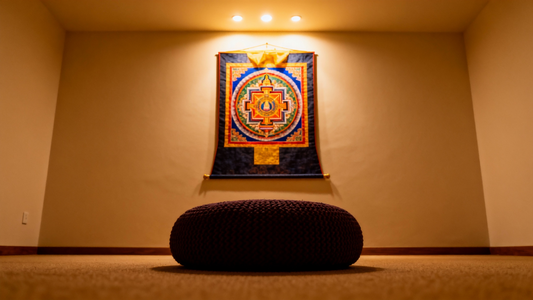

Kalachakra Mandala Explained: Meaning, Structure, and Symbolism in Tibetan Thangka Art
The Kalachakra Mandala, also known as the Wheel of Time Mandala, is one of the most complex and profound mandalas in Vajrayana Buddhism.
It presents a complete vision of the universe, time, and the path to enlightenment, uniting cosmology, meditation, ritual practice, and sacred art into a single, harmonious system.
In Tibetan Buddhist tradition, the Kalachakra Mandala is not merely symbolic.
It is understood as a living map of awakening, where the structure of the cosmos and the structure of the human mind mirror one another.
What Is the Kalachakra Mandala?
The word Kalachakra comes from Sanskrit:
-
Kala — Time
-
Chakra — Wheel
Together, Kalachakra means “The Wheel of Time”, referring to both the cyclical nature of existence and the possibility of transcending it.
A mandala is a sacred geometric diagram representing an enlightened realm or palace.
The Kalachakra Mandala therefore expresses the inseparable relationship between time, space, consciousness, and enlightenment.
Historical Origins of the Kalachakra Tradition
According to Buddhist tradition, the Kalachakra teachings were first given by Shakyamuni Buddha at the request of the king of Shambhala, a legendary enlightened kingdom.
These teachings were later transmitted from India to Tibet around the 11th century, where they developed into a complete tantric system.
Since then, the Kalachakra Mandala has become one of the most important visual and ritual expressions in Tibetan Buddhism, preserved through empowerment ceremonies, meditation lineages, and sacred art such as Thangka painting.
Overall Structure of the Kalachakra Mandala
The Kalachakra Mandala is traditionally described as:
-
Five inner palace levels
-
Six concentric outer circles
This structure creates the classic “outer circle, inner square” form, symbolizing both the universe and the awakened mind.
The Five Inner Palaces: Stages of Enlightenment
1. The Great Bliss Mandala (Innermost Level)
The innermost palace represents the ultimate state of awakening — the union of wisdom and compassion.
At its center appears Kalachakra Buddha in union with his consort, seated on an eight-petaled lotus.
This level symbolizes complete realization, where emptiness and bliss are experienced as one.
2. The Wisdom Mandala
This level represents subtle awareness and insight.
It is structured through symbolic pillars and sacred spaces, expressing the many facets of enlightened wisdom and the refinement of perception.
3. The Mind Mandala
The Mind Mandala illustrates the transformation of ordinary mental activity.
Thoughts, emotions, and perceptions are depicted as purified and integrated into the path of awakening.
4. The Speech Mandala
This palace represents enlightened speech and sacred sound.
Mantras, seed syllables, and symbolic forms emphasize the role of vibration and language in spiritual transformation.
5. The Body Mandala (Outer Palace)
The outer palace represents enlightened form manifesting in the material world.
It includes four elaborately decorated gates aligned with the cardinal directions, symbolizing access points into the sacred realm.
The Six Outer Circles: Elements and Protection
Surrounding the palace are six concentric rings, each representing fundamental aspects of existence:
-
Earth — Stability and foundation
-
Water — Purification and flow
-
Fire — Transformation and vitality
-
Wind — Movement and energy
-
Space — Openness and infinity
-
Wisdom — Transcendent awareness
Together, they form a protective boundary and express the unity of cosmic and inner elements.
Kalachakra Buddha: The Central Deity
At the heart of the mandala resides Kalachakra Buddha, depicted with:
-
A blue body, symbolizing ultimate reality
-
Four faces, representing different enlightened activities
-
Twenty-four arms, holding ritual implements that symbolize mastery over cyclic existence
Kalachakra appears in union with his consort, expressing the inseparability of wisdom and skillful means.
This imagery teaches transformation, not symbolism of conflict.
The 722 Deities of the Kalachakra Mandala
The Kalachakra Mandala is home to 722 deities, all understood as manifestations of awakened qualities.
They correspond to different levels of purification:
-
Body — physical form
-
Speech — sound and energy
-
Mind — thought and perception
-
Wisdom — insight
-
Great Bliss — complete awakening
On deeper levels, these deities correspond simultaneously to:
-
Cosmic structures
-
Human energy channels
-
Stages of spiritual realization
The Three Wheels of Time
A defining feature of the Kalachakra system is the teaching of the Three Wheels of Time:
Outer Wheel of Time
Represents the structure of the universe, celestial movements, seasons, and cycles of existence.
Inner Wheel of Time
Corresponds to the human body — breath, subtle energy channels, and consciousness.
Alternative Wheel of Time
Refers to spiritual practice, where inner and outer realities are unified through meditation and realization.
Key Numbers in the Kalachakra Mandala
The Kalachakra Mandala is highly structured and numerically precise:
-
5 Inner Palaces — stages of awakening
-
6 Outer Circles — elements of existence
-
722 Deities — enlightened manifestations
-
11 Empowerments — stages of initiation
-
6 Yogas — core Kalachakra practice
These numbers are not symbolic decoration; they express a complete spiritual system.
Symbolism vs. Practice
The Kalachakra Mandala functions on two interconnected levels:
-
Symbolic level — cosmology, sacred geometry, and philosophical meaning
-
Practical level — empowerment rituals, visualization, and meditation
Traditionally, deeper practices are studied under qualified teachers, while the mandala itself serves as a visual and contemplative reference.
👉 Learning Center: Learning Center – ThangkaMarket
Forms of the Kalachakra Mandala in Art
The Kalachakra Mandala appears in several artistic forms:
-
Sand Mandalas — emphasizing impermanence
-
Three-dimensional Mandalas — architectural devotion
-
Thangka Mandalas — portable sacred paintings used for study and meditation
Among these, Thangka paintings are the most accessible and enduring form.
👉 Related Kalachakra Mandala Thangka Collection: Mandala – ThangkaMarket
Who Is the Kalachakra Mandala For?
The Kalachakra Mandala speaks to many audiences:
-
Practitioners of Vajrayana Buddhism
-
Collectors of Himalayan sacred art
-
Students of Buddhist philosophy
-
Meditation and mindfulness seekers
Its message transcends cultural boundaries, offering insight into balance, time, and awareness.
Key Terms Explained (Glossary)
-
Kalachakra — The Wheel of Time, symbolizing cosmic and inner cycles
-
Mandala — A sacred diagram representing an enlightened realm
-
Great Bliss — The union of emptiness and awareness
-
Wisdom and Skillful Means — The inseparable principles of enlightenment
-
Three Wheels of Time — Outer, inner, and transformative dimensions of reality
Explore Related Deities and Mandalas
To deepen your understanding of Buddhist deities, mandalas, and their symbolism:
👉 Main Deity & Mandala Guide: Deity Encyclopedia – ThangkaMarket\Mandala Guide – ThangkaMarket
Frequently Asked Questions About the Kalachakra Mandala
What is the Kalachakra Mandala?
The Kalachakra Mandala, also known as the Wheel of Time Mandala, is a sacred diagram in Vajrayana Buddhism that represents the structure of the universe, time, and the path to enlightenment.
Is the Kalachakra Mandala only for advanced practitioners?
Traditionally, deeper Kalachakra practices require empowerment from qualified teachers.
However, the mandala itself can be studied, appreciated, and contemplated as sacred art and symbolic teaching by anyone.
What makes the Kalachakra Mandala different from other Buddhist mandalas?
The Kalachakra Mandala uniquely integrates cosmology, time cycles, human physiology, and spiritual practice into a single system, making it one of the most complex mandalas in Tibetan Buddhism.
Can the Kalachakra Mandala be used for meditation?
Yes. Many people use Kalachakra Mandala Thangka paintings as visual meditation references, focusing on its structure, symmetry, and symbolism to cultivate mindfulness and inner balance.
Is it appropriate to display a Kalachakra Mandala Thangka at home?
Yes. Kalachakra Mandala Thangkas are traditionally displayed in meditation rooms, study spaces, or sacred areas of the home as symbols of harmony, protection, and spiritual insight.
Does owning a Kalachakra Mandala Thangka require initiation?
No. Owning or displaying a Thangka does not require initiation.
Formal empowerment is only necessary for specific ritual or yogic practices.
What should I look for in an authentic Kalachakra Mandala Thangka?
Authentic Thangkas are traditionally hand-painted, follow precise geometric proportions, use mineral pigments, and adhere to established iconographic guidelines passed down through Himalayan artistic lineages.
Why is the Kalachakra Mandala important in Tibetan Thangka art?
Because it preserves one of the most complete visual teachings of Vajrayana Buddhism, combining philosophy, meditation, sacred geometry, and artistic mastery into a single artwork.
Conclusion
The Kalachakra Mandala is one of the most complete visual expressions of Buddhist wisdom ever created.
It unites time, space, body, mind, and enlightenment into a single sacred design.
Whether approached as a spiritual teaching, a meditation aid, or a masterpiece of Himalayan art, the Kalachakra Mandala remains a timeless guide toward harmony, clarity, and awakening.
Previous
The Five Dhyani Buddhas: Wisdom, Symbolism, and Their Role in Himalayan Buddhist Art
Next
Mandala in Meditation Practice – A Complete Guide
Related articles
Long-term Preservation
Dec 14 2025