
Karma Gadri Style Thangka: The Elegant Fusion of Tibetan Spirituality & Chinese Painting Aesthetics
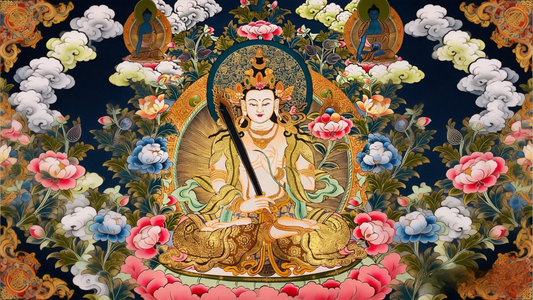
Within the diverse landscape of Tibetan Thangka art, the Karma Gadri style stands out as a luminous example of cultural fusion. Distinguished by its open landscapes, soft color palettes, and spacious compositions, this style bears profound influences from Chinese painting, emphasizing elegance, natural scenery, and subtle atmospheric tones. Unlike the rigidly orthodox monastic traditions of Menri style, Karma Gadri leans into artistic expression and narrative fluidity, making it beloved by collectors who appreciate the harmony between sacred spirituality and secular aesthetic beauty. This article delves into the origin, core characteristics, craftsmanship, and collection value of the Karma Gadri style, unlocking the secrets of this elegant and expressive Thangka tradition.
I. What Is Karma Gadri Style? The Origin of a Fusion Tradition
The Karma Gadri style emerged in the 15th century, rooted in the Karma Kagyu sect of Tibetan Buddhism—one of the most influential sects in Tibetan history. Its name derives from "Karma" (referring to the Karma Kagyu sect) and "Gadri" (meaning "painting studio" in Tibetan), signifying its origin in the sect’s official painting workshops. The defining feature of this style is its integration of Tibetan Buddhist iconography with Chinese painting techniques, a fusion that began with the exchange between Tibetan monks and Han Chinese artists during the Ming Dynasty.
Unlike the Menri style, which was refined within monastic walls to prioritize orthodoxy, Karma Gadri developed in a more open environment, absorbing artistic elements from Han Chinese landscape painting, flower-and-bird painting, and figure painting. This cultural fusion gave birth to a style that retains the spiritual core of Tibetan Buddhism while embracing the elegant, naturalistic aesthetics of Chinese art. Over time, Karma Gadri spread across Tibet, Bhutan, and parts of Nepal, becoming one of the most popular folk and devotional Thangka styles.
Thangkamarket:Karma Gadri Style – ThangkaMarket
II. Core Characteristics of Karma Gadri Style: The Five Hallmarks of Elegance
The Karma Gadri style’s unique charm lies in five core characteristics, which reflect its fusion of Tibetan and Chinese artistic traditions and create its distinctive elegant and naturalistic temperament:
1. Open Landscapes: Naturalistic Scenery with Spatial Depth
Unlike the stylized, symbolic landscapes of the Menri style, Karma Gadri is celebrated for its open, naturalistic landscapes—directly influenced by Chinese landscape painting (such as the Shan Shui tradition). These landscapes are not merely background decorations but an integral part of the narrative, creating a sense of spaciousness and immersion.
• Naturalistic Details: Landscapes feature realistic elements like rolling hills, winding rivers, dense forests, and misty valleys. Artists pay attention to the texture of rocks, the layering of trees, and the flow of water, bringing a sense of "life" to the natural scenery.
• Spatial Depth: Using Chinese painting’s "layered distance" technique (foreground, midground, background), artists create a strong sense of spatial depth. For example, distant mountains are rendered in lighter tones with blurred outlines, while nearby trees and rocks are more detailed and vivid—making the canvas feel expansive and three-dimensional.
• Harmony Between Humans and Nature: Deities and human figures are integrated into the landscape, rather than dominating it. This reflects the Chinese philosophical concept of "harmony between humans and nature" and the Tibetan Buddhist belief in the interconnectedness of all beings.
2. Soft Palette: Muted Tones with Subtle Gradients
The color palette of Karma Gadri is a stark contrast to the bold, solid colors of the Menri style. It favors soft, muted tones, with subtle gradients that create a gentle, elegant atmosphere—another influence from Chinese painting’s emphasis on tonal harmony.
• Pigment Selection & Processing: While still using natural mineral pigments (lapis lazuli, malachite, cinnabar), Karma Gadri artists grind the pigments into finer particles and mix them with more animal glue to create lighter, more transparent colors. They also incorporate plant-based pigments (such as indigo and safflower) for softer hues like pale blue, light green, and blush pink.
• Gradient Blending: Unlike the Menri style’s solid color blocks, Karma Gadri uses blending techniques to create subtle gradients. For example, the sky transitions from pale blue at the horizon to deeper blue at the top; mountains blend from grayish-green at the base to snow-white at the peaks. This blending creates a soft, atmospheric effect.
• Restrained Use of Gold: Gold is used even more sparingly than in the Menri style, often only for small details like deity jewelry or tiny auspicious symbols. When used, it is mixed with transparent glues to create a soft, warm glow that harmonizes with the muted palette.
3. Spacious Composition: Asymmetry & Narrative Flow
Karma Gadri abandons the symmetrical, centrally focused composition of the Menri style in favor of spacious, asymmetrical layouts that prioritize narrative flow and visual movement. This gives the style a sense of dynamism and openness.
• Asymmetrical Balance: The main deity is often placed off-center, with landscapes, rivers, or celestial beings filling the remaining space to create a balanced yet dynamic composition. For example, a Buddha might be seated on the left side of the canvas, with a winding river and distant mountains stretching to the right—guiding the viewer’s eye through the scene.
• Narrative Space: The spacious layout allows artists to tell stories within the Thangka. For example, scenes from the Buddha’s life (birth, enlightenment, parinirvana) can be arranged in a continuous flow across the canvas, with landscapes connecting each scene seamlessly.
• Negative Space Utilization: Like Chinese painting, Karma Gadri values negative space (blank areas) to create a sense of openness and tranquility. Blank spaces are often used to represent sky, mist, or water, enhancing the atmospheric quality of the work.
4. Elegant Aesthetics: Fluid Lines & Graceful Figures
Influenced by Chinese figure painting, the Karma Gadri style emphasizes elegance in both linework and figure depiction. Lines are fluid and delicate, and figures have graceful postures that convey a sense of serenity and refinement.
• Fluid Line Technique: Unlike the Menri style’s thick, unbroken "iron lines," Karma Gadri uses thin, flexible wolf-hair or goat-hair brushes to create fluid, curved lines. Lines vary in thickness more subtly—thinner for delicate fabrics, slightly thicker for figure outlines—adding a sense of softness and movement.
• Graceful Figure Postures: Deities and human figures are depicted with more natural, relaxed postures. For example, Bodhisattvas might lean slightly to one side, with flowing robes that drape naturally over their bodies—unlike the rigid, symmetrical postures of the Menri style. Facial expressions are gentle and serene, with soft eyes and slight smiles that convey compassion and approachability.
• Delicate Fabric Details: Robes and garments are adorned with subtle patterns (such as floral motifs or cloud patterns) rendered in fine lines, reflecting the elegance of Chinese silk painting.
5. Subtle Atmospheric Tones: Capturing Light & Mist
One of the most distinctive features of Karma Gadri is its ability to capture subtle atmospheric tones, such as light, mist, and dusk—another influence from Chinese landscape painting. This technique adds a sense of realism and emotional resonance to the work.
• Mist & Cloud Rendering: Artists use dilute pigments and soft brushes to create wispy mist or clouds that wrap around mountains or rivers. This blurs the boundaries between elements, creating a dreamy, ethereal atmosphere.
• Light Effects: Subtle light changes are depicted through tonal variations. For example, dawn or dusk scenes use warm, pale orange or pink tones to simulate the glow of the sun; moonlit scenes use cool, pale blue tones to create a serene, quiet mood.
• Emotional Resonance: These atmospheric tones are not just decorative—they evoke emotions in the viewer. A misty mountain scene might convey tranquility and detachment, while a sunset scene might evoke a sense of reverence for the divine.
III. Craftsmanship of Karma Gadri Style: Fusion of Traditional Techniques
The craftsmanship of Karma Gadri style reflects its fusion of Tibetan and Chinese techniques, with a focus on subtlety and expressiveness. While retaining core Tibetan Thangka craftsmanship, it incorporates unique processes to achieve its distinctive aesthetic:
1. Canvas Preparation: Lightweight & Flexible Foundation
Karma Gadri artists prefer lightweight, high-quality cotton canvas (softer than the linen used in Menri style) to accommodate the fluid linework and delicate blending techniques. The canvas preparation process is slightly simpler than Menri’s, taking 5-7 days: stretching (with moderate tension to maintain flexibility), sizing (with a thinner mixture of animal glue and gypsum), and light burnishing (with agate to create a smooth but not overly hard surface). This foundation allows for easier pigment blending and line control.
2. Pigment Preparation: Fine Grinding & Dilution
To achieve soft tones and gradients, Karma Gadri artists grind mineral pigments into ultra-fine powder (finer than Menri style) using stone mills. Pigments are then diluted with animal glue and water to create transparent or semi-transparent pastes. Plant-based pigments are often added to adjust tones—for example, mixing lapis lazuli powder with indigo plant pigment to create a pale blue. This careful pigment preparation is key to the style’s soft, atmospheric colors.
Thangkamarket:Mineral Pigment Thangka – ThangkaMarket
3. Line & Color Application: Fusion of Tibetan Precision & Chinese Blending
Linework begins with light, sketchy outlines (unlike Menri’s bold initial lines) to map out the composition and figures. Artists then refine the lines with fluid, delicate strokes. For color application, they use "wet-on-wet" blending techniques (influenced by Chinese painting) to create gradients: applying a light layer of pigment, then blending it with a damp brush while the pigment is still wet. This technique requires precise control of water and pigment ratio to avoid bleeding or uneven tones.
4. Gold Application: Subtle Accents
Gold is used sparingly as an accent rather than a focal point. Artists use 24K gold powder mixed with a large amount of animal glue to create a thin, transparent gold paste. This paste is applied to small details (e.g., deity earrings, flower stamens) with a fine brush, creating a soft, understated glow that complements the muted palette. Hot gilding (used in Menri style) is rarely used, as it creates a too-bright contrast with the style’s elegant aesthetic.
Thangkamarket:Gold Thangka – ThangkaMarket
IV. Karma Gadri Style vs. Other Tibetan Thangka Styles: Core Differences
The Karma Gadri style’s fusion of Tibetan and Chinese aesthetics sets it apart from other major styles (Menri, Rebgong). The table below highlights key distinctions, building on the comparison framework from the Menri style guide:
|
Feature |
Karma Gadri Style |
Menri (Miansa) Style |
Rebgong Style |
|
Origin |
15th-century Karma Kagyu sect (Tibetan-Chinese fusion) |
14th-century Menri Monastery (Sakya sect, monastic orthodoxy) |
15th-century Rebgong region (Tibetan-Han fusion, folk-art influence) |
|
Composition |
Asymmetrical, spacious, narrative flow, negative space emphasis |
Symmetrical, balanced, central deity focus, rigid hierarchy |
Full, dense, detailed backgrounds, multi-scene narrative |
|
Color Palette |
Soft, muted tones, subtle gradients, plant-mineral pigment blend |
Bold, solid colors, high contrast, pure mineral pigments |
Rich, vibrant colors, detailed color layering, mineral-dominant |
|
Linework |
Fluid, delicate, curved lines, subtle thickness variation |
Bold, thick, unbroken "iron lines," consistent thickness |
Ultra-fine, precise lines, dense detail work |
|
Core Aesthetic |
Elegant, naturalistic, atmospheric, human-nature harmony |
Solemn, sacred, orthodox, spiritual rigor |
Exquisite, decorative, vivid, artistic flamboyance |
|
Purpose |
Folk devotion, narrative storytelling, aesthetic appreciation |
Monastic ritual, meditation, religious orthodoxy |
Cultural expression, decoration, religious devotion balance |
V. Collecting Karma Gadri Style Thangkas: What to Look For
Karma Gadri style Thangkas are highly sought after by collectors who appreciate the fusion of Tibetan spirituality and Chinese aesthetics. Here are key factors to consider when purchasing:
1. Authenticity: Prioritize Lineage & Technique Purity
Genuine Karma Gadri Thangkas are created by artists trained in the Karma Kagyu sect’s painting lineage or through strict master-apprentice systems that preserve the style’s fusion techniques. Look for certificates of authenticity confirming the artist’s lineage. Avoid works with overly bold colors, rigid lines, or no subtle gradients—these are likely modern reproductions that lack the style’s core elegance.
2. Craftsmanship: Check for Fluidity & Subtlety
• Linework: Fluid, delicate lines with no jagged edges or harsh retouching. Lines should convey movement and softness (e.g., flowing robes, wispy clouds).
• Colors: Soft, muted tones with natural gradients. Avoid works with bright, solid colors or uneven blending (signs of synthetic pigments or poor technique).
• Landscapes: Naturalistic details with spatial depth (distant elements lighter and blurrier, nearby elements clearer). Check that landscapes integrate harmoniously with figures.
• Gold Application: Thin, subtle gold accents with a soft glow—no thick, bright gold layers (sign of non-traditional techniques).
3. Subject Matter: Narrative Scenes & Landscape-Centric Works
The most valuable Karma Gadri Thangkas feature narrative scenes (e.g., Buddha’s life story, Bodhisattva’s journeys) or landscape-centric compositions (e.g., deities in mountain valleys, celestial beings amid clouds). These works best showcase the style’s strengths in storytelling and atmospheric landscape depiction. Avoid overly simple, icon-only works, as they do not highlight the style’s unique value.
4. Mini Karma Gadri Style Pendants: Elegant Daily-Wear Pieces
For first-time collectors or those seeking daily-wear sacred art, mini Karma Gadri style pendants (2-5cm) are an excellent choice. These pendants replicate the style’s core features—fluid lines, soft tones, and small-scale landscape elements (e.g., a tiny mountain or river beside the deity) using the same mineral-plant pigment blend and delicate linework as full-sized Thangkas. They are perfect for those who appreciate elegant, understated sacred jewelry, offering the fusion beauty of Karma Gadri in a portable form.
VI. How to Care for Karma Gadri Style Thangkas
Karma Gadri style Thangkas require careful care, especially due to their soft pigments and delicate blending. Here are key maintenance tips:
• Avoid Direct Sunlight & High Temperature: The soft, diluted pigments are more prone to fading than Menri’s solid mineral colors. Hang Thangkas in a cool, shaded area away from windows, heaters, or air conditioners (high temperature can dry out the canvas and crack the pigment layers).
• Control Humidity Strictly: Maintain a dry, ventilated environment with relative humidity of 50-55%. High humidity can cause pigment bleeding or mold growth; low humidity can make the canvas brittle. Avoid hanging in bathrooms, kitchens, or damp basements.
• Handle with Extreme Care: The delicate pigment layers are easily damaged by friction. Never touch the surface with bare hands (oil and sweat can dissolve the thin pigment layers). Use cotton gloves when handling, and avoid folding or rolling the Thangka (frame it or store it flat in a acid-free protective case).
• Clean Gently & Infrequently: Dust with a ultra-soft brush (e.g., a fine makeup brush) once every 6-12 months. Do not use water, chemical cleaners, or rough cloths—even gentle wiping can remove the delicate pigment layers.
Conclusion: The Timeless Elegance of Karma Gadri Style
The Karma Gadri style is a brilliant fusion of Tibetan spiritual depth and Chinese artistic elegance. Its open landscapes, soft palettes, spacious compositions, and subtle atmospheric tones break away from the rigid orthodoxy of monastic Thangka traditions, offering a more expressive and accessible form of sacred art. This fusion not only reflects the cultural exchange between Tibet and Han China but also demonstrates the adaptability and creativity of Tibetan Thangka art.
For collectors, a genuine Karma Gadri Thangka is a treasure that combines spiritual significance with aesthetic beauty—ideal for both devotional use and artistic appreciation. For art lovers, it is a window into the rich cultural dialogue that has shaped Himalayan art for centuries. Whether in full-sized works or mini pendants, the elegant charm of Karma Gadri style continues to captivate audiences worldwide.
If you have more questions about Karma Gadri style Thangkas—whether identifying authenticity, choosing a piece, or caring for your collection—please feel free to leave a comment below or contact our team of Thangka experts.
Previous
Menri (Miansa) Style Thangka: The Classical Tibetan Monastic Tradition of Balanced Beauty & Deep Symbolism
Next
Newar Style Thangka: Exquisite Gold Work & Luminous Deities by Nepali Masters
Related articles
Long-term Preservation
Dec 14 2025